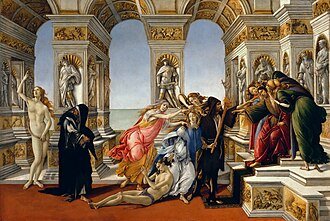
Venus and Mars
Sandro Botticelli, 1485

Venus and Mars is an oil and egg tempera painting on poplar panel that Sandro Botticelli made around 1485, when the early Florentine Renaissance was exploring mythological subjects that could sit comfortably within domestic life. Its long, narrow horizontal format suggests it may have been part of a headboard for a bedroom, probably linked to a wedding, though the original recipient is not documented with certainty. The scene shows Venus, fully dressed and with her hair arranged, resting on a meadow opposite Mars, who sleeps nude apart from a white cloth over his genitals. The god of war has set aside his armour and red cloak beside him, while three small satyrs play with his weapons and helmet, and one blows a shell close to his ear without waking him. A grove of myrtle, a tree associated with Venus, closes the background.
The composition is clever mainly in how it handles the awkward format. The two figures are arranged in near symmetry, and between them an inverted triangle forms, closed by the spear the satyrs hold. Venus's diagonal body suggests repose, while Mars's rising diagonal reads as more active, and the contrast between her watchfulness and his sleep gives the scene its tension. The satyrs belong to the retinue of Bacchus and carry their traditional traits of goat legs, horns and tails, appearing here among the earliest Renaissance depictions to show them in such a mischievous mood.
Its meaning remains debated. It has been read as an allegory of love's power, or of humanity, overcoming the violence of war, a reading with Neoplatonic overtones that suits the Florentine intellectual climate. The wasps near Mars's head relate to the Vespucci family arms, and the surname recalls the Italian word for wasp, which reinforces a possible link with a marriage commission. Some writers have seen an echo of Simonetta Vespucci in Venus, though this identification is uncertain and does not hold entirely when compared with Poliziano's poem. Botticelli also drew on an ancient sarcophagus and a literary description of a classical painting, showing how he combined antique sources with his own invention.
- Painter
- Sandro Botticelli
- Date
- 1485
- Medium
- oil paint, egg tempera, poplar panel
- Dimensions
- 69 × 173 cm
- Museum
- National Gallery, London
- Movement
- Early Renaissance
- Genre
- mythological painting
- Depicts
- Mars, walking stick, satyr, helmet, lance, Venus, pillow
More works by Sandro Botticelli