Zonnebeke
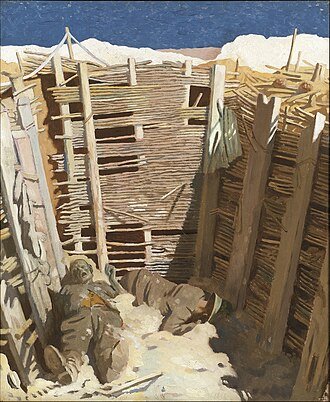
William Orpen, 1918
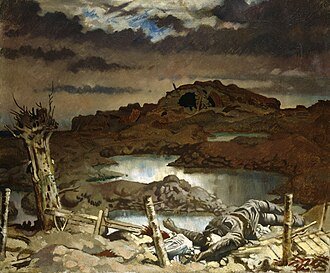
Zonnebeke is one of the paintings William Orpen made in 1918, when he worked as British official war artist during the First World War. Its title comes from the Belgian municipality of Zonnebeke, in Flanders, which was completely destroyed during the Passchendaele campaign of June to November 1917. That offensive cost enormous losses to both British and German troops, and by its end the Allies had advanced only about five miles. The picture shows a desolate battlefield under grey skies: flooded trench remains, a corpse lying on the right and a badly damaged tree on the left. Orpen keeps the raw realism of his earlier works from the French front, although in 1918 he also produced more allegorical pictures. In his war memoirs he recalls an officer who said the Somme could be painted from memory, with a flat horizon and mud-holes, but that the smell could not be painted. The work tries to convey exactly that atmosphere of death and devastation.
- Painter
- William Orpen
- Date
- 1918
- Medium
- oil paint, canvas
- Dimensions
- 76 × 64 cm
- Museum
- Tate, London
More works by William Orpen