Allegretto Nuzi (1315-1373) was an Italian painter who worked in a Gothic style, mainly around Fabriano, in the Province of Ancona. He matters because his work links the local tradition with the painting of Giotto and the Sienese masters.
He was probably trained in Fabriano by local masters, among them the so-called Master of Campodonico. Documents place him in Florence in 1346, where he would have seen works by Giotto and his followers. His painting has been described as both Giottesque and Sienese.
Nuzi worked mainly on commissions from churches, producing religious subjects such as The Crucifixion (1350), Madonna of Humility (1365) and Saint Augustine between Saint Nicholas of Tolentino and Saint Stephen (1350). His masterwork in Fabriano is the fresco cycle in the Chapel of Sant'Orsola in the church of Santa Lucia. He also painted some wooden statues, now in the Pinacoteca Civica Bruno Molajoli in Fabriano.
Works (8)
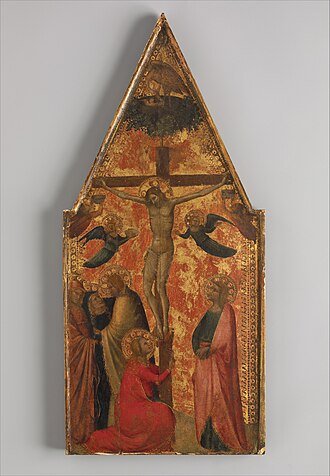
Egg tempera on panel depicting the Crucifixion of Jesus of Nazareth, one of the central subjects of Christian religious art. The work is attributed to Allegretto Nuzi and dated to around 1350. Its narrow, elongated format compels the composition toward the figure of the crucified Christ, who occupies the center of the scene and dominates the picture space.

A work by Allegretto Nuzi, an Italian painter of the fourteenth century linked to the Fabriano school, dated 1360 according to its record. It is a religious painting in tempera on cardboard, in a wide, elongated format showing several male figures of apostles. Their arrangement in a row suggests a decorative frieze. The available information does not clarify its original commission or setting.

This panel by Allegretto Nuzi shows the Virgin Mary seated on a throne with the Christ Child in her lap, an image of devotion typical of Italian religious painting of the fourteenth century. It is executed in tempera on panel, the common technique of the period, and belongs to the collection of the National Gallery of the Marche. Beyond these facts, the record offers no further details about its commission or other features of the work.
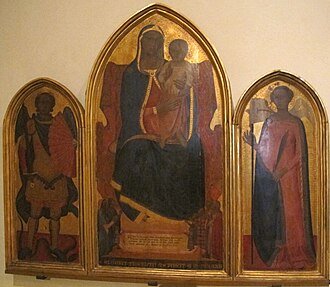
Panel painting in tempera showing the Virgin Mary enthroned with the Christ Child, flanked by the archangel Michael and Saint Ursula of Cologne. A donor figure also appears among the group, which usually points to a private devotional commission. Dated 1365, the work is held in the Vatican Picture Gallery.

A work by Allegretto Nuzi, an Italian painter associated with the Fabriano school, showing the Virgin Mary holding the Christ Child. It is painted in tempera on panel, a technique common in religious painting of its time. Its tall, narrow vertical format suggests a devotional purpose, although the record offers no further details about its commission or origin.

This panel by Allegretto Nuzi, dated 1365, shows the Virgin Mary with the infant Jesus in a work of religious art. It is executed in tempera and gold on wood, a technique common in altarpiece painting of its time. The figures appear frontal and solemn, and the golden background reinforces their sacred character. No details about its commission are available in the record.

The panel brings together the Virgin and Child with four saints: Mary Magdalene, John the Evangelist, Bartholomew and Venantius of Camerino. It is painted in egg tempera on wood and dated to around 1400. Its large horizontal format suggests it was probably conceived for a religious setting of some importance.

Where to see the work
- Pinacoteca civica Bruno Molajoli Fabriano · 3
- Metropolitan Museum of Art New York City · 1
- Musée des Beaux-Arts de Strasbourg Strasbourg · 1
- Galleria Nazionale delle Marche Urbino · 1
- Pinacoteca Vaticana Vatican City · 1
- Pinacoteca civica Tacchi-Venturi San Severino Marche · 1
Curiosities
A conventional name
The Master of Campodonico is a label historians use for an anonymous artist whose real name has not survived. He is named after a work attributed to him that is associated with Campodonico. That Nuzi may have trained with him shows how many fourteenth-century painters in the provinces learned in local workshops, often leaving little documentary trace of their names.
A documentary anchor
Little is known about Nuzi's early life, but the documents confirming his presence in Florence in 1346 are among the few dated records that help place him in time. This entry anchors his career at a specific moment and lets specialists reason about the influences he may have absorbed in Giotto's city.