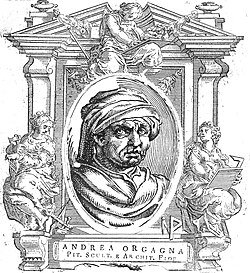
Orcagna
1320–1368 · Italo-Gothic painter, sculptor and architect of Florence
Andrea di Cione, known as Orcagna, was a Florentine painter of the fourteenth century, born around 1315-1320 and dying in Florence in 1368. His work sits between the legacy of Giotto, in whose workshop he trained, and the Gothic taste spreading through Italy. He also worked as a sculptor, goldsmith, mosaicist and architect, and Giorgio Vasari remembers him as a poet as well, which shows the breadth of his activity in the Florentine art world.
His career unfolded mainly in Florence and Orvieto. In 1352 the Orsanmichele company commissioned from him the church's tabernacle, a canopy enriched with sculpture and inlays that is regarded as one of the most perfect works of Italian Gothic. Around 1354 he painted the polyptych for the Strozzi chapel in Santa Maria Novella. Between 1359 and 1360 he was head of works at the cathedral of Orvieto, and later served as an adviser to the same building workshop.
His style balances two spiritual currents of the period: the abstract, conceptual tendency associated with the Dominicans and the naturalistic, sculptural one linked to the Franciscans. His figures are solid and orderly, within carefully considered compositions. Together with his brother Jacopo he produced several polyptychs, now held in the Accademia gallery and the Uffizi in Florence.
His legacy is visible in the Florentine school of the fourteenth century and in his brothers Jacopo, Nardo and Matteo di Cione, who carried on the family tradition. Around 1367 he received a commission for a panel for a pillar of Orsanmichele; already ill with the sickness that would cause his death, he left it unfinished, and his brother Jacopo completed it.
Works (4)

This panel painting in tempera shows Saint Matthew, one of the four Evangelists. It is attributed to Andrea Orcagna and dated to 1400, though that date should be treated with caution, as no further context is available. Its large scale and wooden support place it among major religious paintings.
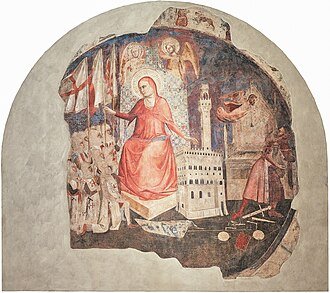
Painted in tempera and gesso on a large scale, this work is attributed to Andrea Orcagna and dated 1343. Its title points to the expulsion of the Duke of Athens, a historical episode, and its figures include a tyrant, a soldier and a woman named Anna. It is held in the Palazzo Vecchio in Florence.
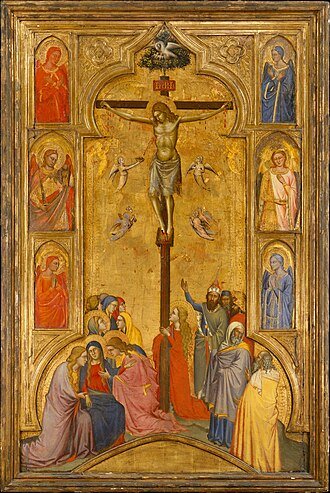
The Crucifixion by Andrea Orcagna, dated 1365 and painted in tempera on panel, is a religious work showing Jesus of Nazareth on the cross, accompanied by the Virgin Mary and angels who convey deep sorrow. The record offers no further details about its commission or setting, so any reading should rest on the scene itself, which is devotional and restrained in tone.
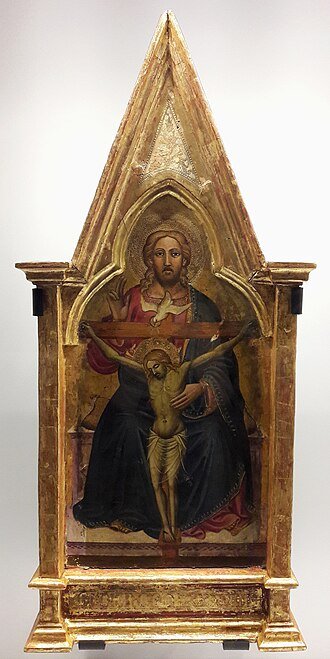
Painted in tempera and gold leaf on panel, this work depicts the Holy Trinity, a common subject in religious art. It is attributed to Andrea Orcagna and dated 1400. The gold background and the frontal arrangement of the figures create a luminous, unreal space, suited to devotion and contemplation rather than to a specific setting.
Where to see the work
- Uffizi Gallery Florence · 1
- Palazzo Vecchio Florence · 1
- Metropolitan Museum of Art New York City · 1
Teachers and pupils
Studied with
- Giotto 1276–1337
Curiosities
A fresco and Liszt's music
Among the works associated with him is the fresco The Triumph of Death, which inspired Franz Liszt's Totentanz, one of his most famous concertos. The Hungarian composer's piece is a musical reading of the dance of death, a theme that medieval and late medieval painters treated often. In this way a fourteenth-century Florentine image came to speak to nineteenth-century Romantic music, showing the lasting visual power of death imagery in Italian tradition.
A loggia wrongly credited to him
For a long time the Loggia dei Lanzi in Florence was falsely attributed to him. The building was in fact constructed by his pupils Benci di Cione and Simone Talenti. The mistake shows how the reputation of a fourteenth-century master could extend to works from his circle, and how later scholarship had to revise the authorship of many Florentine monuments.
A man of letters in Vasari's eyes
Giorgio Vasari included Orcagna in Lives of the Artists, his famous collection of artist biographies, and remembers him also as a poet. According to Vasari, he was the strongest personality in Florence around the middle of the fourteenth century. This judgement, written almost two centuries after his death, helps explain why his figure stayed present in the history of Italian art.