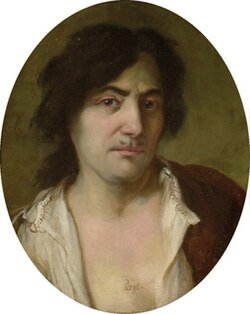
Antonio Bellucci (1654-1726) was an Italian painter of the Rococo period, best known for his work in England, Germany and Austria. Although he had been a soldier earlier in life, his name is associated with painting. Trained in Venice alongside artists of his generation such as Ricci, Tiepolo and Amigoni, he sought commissions north of Italy and beyond, where patrons wanted grand Italianate frescoes for their palaces.
He first trained with Domenico Difnico in Sebenico (Šibenik), in Venetian Dalmatia. By around 1675 he was working in Venice, where his works included a St Lorenzo Giustiniani for the church of San Pietro di Castello. In 1692 he completed four altarpieces for Klosterneuburg. From 1695 to 1704 he lived in Vienna, where he painted the Triumph of Hercules and other allegorical ceilings at the Palais Liechtenstein for Charles VI.
From 1705 to 1716 he worked almost continuously in Düsseldorf for Johann Wilhelm, Elector Palatine. For Schloss Bensberg he painted court scenes. Between 1716 and 1722 he was in England, where he decorated ceilings for James Brydges, 1st Duke of Chandos, at Cannons, and paintings in St Lawrence, Whitchurch, are attributed to him. He returned to his native country late in life and died in Soligo. A self-portrait by him is held at the Ashmolean Museum, Oxford.
His legacy is that of a painter who carried the Venetian decorative manner to northern Europe during the transition towards Rococo.
Works (2)
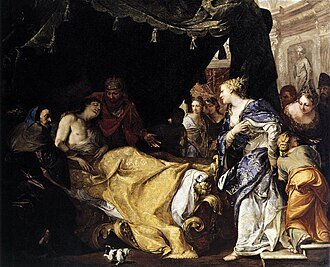

Mythological painting by Antonio Bellucci, dated 1698, showing Hercules with Omphale in a palace, an episode from classical myth in which the hero serves the queen of Lydia. It is an oil on canvas of large dimensions. With no supporting sources available, the reading remains cautious and limited to what can be stated with confidence.
Where to see the work
- Hessen Kassel Heritage Kassel · 1
- Ca' Rezzonico Venice · 1