Antonio del Castillo y Saavedra (Córdoba, 1616-1668) was the leading figure of the Baroque painting school of Córdoba in Spain. Besides religious painting, he stood out as a landscape painter and draughtsman, which places him among the major figures of the Spanish Golden Age.
The son of the painter Agustín del Castillo and Ana de Guerra, he was orphaned at fifteen. He trained in his father's workshop and with the imagemaker Ignacio Aedo Calderón. According to Palomino, he completed his studies in Seville with José de Sarabia, although any link with Zurbarán is undocumented. After marrying Catalina de la Nava in 1635, he established himself in Córdoba with commissions for churches and convents, such as The Martyrdom of Saint Pelayus for the cathedral. His most prosperous period came after his second marriage, with works such as the Calvary of the Inquisition.
His painting remained within the naturalist orbit of Zurbarán, with solemn compositions and tenebrist lighting. His narrative pictures stand out for their sense of space and their landscapes, for which he made many studies from nature, around 150 of which survive. In 1666 he visited Seville and encountered Murillo's painting, which seems to have influenced his last works. He died in Córdoba in 1668. His legacy lies in bringing landscape and drawing from nature into seventeenth-century Córdoban painting.
Works (7)

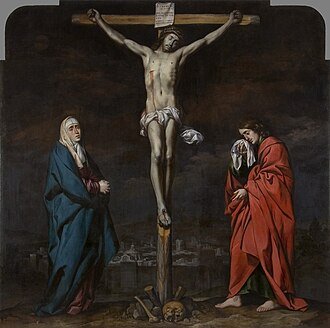
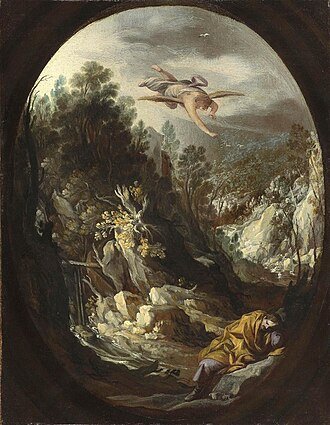
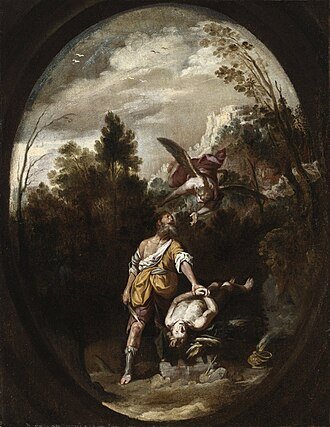
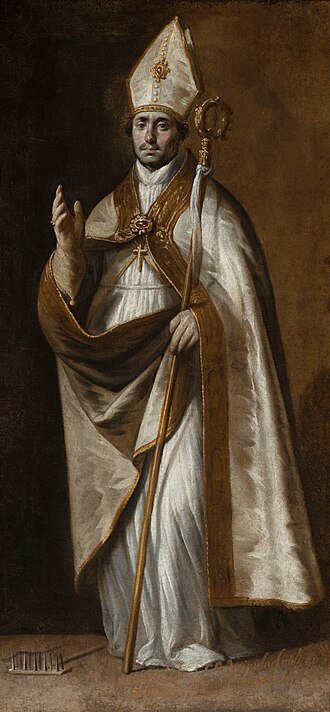
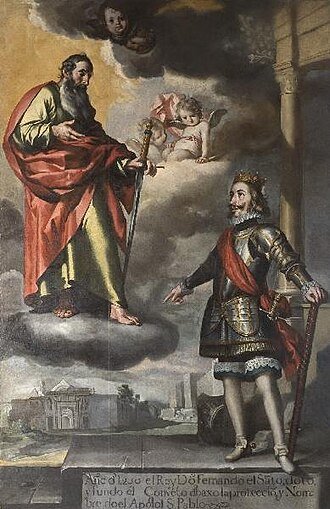
Baroque painting by Antonio del Castillo, dated 1655 and held at the Museo de Bellas Artes in Córdoba. It shows Saint Ferdinand, recognisable by his royal status, presenting to Saint Paul the foundation of the Dominican convent in Córdoba, accompanied by a cherub and a sword, attributes linked to the saint king. The large vertical canvas belongs to the Córdoba school, where religious painting held considerable importance in the seventeenth century.
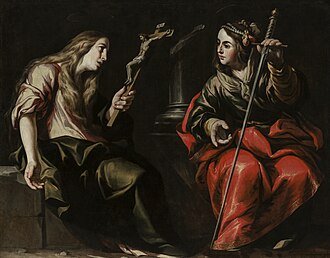
This canvas by Antonio del Castillo, dated 1655, shows Mary Magdalene and Saint Catherine of Alexandria, recognizable by their attributes: the crucifix, associated with Mary Magdalene, and the sword, the instrument of martyrdom linked to Catherine. It belongs to the Córdoba school of painting and to the religious art of its time. The record offers no further details about its commission or history, so it is best to stay with what the composition shows and its place within seventeenth-century Andalusian religious art.
Where to see the work
- Museum of Fine Arts of Córdoba Córdoba · 7
Curiosities
A severe verdict from Palomino
According to Palomino, when Castillo saw Murillo's painting in Seville in 1666, he exclaimed: "Castillo is already dead!" The biographer judged his colour to lack grace and good taste, and considered that his last works improved thanks to what he learned from the Sevillian. Palomino also described how Castillo walked the Córdoban countryside to copy sites, farmhouses and animals from life.
A poem against the plague
During the plague of 1649 and 1650, Castillo submitted a poem to the competition the city held in honour of the archangel Saint Raphael, asking for protection. His six stanzas, devoted to the archangel's first appearance to Friar Simón de Sousa in 1278, won second prize and were published in 1653 in Pedro Mexía de la Cerda's commemorative book.