Antonio Diziani
1737–1797 · Venetian late Baroque landscape painter
Antonio Diziani (9 February 1737 – 23 June 1797) was an Italian painter of the late Baroque period, working mainly on landscapes and views around Venice. Born in Venice, he was the son and pupil of Gaspare Diziani, a prominent decorative painter, and the younger brother of the painter Giuseppe Diziani.
Both brothers were listed in the Venetian painters' guild between 1761 and 1773, and together they held governing posts in the guild in 1778. In 1766 Antonio submitted a Landscape with the Magdalene as his test piece for the Academy of Fine Arts, but he was not admitted until 1774, the year he was elected a member of the Painting and Sculpture Academy.
His work draws on Marco Ricci and, more strongly, on Giuseppe Zais and Francesco Zuccarelli. He preferred landscapes of the Venetian countryside, painted with long, feathery brushstrokes and the blue tonality inherited from his father's influence. Unlike the heroic sense of Ricci, his landscapes depict a picturesque, gentle rustic world. He worked in oil and gouache and, together with his father, contributed to the frescoes of Villa Barbini in Casella d'Asolo.
Works (2)

Painting by Antonio Diziani in oil on canvas showing Bertoldino, a comic character, rising into the air among geese. Its listing as mythological painting sits uneasily with the scene, which seems closer to humorous folk storytelling than to classical myth. The work is held at Ca' Rezzonico.
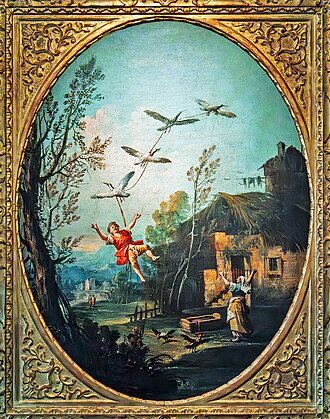
The painting shows Bertoldino airborne, tied to a group of geese that seem to be carrying him off. No reference texts are available, so this description rests only on the title and the catalogue record, with no firm information about the character or the circumstances of its making. The record gives 1650 as the date, a figure best treated with caution. It is an oil on canvas now held at the Museum of 18th-century Venice.
Where to see the work
- Ca' Rezzonico Venice · 1
- Museum of 18th-century Venice Venice · 1