
Acisclo Antonio Palomino de Castro y Velasco (Bujalance, Córdoba, 1655 - Madrid, 1726) was a Spanish Baroque painter who is remembered today mainly for his writing. Born into a well-off family, he studied in Córdoba, where he also learned drawing and painting from Juan de Valdés Leal and Juan de Alfaro, who helped him reach the royal court.
He settled in Madrid in 1678 and married Catalina Bárbara Pérez de Sierra. In 1688 he was appointed painter to King Charles II, which gave him work at the Alcázar and the Buen Retiro. He collaborated with Luca Giordano at El Escorial and painted frescoes for the Casa de la Villa in Madrid. His most extensive work was in Valencia, where he decorated the basilica of the Virgen de los Desamparados and the church of the Santos Juanes, and left the vault of San Nicolás. He also worked in Salamanca, Granada and Córdoba, where he painted for the Mezquita-cathedral.
His style combines Baroque movement and colour with a clear, orderly composition from which he removed secondary details. His works show the move from the Baroque towards Rococo and later Neoclassicism.
His main legacy is El Museo Pictórico y Escala Óptica, published between 1715 and 1724. Its third volume, El Parnaso español, gathers biographies of Spanish Golden Age painters, which is why he is called the Spanish Vasari. The work was translated into English, French and German, and it remains a basic source for the history of Spanish painting.
Works (3)
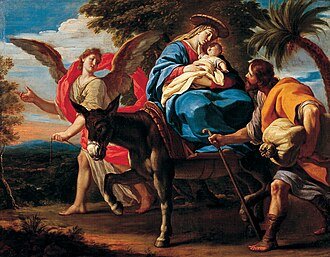
Antonio Palomino painted this scene of the Flight into Egypt, when Mary and the Christ Child ride on a donkey while Joseph walks beside them, guided by an angel. In the landscape, a bent palm tree points to the miracle of the palm, a story found in the apocryphal gospels rather than the canonical ones. Dated roughly 1712 to 1714, when the painter was mature, the work is held at the Museo de Bellas Artes in Córdoba.
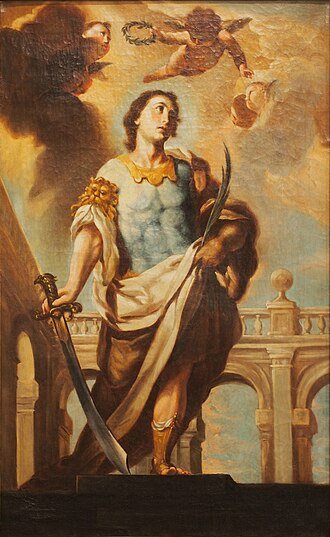
This oil on canvas by Antonio Palomino shows Saint Acisclus, a martyr venerated in Córdoba, dressed in Roman attire and holding a sword and a palm, attributes that identify his martyrdom. It is a preparatory sketch for the final canvas of the high chapel retable in the Mosque-Cathedral, where the saint appears alongside Saint Victoria as the city's patrons. Its passage through private collections before entering the Museum of Fine Arts in Córdoba makes it a valuable record of the painter's creative process.
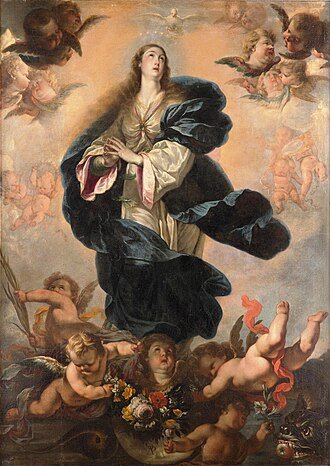
The painting shows the Virgin Mary, the central figure of this religious subject, made in 1712 by Antonio Palomino in oil on canvas. Its theme refers to the belief, upheld by the Church, that Mary was conceived without original sin. The work is held at the Museo del Prado, where it forms part of its collection of religious art.
Where to see the work
- Museum of Fine Arts of Córdoba Córdoba · 2
- Museo del Prado Madrid · 1