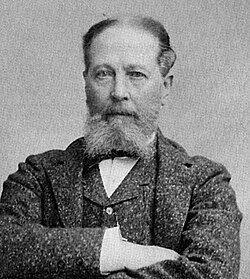
August Malmström
1829–1901 · Swedish painter of rural scenes and Nordic themes
Johan August Malmström (Nubbekullen, 14 October 1829 – 18 October 1901) was a Swedish painter best known for his scenes of country life, often featuring children. His most widely recognised work, Grindslanten (1885), shows a typical scene from nineteenth-century Sweden. Influenced by the national romanticism of Gothicismus, he also drew on Norse mythology and made illustrations for editions of Frithiofs saga and The Tales of Ensign Stål. He was a professor and later director at the Royal Swedish Academy of Arts, and he worked as an illustrator for newspapers and publishers, designed furniture and was a designer for Gustavsberg porcelain.
Malmström grew up on a small farm in Östergötland, where his father, a carpenter and ornamental sculptor, taught him woodwork. An injury to his right hand spared him heavy labour and left him more time for drawing and painting. He entered the Academy in Stockholm in 1849, but in 1856 he moved to Düsseldorf, where he painted King Heimer and Aslög, which won the Royal Medal. He then settled in Paris alongside Mårten Eskil Winge, studied under Thomas Couture and copied works by Titian and Raphael in Italy between 1859 and 1860. His breakthrough came after his return to Sweden in 1864, and from 1867 he taught at the Academy until 1894.
His legacy lives on through his students, among them Elise Arnberg, Elisabeth Keyser and Emma Josepha Sparre, and through works such as Dancing Fairies (1866), The Battle of Bråvalla (1862) and The old and the young Sweden (1894). He died in 1901 and was buried in the cemetery of Solna Church near Stockholm. He bequeathed some 650 watercolours and drawings, along with 26 sketchbooks, to the Nordic Museum on Djurgården.
Works (5)


This painting is attributed to the Swedish painter August Malmström, though the record gives only his name. Without further reliable information about the work, its subject, date and commission cannot be stated with certainty. What can be said is that it belongs to the output of an artist active in the Nordic world during the nineteenth century.

Where to see the work
- Nationalmuseum Stockholm · 1
- Östergötland Museum Linköping Municipality · 1
Teachers and pupils
Pupils
- Elise Arnberg 1826–1891
- Elisabeth Keyser 1851–1898
- Emma Josepha Sparre 1851–1913
Curiosities
An ox to pay for studies
To finance their son's stay in Stockholm, Malmström's parents sold their only ox. The decision shows the sacrifice of a farming family that bet on the talent of a boy they had encouraged since childhood. It contrasts with the later career of a painter who would go on to direct the very institution where he had trained.
A work without a prize
In the Academy's annual contest of 1855, Malmström was the only student to submit a painting of King Gustaf II Adolf in mortal danger at the battle of Wittsjö. Even so, the jury judged the work to be in no condition to be rewarded. The episode shows his diligence in the competitions, although it did not always bring him an award.
Copying Titian out of necessity
Travel scholarships required the copying of a work by a great master. Malmström chose Christ Crowned with Thorns by Titian because the artist's other paintings were already occupied by other copyists, in some cases for many years. The choice was therefore a practical solution to the shortage of available works.