
August Strindberg
1849–1912 · Swedish playwright, novelist and painter
Johan August Strindberg (Stockholm, 1849 – Stockholm, 1912) is one of the central figures of modern Swedish literature. He worked as a playwright, novelist, poet, essayist and painter. Abroad he is known mainly for his theatre, but in Sweden he is regarded as the father of modern Swedish letters. Over four decades he wrote more than sixty plays and more than thirty works of fiction, autobiography, history and cultural analysis. His painting has a smaller place in art history, yet it is notable because he moved away from faithful depiction of the visible world at a time when most of his contemporaries were pursuing exactly that.
Childhood and early years
Strindberg was the son of a shipping agent and of a former servant who had been his father’s lover. He grew up in a home shaped by paternal authority and by his mother’s intense religious faith. Her death, when he was thirteen, left a lasting mark on him. He attended the Stockholm Lyceum, developed an early interest in natural science, photography and religion, and enrolled at Uppsala University in 1867. After his father’s business failed, money problems forced him to combine his studies with work as a schoolteacher and a private tutor. He never completed a degree. His first attempts at the theatre also failed: he was rejected by the Royal Theatre with his first major play, Master Olof, and his acting at the dramatic school was poor. Success came in 1870, when the Royal Theatre staged In Rome and gave him a grant to continue his studies.
Marriages and early controversies
In 1875 he took a post as assistant librarian at the Royal Library in Stockholm, a job he later described as a frustration. That year he met Siri von Essen, whom he married in 1877. The couple had children, but the marriage soon soured under financial strain and because Siri’s acting career was not going well. In 1879 he published The Red Room, a satire of Stockholm society that many regard as the first modern Swedish novel. In 1884 came Getting Married, a collection of stories that argued for an egalitarian view of women and led to a blasphemy trial from which he was acquitted. A second volume took a sharply anti-feminist turn, and his attitude towards women grew increasingly hostile, a trait visible in much of his later work.
Exile and naturalist theatre
After the trial Strindberg spent six years in voluntary exile in France, Switzerland, Germany and Italy. There he wrote the naturalist plays that made his name. The Father, Miss Julie and Creditors, written around 1887 to 1889, broke with the Romantic tradition of the Swedish stage. In the preface to Miss Julie and in essays such as On Psychic Murder, he argued for a theatre in which conflict arises from struggles between minds rather than from plot. He tried to open an experimental theatre in Copenhagen modelled on André Antoine’s Théâtre Libre, but the project collapsed quickly. In 1891 he divorced Siri and, after a short stay in Sweden, settled in Berlin, where in 1893 he married the Austrian journalist Frida Uhl. The marriage ended after roughly a year of living together.
Crisis and painting
In the mid-1890s he went through what he called his ‘Inferno crisis’, a period of paranoia, loneliness, heavy drinking and drug use, as well as scientific experiments, which he later described in his autobiographical work Inferno. The period drew him towards the occult, alchemy and, for a while, Catholicism, and his later writings were steeped in the ideas of Swedenborg. It was also when he began to paint, mostly in periods of personal crisis. About 117 paintings are accepted as his, and most were made in just a few years. His seascapes, landscapes and urban views, such as The City (1903), Wonderland (1894) or Alley (1903), move away from visual fidelity in order to convey a mood, and many specialists rank them among the most original works of nineteenth-century art. His friendships with Edvard Munch and Paul Gauguin kept him close to modern tendencies, yet his painting followed a path of its own. He also worked as a photographer, and chance played an important role in his creative process.
Final years and legacy
In 1899 he settled permanently in Stockholm, beginning the most productive phase of his career. He wrote To Damascus, A Dream Play and The Ghost Sonata, works that anticipate expressionism and surrealism through their loose structure and their treatment of time and space. He helped run the Intimate Theatre, a small chamber theatre where his more intimate plays were staged. His last major controversy came in 1910, with an article attacking King Charles XII. He died in 1912 of cancer, and more than 50,000 people attended his funeral. Today his legacy is spread across theatre, which he renewed and which anticipated much of the twentieth century, the novel, and a body of painting and photography that Stockholm preserves in a museum devoted to him.
Works (8)


Landscape painting dated 1894, executed in oil on cardboard. It shows a tree and a flower, simple motifs that make up a restrained scene. The available information does not specify its context or any commission, so it is best read mainly as a study of nature.

This 1903 painting by August Strindberg, known in Spanish as Callejón, is held at the Thiel Gallery. Its narrow, elongated format suggests a corridor-like space that draws the eye toward the far end. Without further documentation, the context of its creation and the artist's specific intentions cannot be determined with certainty.

This small oil on panel, dated 1902 and attributed to August Strindberg, is a modest-scale work. With no reference texts available, its subject, commission and original setting cannot be established. The wooden support and compact size may point to a study or a personal piece, though that remains a cautious inference rather than a documented fact.
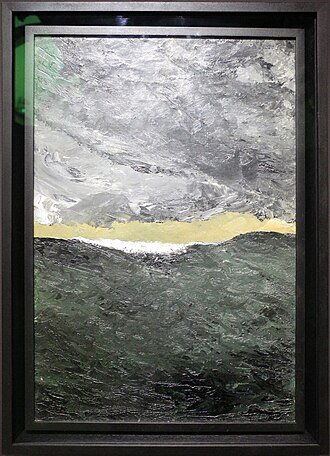

Painted in oil on cardboard, this seascape shows a rough sea under a heavy sky. The broom buoy, a floating marker that indicates a point on the water, becomes a small focal point against the dark waves. Given its modest size, the work reads more like a direct observation of a moment than an elaborate composition.

August Strindberg painted this work in 1892, and its title links the scene to the legend of the Flying Dutchman, a phantom ship doomed to sail without rest. The title points to a stormy sea among rocky skerries, though there is no further information about its composition or the circumstances of its making.

This seascape by August Strindberg takes as its subject the Korsö tower, which stands out as a visual landmark within a marine landscape. Painted in oil on canvas in 1901, the work focuses on the relationship between the isolated structure and the water surrounding it. The available information does not allow us to specify its commission or how it was received at the time.
Where to see the work
- Nationalmuseum Stockholm · 3
- Thiel Gallery Stockholm Municipality · 1
- Musée d'Orsay Paris · 1
- Statens Museum for Kunst Copenhagen Municipality · 1
- Uppsala University Uppsala Municipality · 1
Curiosities
A mass funeral
Despite his controversies and difficult temperament, Strindberg was recognised as a notable figure in Sweden at his death in 1912. Ordinary people turned out in large numbers for his funeral, and more than 50,000 people followed the procession. For a writer who had spent much of his life at odds with the middle classes and the institutions, this response from working people was especially meaningful.
A relative in the Arctic
Nils Strindberg, the son of one of August’s cousins, died in the failed Arctic balloon expedition led by S. A. Andrée in 1897. The family thus became linked to one of the great tragedies of Swedish polar exploration. The episode shows how closely the Strindberg name was tied to the public life and scientific adventures of the period, even though the writer himself took no part in them.
Help from Germany
When his popularity was at a low point and a shortage of income plunged him into depression, an appeal in a German magazine raised a fund that allowed him to leave Sweden and join the artistic circles of Berlin. With that money he was able to return to writing.