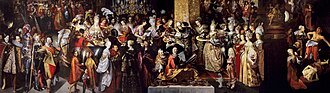
Bartholomeus Strobel the Younger, known in Polish as Bartłomiej Strobel, was a Baroque painter of Silesian origin who worked mainly in Prague and in cities of what is now Poland. Born in Breslau in 1591 into a Protestant family of German descent, he is remembered for his portraits and religious paintings for the local elites, and above all for the large feast of Herod now in the Museo del Prado in Madrid.
He trained in the workshop of his father, Bartholomäus the Elder, a painter who also worked in decorative arts. By around 1610 he was working in Prague, the artistic centre of Rudolf II's court, and in 1618 he is documented in Danzig holding an imperial letter that allowed him to work throughout the Holy Roman Empire without local guild permission. He served as court artist to Archduke Charles of Austria, Bishop of Breslau, and later to Prince Karol Ferdynand Vasa. He also painted Emperor Matthias and produced works for Sigismund III and Ferdinand II. His meticulous style kept late Mannerist habits inherited from Spranger and the court of Rudolf.
The Thirty Years War disrupted Silesia, and around 1634 he settled in Danzig, where he took commissions from burghers, aristocrats and churches, also working in Toruń and Elbląg. In 1639 King Władysław IV appointed him court painter. His best-known work combines a biblical subject with a lavish court banquet and portraits of contemporary figures, whose identities remain uncertain. A smaller version is in Munich and Daniel and Cyrus before the Idol Bel is in Warsaw. In 1643, after a serious illness, he converted to Catholicism with the Jesuits in Toruń. His last documented mention has moved later as research has advanced, and he is presumed to have died around 1650, perhaps in Toruń. His legacy is that of a painter bridging Northern Mannerism and Baroque art in Central and Eastern Europe.
Works (8)
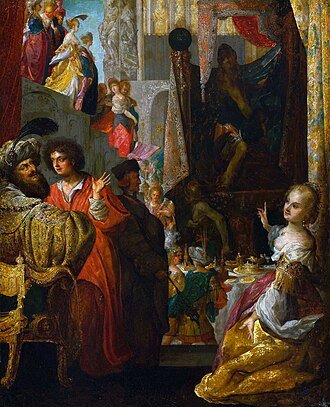
Oil painting on copper dated 1630 showing Daniel and Cyrus before the idol Bel, with a woman, a man and food present in the scene. The subject draws on the biblical account in which Daniel disproves the belief that the idol consumes the offerings left before it. Its copper support and small size suggest a private devotional use.

Portrait of Guglielmo Orsetti, painted in 1644 by Bartholomäus Strobel the Younger and now held at the National Museum in Warsaw. The available record identifies only the sitter as a man, with no documented commission or setting. Its large upright format on canvas suggests a formal likeness, though its original context cannot be confirmed.
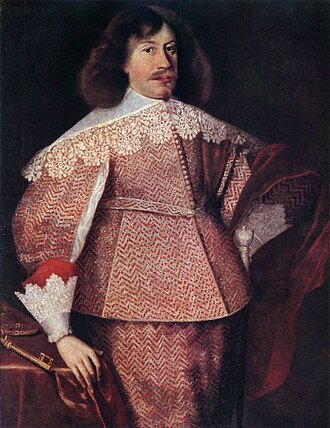
This portrait depicts Janusz Radziwiłł (1612–1655), dated 1634 and painted in oil on canvas by Bartholomäus Strobel the Younger. Portraiture, the genre here, aims above all to fix the likeness of a specific individual. The work is now held by the National Art Museum of Belarus. With the information available, little more can be said with confidence.

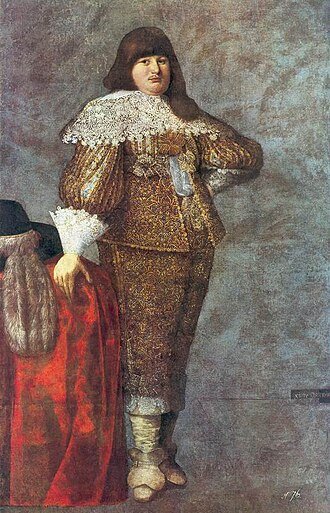
Portrait of Władysław Dominik Zasławski, dated 1630 and painted by Bartholomäus Strobel the Younger. It is an oil on canvas in upright format and close to life size, presenting the sitter as a member of the nobility. Beyond these facts, little is known about its commission, composition or reception, so any reading should stay close to what the painting itself shows.


Portrait of Władysław Dominik Zasławski-Ostrogski, painted by Bartholomäus Strobel the Younger in 1635. This oil on canvas belongs to the formal portrait genre, in which the sitter is shown in a dignified, ceremonial manner. Held at the Palace Museum in Wilanów, near Warsaw, it offers a view of portrait painting of the period in the Polish context.
Where to see the work
- National Museum in Warsaw Warsaw · 3
- Belarusian National Arts Museum Minsk · 2
- Museo del Prado Madrid · 1
- Palace Museum in Wilanów Warsaw · 1
Curiosities
An imperial letter of freedom
In 1618, when he is documented in Danzig, he received a document from the emperor known as a Freibrief. It allowed him to work anywhere in the Holy Roman Empire without the permission of the local guild, and the award was repeated in 1624. This was an unusual advantage for a painter of his time, making it easier to accept commissions in cities with different guild rules.
A portrait never paid for
In 1632 he painted the portrait of the invading Prince Ulrik of Denmark, who was active in Silesia during the war. Strobel was never paid for the work, as Ulrik was murdered the following year. The case shows the instability of those years, when painters depended on patrons who could disappear almost overnight.