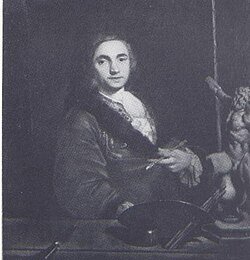
Bartolomeo Nazari
1699–1758 · Italian late-Baroque portraitist active in Venice
Bartolomeo Nazari (Clusone, near Bergamo, 1693 or 1699, depending on the source, Milan, 1758) was an Italian painter of the late Baroque, mainly active in Venice as a portraitist. He came from a lower-middle-class family and trained as an apprentice under Angelo Trevisani. He also worked in the Roman studio of Francesco Trevisani and studied with Benedetto Luti. Some writers describe him as a pupil of Fra Galgario, the Bergamo portraitist, although that link is uncertain.
He was back in Venice by 1724 and was registered with the Fraglia dei Pittori, the Venetian painters' guild, by about 1726. In 1744 he went to Frankfurt to paint Emperor Charles VII and his family. His patrons included the consul Joseph Smith and the former general Johann Matthias von der Schulenburg, who owned more than eight of his portraits. He also painted several opera singers, among them Farinelli, and in 1756 he joined the newly founded Accademia di Belle Arti in Venice. He died in Milan on his way back from Genoa, where he had painted the Doge Giovanni Giacomo Grimaldi.
His son Nazario and his daughter Maria were also painters, and his portrait of Samuel Egerton is held at the Ca' Rezzonico in Venice.
Works (2)
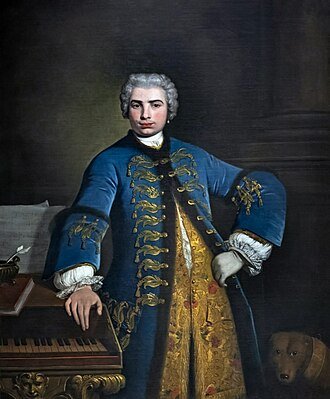
Portrait of the castrato Carlo Broschi, known as Farinelli, painted by Bartolomeo Nazari in 1734. The sitter appears beside a music score and a dog, details that suggest his connection to music and courtly life. The work is held at the Royal College of Music. With no further documentation available, it is best read as evidence of how the singer was presented publicly in Italian painting of the period.

Oil on canvas portrait dated 1730 by Bartolomeo Nazari, depicting Samuel Egerton. Little information is available about how the work was commissioned, composed or displayed, so any reading of it should remain cautious. The painting is held at the Ca' Rezzonico museum.
Where to see the work
- Ca' Rezzonico Venice · 1