Berlinghiero Berlinghieri
1175–1236 · Italian painter of Lucca, early thirteenth century
Berlinghiero was an Italian painter active in Lucca in the early thirteenth century, working in the Italo-Byzantine style. His paintings show how Tuscan painting of the period remained tied to Byzantine tradition, while sculpture and architecture were already turning toward newer Gothic and late Romanesque models. For this reason he is regarded as one of the first steps in the transition from Byzantine art to Western art.
He is thought to have been born in Volterra, though the evidence is limited. A document dated March 22, 1228, now lost and known only from a somewhat garbled seventeenth-century copy, lists him among the citizens of Lucca who swore to keep the peace with Pisa, together with his two adult sons, Bonaventura and Barone. From this reference his birth is usually placed around 1175 and his death in 1236. The name by which he is known comes from the inscription "Berlingerius me pinxit" on a crucifix, and the older form "Berlinghiero Berlinghieri" is not considered his actual name.
His earliest surviving work attributed to him is a crucifix in the Museo Nazionale di Villa Guinigi in Lucca, whose figure is static and Byzantine in type. Around 1230 to 1235 he painted a second crucifix, now in the San Matteo museum in Pisa, where the figures show greater expressiveness, probably under the influence of Giunta Pisano. He is also credited with two Madonnas with Child, one at the Metropolitan Museum of Art in New York, known as the Madonna Strauss, and another in the Pisa Cathedral, which came from Camaiore. Both keep Byzantine features such as gold backgrounds and elongated figures, and it can be hard to separate his own hand from that of his sons.
His legacy lies in being one of the first painters in thirteenth-century Italy to move toward a more expressive figuration than that of his Byzantine models.
Works (2)
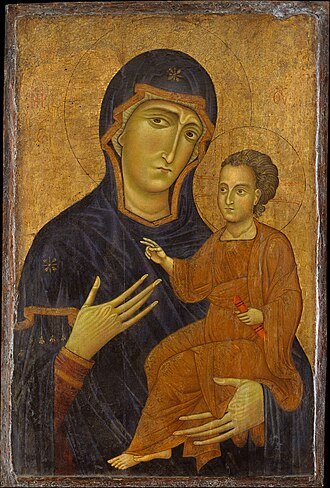
A devotional panel painting in gold and tempera on wood, showing the Virgin Mary holding the Christ Child. It is dated around 1230 and attributed to Berlinghiero Berlinghieri. The gilded background and religious theme suggest a devotional purpose. It is now at the Metropolitan Museum of Art, New York.
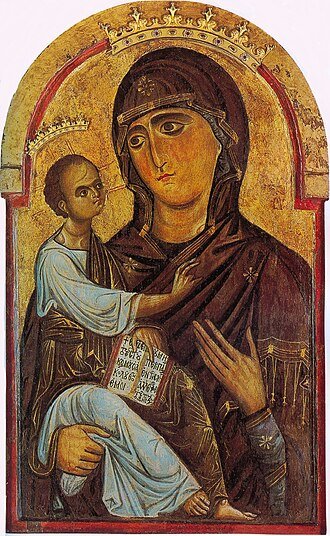
A religious painting dated around 1200 and attributed to the painter Berlinghiero Berlinghieri, executed in tempera on panel. It depicts the Virgin Mary with the Christ Child, a subject widespread in religious art of the period. It is kept in the Cathedral of Pisa. With the information available, little more can be said about its commission or its specific technique.
Where to see the work
- Metropolitan Museum of Art New York City · 1
- Pisa Cathedral Pisa · 1