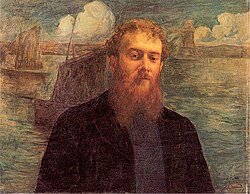
Charles Cottet
1863–1925 · French painter of dark Breton scenes and seascapes
Charles Cottet (Le Puy-en-Velay, 1863 - Paris, 1925) was a French painter who bridged Symbolism and Post-Impressionism. He is best known for his sombre, carefully composed scenes of rural and seafaring Brittany, including fishermen's lives and harbours at dawn. His dark palette stood apart from the brighter work of many Post-Impressionists, and his social realism is often traced back to Courbet.
Cottet studied at the École des Beaux-Arts and the Académie Julian, where he worked under Puvis de Chavannes and Alfred Philippe Roll. Several of his fellow students at Julian later formed with him the Bande noire, also known as the Nubians, which included Lucien Simon and André Dauchez. He travelled and painted in Egypt, Italy and on Lake Geneva, but a trip to the Breton coast in 1886 left the deepest impression, and over the following twenty years he returned there repeatedly. He first exhibited at the Salon of 1889.
Among his key works are Au pays de la mer. Douleur, from 1908-09, now in the Musée d'Orsay, and Petit village au pied de la falaise, from 1905, held by the Musée Malraux in Le Havre. In 1896 he also painted views of Venice seen from the sea, now in the Hermitage. His paintings are held in museums including the Pushkin, the National Gallery of Art in Washington and the Musée d'Orsay.
His friends included Ignacio Zuloaga, Auguste Rodin, Charles Maurin and Félix Vallotton, who portrayed him in his group painting Five Painters. Amédée Ozenfant is listed among his pupils. His legacy lies in giving visibility to popular Breton life through a sober gaze, and in sustaining an individual style against the luminous fashions of his day.
Works (1)
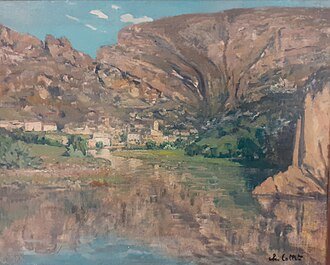
A landscape painted in 1905 by Charles Cottet, showing a small village nestled at the foot of a cliff. It is an oil on canvas of modest size. The available information does not clarify the commission or the artist's specific intent, so the most reliable reading rests on what is visible: the contrast in scale between the cluster of houses and the rocky mass that towers above them.
Where to see the work
- MuMa Museum of modern art André Malraux Le Havre · 1
Teachers and pupils
Pupils
- Amédée Ozenfant 1886–1966