
Daniel Seghers (Antwerp, 1590-1661) was a Flemish Baroque painter who specialised in flowers. A Jesuit lay brother, according to some sources, he is best known for garland paintings, a devotional genre he helped define and which European courts prized in the seventeenth century.
After his father's death, around 1601, his mother moved to Utrecht in the Dutch Republic, where Daniel received a Calvinist upbringing. Back in Antwerp, he enrolled in the Guild of Saint Luke in 1611 as a pupil of Jan Brueghel the Elder. Around 1614 he converted to Catholicism and entered the Jesuit novitiate at Mechelen. After a period in Brussels, he took his vows in 1625 and spent about two years in Rome, where he completed his training. He returned to Antwerp in 1627 and worked there until his death, leaving a large output.
His style is recognisable from tulip and rose garlands arranged loosely and lit as if the light came from within the flowers. These surround a devotional image, a Gospel scene or a religious symbol. Figures were often painted by other artists, such as Cornelis Schut, Erasmus Quellinus II or Thomas Willeboirts Bosschaert. In his Pietà compositions he replaced the flowers with thistles and thorns, a reference to the crown of thorns. His paintings, often given by the Jesuits to princes such as Frederick Henry of Orange-Nassau or Christina of Sweden, reached Spain early, where they influenced Juan de Arellano.
His legacy lies in consolidating the garland with a stone cartouche and in his influence on painters such as Jan Davidsz. de Heem. His works are held in major European museums, and the Museo del Prado keeps several pieces by his hand.
Works (4)
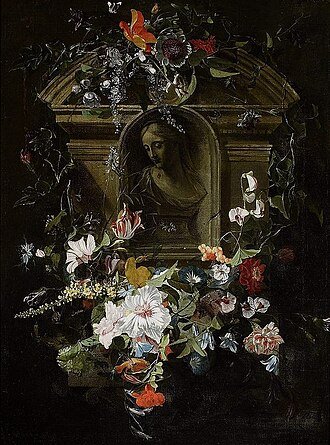
Bust-length portrait of a woman wearing a wreath of flowers, painted in 1658 by Daniel Seghers. The picture pairs the sitter with a bouquet, so that the human figure and the flowers share the visual interest. Oil on canvas, it is held by the National Museum in Warsaw.

A still life combining flowers, grapes and a garden with a varied group of animals: peacocks, parrots, a rabbit and a snake. Gathering such different creatures in one space, the scene presents the variety of nature as a single, carefully arranged display. Painted in oil on panel, the work rewards close looking.

Garland of flowers painted in 1617 by Daniel Seghers, combining floral painting with a religious subject. At the centre is the scene of the Noli me tangere, the encounter between the risen Christ and Mary Magdalene, framed by a wreath of mixed blooms. The record offers no further details about its commission or history, so it is best to stick to what the composition itself shows.

A still life by Daniel Seghers, painted in oil on copper, a smooth support that allows a very polished finish. It shows a bouquet of flowers arranged in a vase, a subject common in flower painting of his time. The record offers no further details about commission, date or reception, so it is best to stick to what the painting itself shows.
Where to see the work
- National Museum in Warsaw Warsaw · 1
- Musée d'art et d'histoire de Narbonne Narbonne · 1
- Museu de Belles Arts de València Valencia · 1
- Wallraf–Richartz Museum Cologne · 1
Curiosities
Almost the scent of flowers
Constantijn Huygens, secretary to Prince Frederick Henry at The Hague, praised Seghers's paintings in verse and wrote that one could almost smell the flowers. He also corresponded with the artist several times. The Dutch poet Joost van den Vondel likewise admired his work, which shows how much attention it drew in the literary circles of the period.
Garlands over a Domenichino
During his stay in Rome, Seghers is believed to have added flowers to existing paintings by Domenichino, unlike his later collaborations. For Cardinal Ludovisi he painted a garland around an oval cartouche filled with putti, a composition known as Double wreath surrounding a medallion with the triumph of love.
A catalogue of collaborators
Seghers compiled a list of his flower still lifes recording each work's description, collaborator and patron. The catalogue is incomplete, however, so the figure painters are not always known with certainty. He dated his works only in the period from 1635 to 1651, which makes chronology difficult.