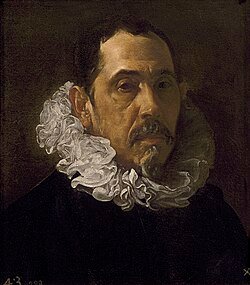
Francisco Pacheco (Sanlúcar de Barrameda, 1564-Seville, 1644) was a Spanish painter and art theorist of the Mannerist period, and one of the central figures of Seville's artistic life in his time. His importance lies as much in his theoretical work as in his paintings: he taught Diego Velázquez and Alonso Cano, and his treatise on painting is a key text of the Spanish Baroque.
He settled in Seville before 1580, where his uncle, the canon Francisco Pacheco, took him in and whose surname he adopted. After training with Luis Fernández, he set up as a master painter around 1585 and, thanks to good relations with the clergy, the aristocracy and the city authorities, built a wide clientele. Around 1610 he travelled to Madrid, visited El Escorial and Toledo, where he met El Greco, and on his return gathered a circle of poets and scholars with a Neoplatonic character.
His painting, academic in tone and influenced by Italian and Flemish art, is above all devotional. His figures, with forms inherited from the great masters, appear static and hard, and he is valued more as a good draughtsman than as a colourist. He also painted portraits and, more rarely, mythological subjects. From 1626 his prominence was overshadowed by the rise of Francisco de Zurbarán and Francisco Herrera the Elder.
As a writer he left the Libro de los retratos, with brief biographies of his fellow members of the circle, and the Arte de la pintura, completed in 1641 and published posthumously in 1649. It is an essential source on techniques, religious iconography and the polychromy of sculpture. He died in Seville in 1644. His legacy endures above all as a theorist and as a teacher of a generation of painters.
Works (3)
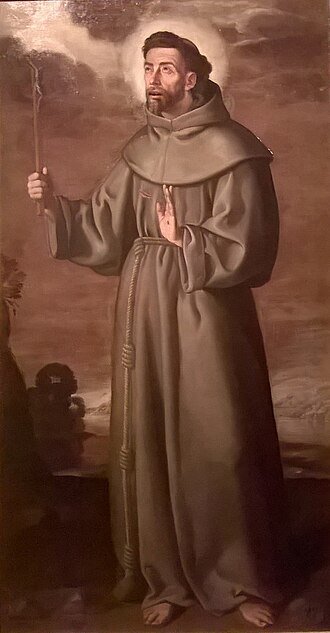
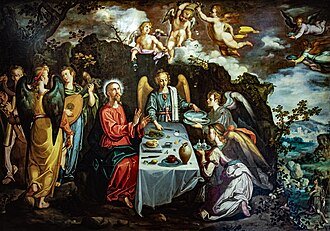
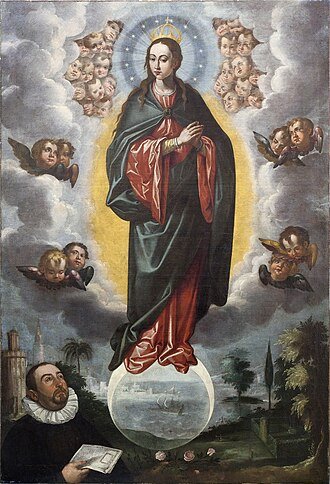
This Immaculate Conception, painted by Francisco Pacheco in 1619 in oil on canvas, depicts the Virgin Mary, the figure usually associated with the doctrine of her conception without original sin. The record also names Miguel Cid among those represented. It is housed in the Cathedral of Saint Mary of the See in Seville, within the city's religious art.
Where to see the work
- Museo de Bellas Artes de Sevilla Seville · 1
- Seville Cathedral Seville · 1
Teachers and pupils
Pupils
- Diego Velázquez 1599–1660
Curiosities
A borrowed name
Pacheco was not born with that surname: his real name was Francisco Pérez del Río. He took the name of his uncle, the licentiate and canon, who led a cultured gathering in Seville. After the uncle's death, the nephew took charge of keeping that gathering going, and it later became the foundation of his own intellectual circle.
A verdict on El Greco
Pacheco knew El Greco and left a much-quoted assessment of his work: «what he did well, no one did better, and what he did badly, no one did worse». The remark sums up both the recognition and the distance of a theorist who admired the Cretan's mastery without fully sharing his daring.
One hundred and sixty pencil portraits
Pacheco drew in pencil some 160 distinguished Sevillians who passed through his gathering over 54 years. These portraits form a sketchbook now kept in the Lázaro Galdiano Museum in Madrid, and they provide a direct record of the city's intellectual society.