
Francisco Ribalta (Solsona, 1565-Valencia, 1628) was one of the Spanish painters who opened the way to the Baroque. Trained within the orbit of painting at El Escorial, he settled in Valencia in 1599, where he developed a personal naturalism and an intense chiaroscuro that became the hallmark of the seventeenth-century Valencian school. His work links late Mannerism with the new Baroque currents.
His youth unfolded between Barcelona and Madrid. His family moved to Barcelona around 1572, and after he was orphaned he is still documented there in 1581; shortly afterwards he was in Madrid, where he signed and dated the Preparations for the Crucifixion of 1582, now in the Hermitage. His time at El Escorial left a mark: in the Meeting of the Nazarene with the Virgin, painted around 1611, he reproduced the figure of Christ carrying the cross by Sebastiano del Piombo that he had studied there.
After the death of Philip II in 1598 he moved to Valencia, probably encouraged by Archbishop Juan de Ribera, who was promoting an artistic renewal in the city. Between 1603 and 1610 he worked on altarpieces in Algemesí, and in 1606 he painted the Last Supper for the Colegio del Patriarca, whose naturalism in the faces of the apostles established his reputation. Commissions from the silversmiths' guild and from the city's Diputación confirmed his standing there.
A devout man committed to the Counter-Reformation, Ribalta aimed to make the supernatural seem credible and close to the viewer through simple compositions, free of superfluous ornament. Works such as Saint Francis Comforted by an Angel Musician and Ramon Llull, both from 1620, show this intention, which he maintained in Christ Embracing Saint Bernard (1625).
His legacy is visible in his pupils. Among them was José de Ribera, and his son Juan Ribalta would become his finest disciple.
Works (4)

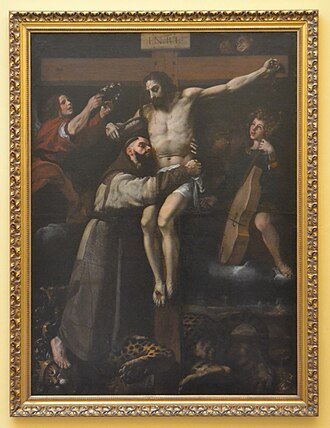
Francisco Ribalta painted this scene around 1620, in which Saint Francis of Assisi embraces the crucified Christ, who seems to lean away from the cross to answer the saint's gesture. The composition focuses attention on the meeting of the two bodies, set on a diagonal and bathed in strong light that stands out against a dark background. It is a devotional religious painting whose drama conveys the mystical intensity of its subject.


Francisco Ribalta painted this canvas around 1620, showing Saint Francis of Assisi comforted by an angel playing the lute. Beside the saint are a cross and a book, objects that point to his devotion and religious contemplation. Ribalta, linked to the painting of Valencia in his time, builds the scene through a restrained contrast between the saint's figure and the light falling upon him. The work is now held by the Museo del Prado.
Where to see the work
- Museo del Prado Madrid · 2
- Museu de Belles Arts de València Valencia · 1
- Museu Nacional d'Art de Catalunya Barcelona · 1
Teachers and pupils
Pupils
- Jusepe de Ribera 1591–1652
- Juan Ribalta 1596–1628
Curiosities
A Judas with a Familiar Face
According to tradition, the face of Judas in the Last Supper of the Colegio del Patriarca was modelled on a neighbour with whom Ribalta was on bad terms. It is a transmitted story rather than a documented fact, but it illustrates how the painter sought real faces for his figures. His naturalism in the apostles is precisely what drew the attention of his contemporaries in Valencia.
A Leonardo Copy in Madrid
In 1666 an inventory of the collection of Doña Catalina de Mardones in Madrid listed a Last Supper about a vara and a quarter high, described as a copy of Leonardo da Vinci by Ribalta and appraised by Juan Carreño de Miranda. The copy probably dates from his years in Madrid, when he could study the famous version kept in the refectory of El Escorial.
The Signature on the Piombo Copy
Antonio Ponz saw in Madrid, at the Hospital de Aragón, one of two copies Ribalta made of a triptych by Sebastiano del Piombo. Above the sacristy door a small altarpiece carried an inscription recording the authorship: Fr Sebastianus del Piombo invenit, Franciscus Ribalta Valentiae traduxit, meaning that Ribalta transferred the work in Valencia.