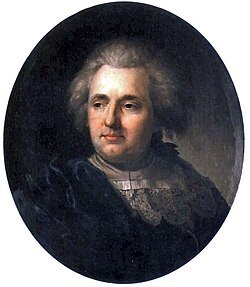
Franciszek Smuglewicz
1745–1807 · Polish-Lithuanian draughtsman and painter, precursor of historicism
Franciszek Smuglewicz (Warsaw, 1745 – Vilnius, 1807) was a draughtsman and painter of the Polish-Lithuanian Commonwealth, regarded as a progenitor of Lithuanian art in the modern era. The son of the painter Łukasz Smuglewicz, and nephew on his mother's side of Szymon Czechowicz, he first learned to paint in the shared workshop of his father and Czechowicz in Warsaw.
In 1763 he travelled to Rome, where he studied fine arts under Anton von Maron and remained for twenty-one years. There he completed his training and embraced the Neoclassical style. A royal scholarship from King Stanisław August Poniatowski brought him into the Academy of Saint Luke, and alongside Vincenzo Brenna he took part in cataloguing artefacts from Nero's Domus Aurea.
In 1784 he returned to Warsaw and founded his own school of fine arts, one of the forerunners of the city's modern Academy of Fine Arts. His classicism kept a strong trace of Polish Baroque, and over time he became a leading figure of historical painting, a genre that dominated Polish fine arts through the nineteenth century. Around 1790 he began a series of sketches and lithographs inspired by Adam Naruszewicz's History of the Polish Nation. Never finished, the series nonetheless brought him great popularity. Works from this period include A Meeting of the Four Years' Sejm (1793) and Kościuszko's Oath at Kraków's Old Town Market (1797).
In 1797 he moved to Vilnius, where he founded and became first deacon of the Institute of Sketch and Painting at the university. In 1801 he painted allegorical ceiling works for Tsar Paul I in the new imperial palace at the Mikhailovsky Castle in St Petersburg, also designed by Brenna. In his later years he devoted himself mainly to historical painting, and depicted everyday life and the architecture of Vilnius in a realistic manner. He taught generations of Polish-Lithuanian painters, among them Jan Rustem, Jan Krzysztof Damel, Gaspar Borowski and Józef Oleszkiewicz, and is remembered as a founder of modern Lithuanian art. He was buried at Rasos Cemetery in Vilnius, though the exact location of his grave is unknown.
Works (4)

A history painting by Franciszek Smuglewicz, dated 1785 and executed in oil on canvas. Its title points to a diplomatic scene: the reception of Persian envoys before the King of Ethiopia. The record offers no further information about the commission, the setting or the composition, so any additional reading should be approached with caution. It is held at the Lithuanian National Museum of Art.
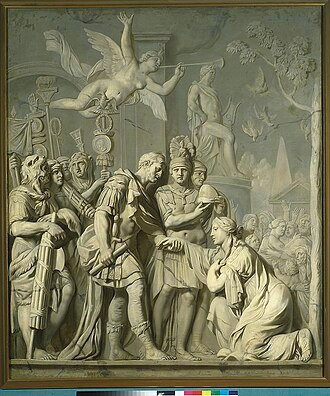
Painted in 1785 by Franciszek Smuglewicz, this history painting shows Emperor Titus in the act of granting rights to Rome. A woman and a lictor carrying fasces, the bundled rods that signified Roman authority, accompany him in the scene. The canvas, held by the National Museum in Warsaw, draws on classical imagery, though little is recorded here about its commission or original setting.
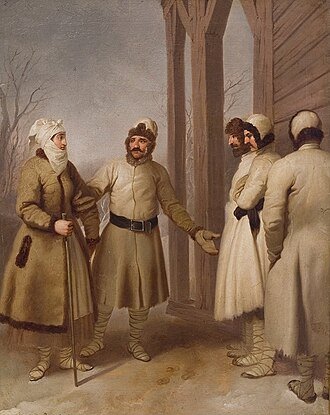

Esther before Ahasuerus shows the biblical scene of Esther appearing before King Ahasuerus, an episode told in the Book of Esther. The oil on canvas, dated 1778, belongs to religious art. Nothing reliable is known about its commission or destination, so the description rests on its subject and technique.
Where to see the work
- Lithuanian National Museum of Art Vilnius City Municipality · 2
- National Museum in Warsaw Warsaw · 1
Teachers and pupils
Studied with
- Szymon Czechowicz 1689–1775
- Łukasz Smuglewicz 1709–1780
Pupils
- Józef Oleszkiewicz 1777–1830
- Jan Damel 1780–1840
Curiosities
A name in several languages
Smuglewicz appears under different forms depending on the language consulted. In Lithuanian he is known as Pranciškus Smuglevičius, while the Polish form is the one usually used in reference works. The variation reflects the reality of an artist trained in the Polish Commonwealth and active in Lithuania, where his figure is now claimed as a forerunner of national painting.
A grave whose location is lost
Smuglewicz was buried in Rasos Cemetery in Vilnius, one of the city's best-known burial grounds. However, the exact position of his grave is not known, so his memory is linked to the cemetery as a whole rather than to a specific site.