
Frans van Mieris the Elder (Leiden, 1635-1681) was one of the leading genre and portrait painters of the Dutch Golden Age. The head of a Leiden family of painters, his sons Jan and Willem and his grandson Frans van Mieris the Younger also became accomplished genre painters. His importance lies in carrying the Leiden fijnschilder manner to an extreme of precision, with brushwork so fine that it is invisible to the naked eye.
The son of a goldsmith and jewel setter, Mieris first trained with a glazier who ran a drawing school, but he soon preferred painting. He worked with Gerard Dou and later with Abraham van den Tempel. From Dou he absorbed a taste for polished finish and orderly composition. He joined the Leiden painters' guild in 1658, though he was probably working independently from about 1655, and he was elected dean of the guild in 1665.
His paintings, usually small in scale, depict the habits of the aristocracy and the everyday life of the wealthier classes, though he also tackled homely scenes, portraits and allegories. He excelled at rendering rich fabrics, especially silk and satin, and rivalled Gerard ter Borch in this. Yet he is generally judged below Ter Borch and Gabriël Metsu, lacking their delicate sense of harmony, and below Dou, whose handling of light and shade he never matched. His early works are lighter, with more delicate flesh tones; his later ones are darker, with more livid shadows.
Mieris enjoyed distinguished patrons, among them Archduke Leopold Wilhelm of Habsburg and Cosimo III de' Medici, Grand Duke of Tuscany. He died in Leiden in 1681. His legacy lived on mainly through his family, and his manner was successfully imitated by others, including the German painter A. D. Snaphaan.
Works (19)


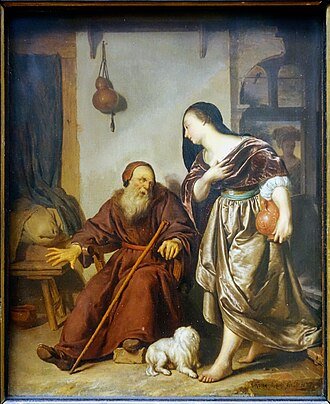
Dated 1671 and painted in oil on panel, this small work shows Jeroboam's wife and the prophet Ahijah, figures from the biblical account in the Books of Kings. Its modest size, about 24 by 20 centimetres, places it within the Dutch Golden Age tradition of religious painting.
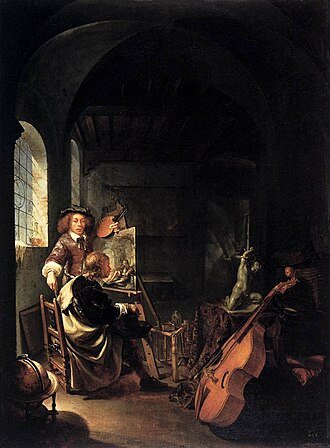
Small oil-on-panel painting dated 1656 and attributed to Frans van Mieris the Elder, showing a painter at work in his studio. As a genre scene, it focuses on the everyday atmosphere of the workshop rather than on a historical or religious subject. Nothing certain is known about its commission or the identity of the sitter.
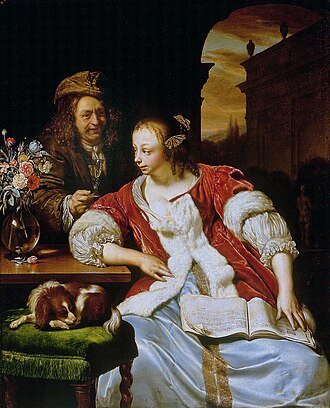
A small panel painted in 1671 by Frans van Mieris the Elder, which is generally considered a double self-portrait. It shows a man and a woman with a dog, and an open songbook placed at the centre. The title suggests a song or conversation halted mid-performance, a moment the viewer must reconstruct from the scene.

Painted in 1663 by Frans van Mieris the Elder, this small oil on panel shows a fair-haired boy, standing and dressed, blowing soap bubbles while holding a glass. Nearby appear a bouquet of flowers, including carnations, and grapevine leaves, along with a sunflower. Such details probably hint, in a discreet way, at the fragility of earthly pleasures.
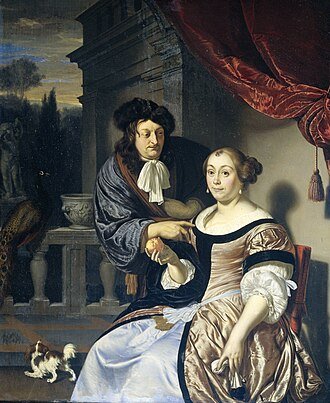
Genre scene dated 1678 and painted by Frans van Mieris the Elder in oil on panel. Its title, A gentleman and a lady, indicates two figures from everyday life, though the available record does not specify a particular situation. The small format suggests close viewing. Held at the Rijksmuseum, it is a modest work within the artist's output.

A portrait of an unidentified woman holding a small dog on her lap, painted in oil on panel in 1672 by Frans van Mieris the Elder. The sitter is seated and wears subdued clothing, stroking her little companion in a gesture that suggests intimacy and quiet. In keeping with Dutch genre painting of the period, fine rendering of fabrics, surfaces and fur sits against a dark background that draws the eye to the face and hands. Given its small panel format, it was likely meant to be viewed up close.

A genre scene painted in 1660 by Frans van Mieris the Elder, in oil on panel and on a small scale. It shows an official inside a cloth shop, an everyday subject of urban life that the painter treated with careful attention to detail. No further information about its commission or reception is available, so any reading should rest on what the scene itself presents.


Dated 1662, this genre scene by Frans van Mieris the Elder was painted in oil on a small wooden panel. As its title states, it shows a woman standing before a mirror, a subject frequently taken up by Dutch painters of the seventeenth century, who used it to explore everyday life and the act of looking at oneself.
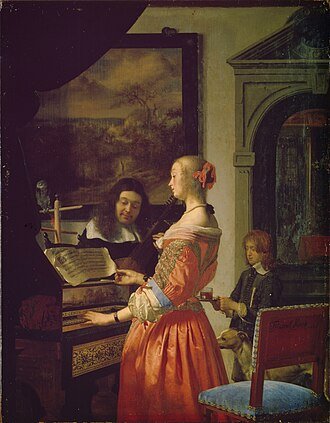
Small-scale genre painting from 1658, executed in oil on panel, showing a woman seated at a harpsichord with a man present in the room. Music serves here as the pretext for an intimate, domestic moment, a common theme in works of this kind. Its modest size invites the viewer to look closely at the scene.

A genre painting dated 1663 by Frans van Mieris the Elder, a small oil on panel showing a woman feeding a parrot. The everyday domestic setting is typical of the artist, who took great care with the rendering of fabrics, objects and plumage. With no further documentation available, its precise meaning should be regarded as open.

Portrait of a seated man in a hat and cloak, accompanied by a dog and leaning on a cane. Painted in 1675 by Frans van Mieris the Elder on a small panel, now in the Louvre. It is prized for its meticulous handling, the rendering of fabrics and the attention to detail typical of the artist's small-scale work.

This genre scene by Frans van Mieris the Elder shows a modest interior where a man, probably a travelling tinker, works on a pot while a woman looks on. Painted in oil on panel in 1658, the work centres on everyday domestic life and the interaction between the figures. Beyond what the composition itself suggests, little more can be said with confidence.

This small panel from 1674, painted by Frans van Mieris the Elder, shows Mary Magdalene in an intimate format meant to be viewed up close. The work belongs to the religious genre and is held in Dresden. Without further reference sources, it is best to limit the description to the image: a figure of the saint rendered with the smooth, polished, meticulous finish for which the Dutch painter was known.

Painting by Frans van Mieris the Elder, dated 1680, executed in oil on panel. It shows a woman with a pet lapdog and a maidservant. Its subject also includes a procuress, suggesting a genre scene with a moral undertone, though its precise meaning cannot be established with certainty from the available information.
Where to see the work
- Staatliche Kunstsammlungen Dresden Dresden · 3
- Cultural Heritage Agency of the Netherlands Art Collection Amersfoort · 1
- Art Gallery of New South Wales Sydney · 1
- Musée Fabre Montpellier · 1
- J. Paul Getty Museum Los Angeles · 1
- Palais des Beaux-Arts de Lille Lille · 1
- Musée des Beaux-Arts de la ville de Paris Paris · 1
- Mauritshuis The Hague · 1
- Rijksmuseum Amsterdam · 1
- Thyssen-Bornemisza Museum Madrid · 1
- Kunsthistorisches Museum Vienna · 1
- Royal Collection · 1
- Gemäldegalerie Berlin Berlin · 1
- Staatliches Museum Schwerin Schwerin · 1
- Johnny Van Haeften Gallery London · 1
- Louvre Museum Paris · 1
- Leiden Collection New York City · 1
Curiosities
A disputed date
A well-known picture dated 1650, showing ladies and gentlemen at an oyster luncheon, hangs in the Hermitage in St Petersburg. If the date were correct, Mieris would have reached his prime at fifteen, which is hard to believe. For that reason the birth date recorded by Houbraken is questioned. Another work, the Doctor Feeling a Lady's Pulse in Vienna, dated 1656, shows his precocity at about twenty-one.
A theft in Sydney
In early June 2007, A Cavalier (Self Portrait), dated to 1657–1659, was stolen from the Art Gallery of New South Wales in Sydney, Australia. The small panel, about 20 by 16 centimetres, had been donated to the gallery in 1993 by media figure and philanthropist James Fairfax. Its size made it easy to carry away, a reminder of how valuable such small works are.