
Giovanni Battista Gaulli, known as Baciccio, was an Italian Baroque painter whose later work already leans toward the Rococo. Born in Genoa in 1639 and dying in Rome in 1709, he is remembered mainly for the illusionistic ceiling fresco of the Gesù church in Rome, a key work of Roman Baroque painting.
He trained in Genoa with Luciano Borzoni, in a cosmopolitan city open to artists from northern Europe. From local masters he absorbed a warm palette, and in the 1660s he experimented with a cooler, more linear style inspired by Bolognese classicism. In 1662 he was admitted to the Academy of St Luke in Rome, where he later held several posts, and the following year he received his first public commission, an altarpiece for San Rocco.
Around 1669, after a visit to Parma where he studied Correggio's fresco in the cathedral, his painting became more pictorial and less linear, and he adopted the di sotto in su composition. At the height of his career he was one of the most esteemed portraitists in Rome.
His masterpiece came about when the election of Gian Paolo Oliva as Jesuit superior revived the decoration of the Gesù. With Bernini's support, Oliva gave the dome commission to Gaulli, then only 22. The main vault, the Veneration of the Holy Name of Jesus, was unveiled on Christmas Eve 1679, and he kept working on the tribune vaults until 1685. Figures swirl upward toward a heavenly light while heretics fall into the shadows below, and Antonio Raggi's stucco figures blend with the painted ones.
His illusionistic style inspired similar ceilings in Roman churches, such as Andrea Pozzo's work at St Ignatius. In his later years, after 1685, he adopted softer colours and more delicate compositions, anticipating the Rococo.
Works (11)

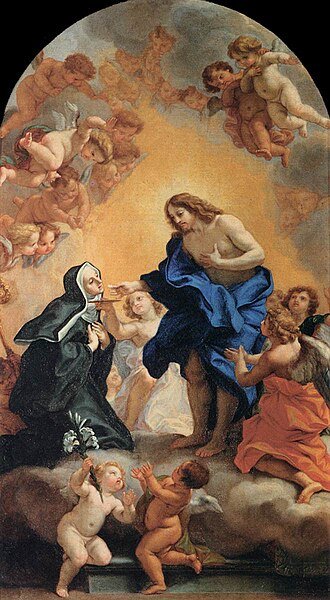
This painting shows a blessed abbess receiving communion directly from the hands of Jesus, with an angel present in the scene. The lily, commonly associated with purity, underlines the devotional character of the moment. It is a small oil on canvas of religious subject, dated 1690 and attributed to Giovanni Battista Gaulli.

This portrait, dated 1681 and painted in oil on canvas by Giovanni Battista Gaulli, shows Cardinal Marco Gallo. Without further documentation, its commission and the circumstances of its making cannot be established with certainty. The painting is held at the National Gallery in London. Its precise context therefore remains uncertain, so the description rests on the portrait itself.

The painting shows John the Baptist preaching to a crowd gathered in a mountainous landscape. The scene is organized around the preacher's figure, while the crowd spreads toward the background. Dated 1695 and executed in oil on canvas, it belongs to the religious art category and is held in the Louvre's collection.

Portrait of the sculptor and architect Gian Lorenzo Bernini, painted in 1675 by Giovanni Battista Gaulli, known as Baciccio. The record offers no further details about its commission or composition. It is an oil on canvas held by the National Galleries of Scotland, showing the artist in maturity in a direct, restrained portrait.

This portrait shows Leopoldo de' Medici, depicted as a cardinal as the title indicates. Giovanni Battista Gaulli painted it in 1667 in oil on canvas, and today it belongs to the Uffizi Gallery in Florence. As a portrait, its main interest lies in how it presents the sitter.

The painting depicts the biblical episode in which Abraham prepares to sacrifice his son Isaac. Dated 1700, it is an oil on canvas held by the High Museum of Art. Its interest lies in how Gaulli arranges the moment of greatest dramatic tension in the story.
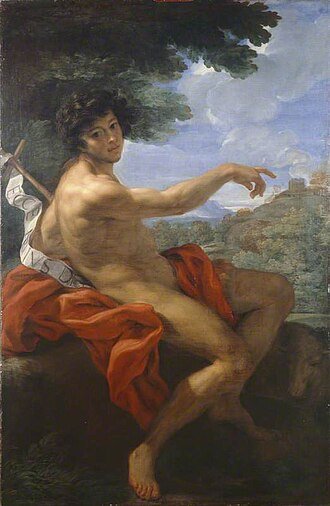


Oil on canvas of modest size, dated 1680 and attributed to Giovanni Battista Gaulli. It is classified as religious art and held in the Museo de los Agustinos. Without reference sources, its specific subject, commission and history cannot be confirmed here, so this description is limited to its technical and documentary details.

This fresco by Giovanni Battista Gaulli, dated 1707, belongs to religious art and is housed in the Basilica of the Holy Apostles. Its subject is the triumph of the Franciscan Order, a composition meant to celebrate this religious community. Without further sources at hand, it is wise to stick to what the record states: a mural work tied to the iconography of the order.
Where to see the work
- Louvre Museum Paris · 2
- National Gallery London · 1
- National Galleries Scotland City of Edinburgh · 1
- Uffizi Gallery Florence · 1
- High Museum of Art Atlanta · 1
- Manchester Art Gallery Manchester · 1
- Musei di Strada Nuova Genoa · 1
- Musée des Augustins Toulouse · 1
Teachers and pupils
Studied with
- Luciano Borzone 1590–1645
Curiosities
A nickname from Genoa
Gaulli is also known as Baciccio, Il Baciccio or Baciccia. These are Genoese pet forms of Giovanni Battista, affectionate familiar versions of the given name typical of his native city. Many sources use them, and the nickname became nearly as recognisable as his surname.
Nudes made modest
His nude figures in the pendentives of Sant'Agnese in Agone offended some viewers, and clothing had to be painted over them. Something similar had happened with Michelangelo's frescoes on the altar wall of the Sistine Chapel. This controversy was remembered when considering such a young painter for the Gesù dome.
A contract in stages
The original contract set two years for the dome and ten years for the rest of the decoration. If approved, he would receive 14,000 scudi plus expenses. Later critics called him a Bernini of painting, which shows how closely his work was associated with the style of his mentor.