
Herri met de Bles (Dinant, c. 1510 - Antwerp, between 1555 and 1567) was a Flemish landscape painter who worked in Antwerp from 1533 to 1566. He is counted among the artists who contributed to Mannerism, and his importance lies in helping to establish a distinctly Northern European kind of landscape, in which nature stops being a mere backdrop and becomes the centre of the picture.
He joined the Antwerp Guild of St Luke in 1535. He ran a workshop where specialists handled figures, architecture and landscape, which is why it is now so hard to separate his own hand from that of his assistants. Together with Joachim Patinir he helped shape a style built on elevated viewpoints, rocky terrain and atmospheric effects rather than strict realism. His compositions usually have more depth and detail than Patinir's, with less rich colours, and they often include small figures engaged in religious episodes or everyday work such as farming and trade.
His known works include The Cure of Folly and landscapes with biblical subjects such as The Road to Calvary or the Parable of the Good Samaritan. A landscape with the Sacrifice of Isaac, produced in his workshop, shows a scene of violence on its left side that the hunters on the right appear to ignore. A trip to Italy is not documented, although his paintings were popular in his lifetime and survive in the collections of wealthy merchants in the Low Countries, Italy and elsewhere. His legacy lies in anticipating a landscape genre that Pieter Bruegel the Elder would later carry much further in the same city.
Works (7)


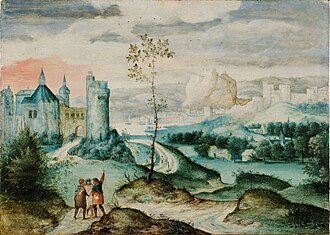
This small oil on panel presents a landscape in which the religious episode of the road to Emmaus takes a back seat to nature. Its main motifs are a tree, a cloud and a city gate, arranged to create depth across the scene. It illustrates how landscape painting could serve as a setting for biblical subjects.

This religious painting shows Saint Jerome within a landscape, a subject common in devotional art. It is dated 1600 and is held at the Musée provincial des Arts anciens. The available information says little about its original context, so any reading should remain cautious: the saint is set within a natural setting that forms an essential part of the composition.

A work by Hendrick met de Bles in which the parable of the Good Samaritan serves as a religious subject within a wide landscape. The natural setting takes the lead, with a panoramic view that places the figures in the background. The sacred theme thus coexists with the depiction of the land, a hallmark of the historical landscape genre.
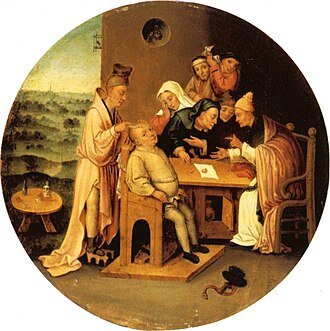
Painting by Hendrick met de Bles, dated around 1500 and executed in oil on panel. It shows a genre scene in which several people attempt to remove a stone from a man's head, a motif tied to the notion of folly. It is held by the Musée Benoît-De-Puydt. Without further references, it is best to describe only what the record allows us to state with caution.

Where to see the work
- King Baudouin Foundation · 2
- Princeton Art Museum Princeton · 1
- Royal Museums of Fine Arts of Belgium Brussels-Capital Region · 1
Teachers and pupils
Pupils
- Frans Mostaert 1528–1560
Curiosities
An owl as a signature
Many of his paintings hide a small owl in a hollow tree or in a gap between two rocks. This detail earned him the nickname Civetta in Italy, meaning little owl. Karel van Mander regarded the bird as his signature, since his works carried no name, which was common at the time.
Herri the Shining One
His Dutch name translates as Herri the Shining One. It probably refers to a striking white lock of hair, though the exact origin of the nickname is uncertain. Some historians have also identified him with Herry de Patenier, a hypothesis that remains open to debate.
Violence that no one sees
In the landscape with the Sacrifice of Isaac, a scene of attack on the left is ignored by a group of hunters on the right, which makes little narrative sense. Technical studies also revealed a layer of paint covering the entire left slope, unusual for his style. Some sources attribute the final execution to Pieter Brueghel or Valckenborch, always after his death.