
Henry Ossawa Tanner
1859–1937 · American Realist painter, pupil of Thomas Eakins
Henry Ossawa Tanner (Pittsburgh, 1859-Paris, 1937) was an American painter of African American descent. He was the first African American painter to gain international recognition. His realist work covers both biblical scenes and everyday life, and his career moved between the United States and France. His importance lies in opening a path for Black artists in international art circles.
Tanner trained in Philadelphia, where he entered the Pennsylvania Academy of Fine Arts between 1879 and 1885 as its only Black student. There he was a pupil of Thomas Eakins, whose emphasis on working from live models and the study of anatomy left a lasting mark on him. After opening his own studio in Philadelphia and spending time in Atlanta, he settled in Paris in 1891, initially intending to study at the Académie Julian, where he worked with Jean-Paul Laurens. At the Louvre he studied Courbet, Chardin and Louis Le Nain, whose scenes of humble people influenced him.
Around 1895 he turned to biblical subjects after a spiritual crisis. His painting Daniel in the Lions' Den was accepted at the Salon of 1896, and the following year The Raising of Lazarus won praise from critics. Thanks to an offer from the critic Rodman Wanamaker, he travelled to Palestine, where he studied mosques, biblical sites and local people, material he later used in his paintings. In 1923 he received the Legion of Honour, an award he regarded as a great honour.
His legacy rests mainly on his pioneering role as an African American painter of international renown, and on how his work helped open space for other Black artists in American and European art.
Works (12)




Nicodemus is a nocturnal scene by Henry Ossawa Tanner, painted in Jerusalem in 1899 during his second stay in Palestine. It shows the private conversation between Jesus and Nicodemus, a Pharisee who, according to the Gospel of John, visits him at night. Tanner submitted the work to the Paris Salon that year, and it is now held by the Pennsylvania Academy of Fine Arts. Dim light and the intimacy of the exchange are hallmarks of his biblical paintings.

Henry Ossawa Tanner painted this Flight into Egypt in Paris around 1899, showing the Holy Family on a dim, nocturnal journey. The figures are left deliberately vague, so viewers can fill in their features themselves. Tanner relies on blues and greens with symbolic intent, and on a faint light meant to suggest mystery and spiritual comfort. The picture belongs to the Symbolist movement of the period and reflects the artist's concern for the persecuted, a theme with a broad, universal reach.


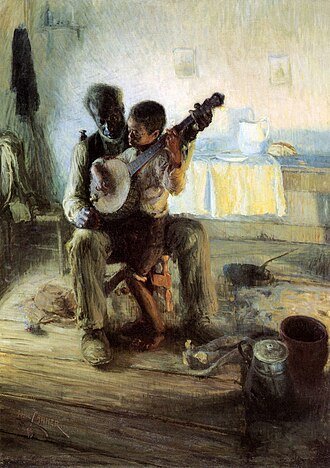
Painted around 1891 in Brittany during one of Tanner's first summers in France, this portrait of a sensual-looking woman is unsigned, so it is attributed to him by comparison with works from the following years. Its most notable feature is its handling of light: a side source illuminates the face while a lit background lifts the figure, a device Tanner also used in The Banjo Lesson. It is probably a study, and the sitter remains unidentified.

Henry Ossawa Tanner painted this work in 1897, during a trip to the Middle East, and it shows lions in a desert landscape. The canvas reflects the artist's fascination with the region he visited in those years, combining close observation of the animals with the bright, arid atmosphere of the desert.

Tanner painted this scene of the raising of Lazarus, told in the Gospel of John, at the moment the dead man opens his eyes before a stunned crowd. The two kneeling women beside Jesus, traditionally identified as Lazarus's sisters, convey the wonder and emotion of the instant through their gestures. Its success at the Paris Salon of 1897 and its purchase by the French state, an unusual honour for a foreign artist, advanced his career considerably.
Where to see the work
- Smithsonian American Art Museum Washington, D.C. · 3
- Philadelphia Museum of Art Philadelphia County · 1
- The Nelson-Atkins Museum of Art Kansas City · 1
- Pennsylvania Academy of the Fine Arts Philadelphia · 1
- Detroit Institute of Arts Detroit · 1
- Musée d'Orsay Paris · 1
Teachers and pupils
Studied with
- Jean-Paul Laurens 1838–1921
- Jean-Joseph Benjamin-Constant 1845–1902
Curiosities
A pioneering sister in medicine
One of Tanner's sisters, Halle Tanner Dillon Johnson, was the first woman to obtain a licence to practise medicine in Alabama. The family had a strong commitment to education and social struggle: his father, Benjamin Tucker Tanner, was a pastor of the African Methodist Episcopal Church and was friends with Frederick Douglass, whom he sometimes supported and sometimes criticised. His mother had been born enslaved in Virginia and escaped north along the Underground Railroad.
A name that recalls a battle
Tanner's middle name, Ossawa, commemorates the struggle at Osawatomie between pro-slavery and anti-slavery forces. The name reflected the family's commitment to the abolitionist cause. Tanner kept it throughout his life and career, and it appears in the signatures on his works and in records of his exhibitions.
A portrait painted by his teacher
Two decades after Tanner had been his student, Thomas Eakins painted a portrait of his former pupil. Eakins had been one of the first American artists to promote working from live models and anatomy classes, and Tanner was one of his favourite students. The portrait stands as evidence of a relationship that left a mark on both men and continued long after Tanner's years of training had ended.