
Jean-Paul Laurens
1838–1921 · French academic painter and illustrator
Jean-Paul Laurens (Fourquevaux, 1838 – Paris, 1921) was one of the last major exponents of French academic painting and history painting. A painter, sculptor and illustrator, he based his works on historical and religious subjects through which he voiced anti-clerical views and opposition to monarchy and clerical oppression. His technical mastery and erudition were much admired during the French Third Republic.
He trained at the fine arts school in Toulouse and, after winning a scholarship, moved to Paris, where he studied under Léon Cogniet and Alexandre Bida. His breakthrough came with Pope Formosus and Stephen VI (1870), shown at the Paris Salon. He was made a knight of the Legion of Honour in 1874, and his popularity grew after his showing at the 1878 Universal Exhibition in Paris. In 1891 he replaced Jean-Louis-Ernest Meissonier at the Académie des Beaux-Arts, and in 1893 he took over the direction of the Toulouse fine arts school.
The state commissioned him for many public works: his first was for the Paris City Hall, followed by a mural for the Palais de la Légion d'honneur and a series on the life of Saint Genevieve for the Panthéon. He also decorated the Odéon theatre and the Capitole in Toulouse. As an illustrator he was known for his drawings for Augustin Thierry's Récits des temps mérovingiens, and his designs were used by the Gobelins tapestry manufactory.
Some historians found his realistic technique and theatrical staging overly didactic, but his work has since been re-evaluated as an original renewal of history painting, a genre in decline during his lifetime. He co-founded the Société des artistes français, and several of his students, such as Arturo Michelena, built careers of their own. He died in his Paris studio in 1921.
Works (9)


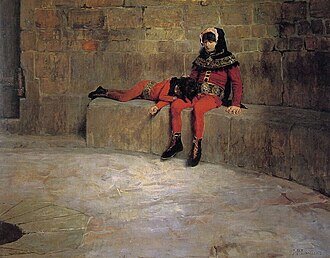


Painting by Jean-Paul Laurens, dated 1863 and executed in oil on canvas within academic art and history painting. It shows the suicide of Cato the Younger, a figure of late Roman Republican times, lying on his bed with a sword, at a moment of intense drama. The scene relies on a clear treatment of anatomy and a lighting that draws attention to the body of the protagonist.
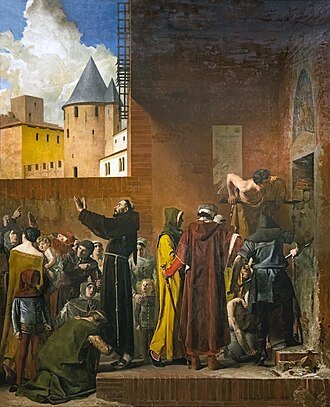
Academic history painting showing a large crowd before a wall in Carcassonne, where a walling-up is taking place. A monk stands among those present, giving the scene a religious tone. Little is known about the episode itself, so the canvas is best read as a collective narrative of a dramatic event.
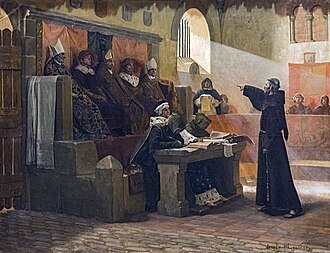

This canvas by Jean-Paul Laurens, dated 1870, depicts the so-called Cadaver Synod, a posthumous trial in which Pope Stephen VI put the corpse of his predecessor Formosus on trial. The scene shows an ecclesiastical court gathered around the body, and its sombre tone emphasises the macabre nature of the episode. Without further references, the work can be described as a history painting on a medieval subject, oil on canvas from 1870.
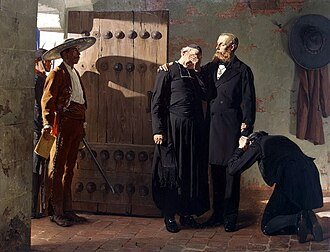
Where to see the work
- Musée des Augustins Toulouse · 3
- Musée d'Orsay Paris · 2
- Museum of Fine Arts of Lyon Lyon · 1
- Nantes Museum of Arts Nantes · 1
- Hermitage Museum Saint Petersburg · 1
Teachers and pupils
Studied with
- Léon Cogniet 1794–1880
- Alexandre Bida 1813–1895
Pupils
- Henri-Jean Guillaume Martin 1860–1943
- Thomas Hart Benton 1889–1975
- Arturo Michelena 1863–1898
- François Flameng 1856–1923
- Amélie Beaury-Saurel 1848–1924
- Henry Moret 1856–1913
- Edmund Dulac 1882–1953
- Kay Rasmus Nielsen 1886–1957
- Augusta Dohlmann 1847–1914
- Paul Albert Laurens 1870–1934
- Angèle Delasalle 1867–1941
- Jean-Pierre Laurens 1875–1932
- Jean Alexandru Steriadi 1880–1956
Curiosities
A commission from the Paris City Hall
His first state commission came from the Paris City Hall, and shortly afterwards he received a mural for the Palais de la Légion d'honneur, executed between 1874 and 1876. These early commissions opened the door to a long series of public works that made him one of the official painters of the Third Republic.