
Henry Scott Tuke
1858–1929 · English painter of the Newlyn School
Henry Scott Tuke (York, 1858 - Falmouth, 1929) was an English painter associated with the Newlyn School, best known for his paintings of nude boys and young men outdoors, on beaches and by the sea. His work is regarded as an early contribution to homoerotic imagery in British painting, and he is now considered one of the pioneers of gay culture. He was also an accomplished maritime painter, producing many watercolours of sailing ships, and he painted portraits of figures from his social and family circle. Born into a Quaker family, he trained at the Slade School of Art in London, then studied in Italy and in Paris under Jean-Paul Laurens, where he met John Singer Sargent.
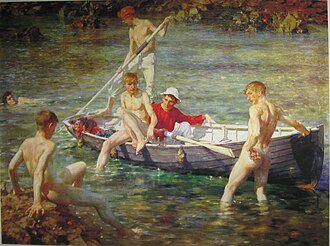
In 1883 he returned to Britain and settled briefly in Newlyn, but soon moved to Falmouth in Cornwall, where he remained until his death. There he painted local young fishermen and swimmers, who posed for him over many years, and he bought a fishing boat that he turned into a floating studio. His handling of paint was looser than that of his colleagues, with bright colour and a sensitive response to summer light. Works such as August Blue (1893) and Rubies, Gold and Malachite (1902) reflect his mature period, when he moved away from the mythological subjects of his early pictures. He became an Associate of the Royal Academy in 1900 and a Royal Academician in 1914.
His paintings of his models are now read as a record of a sensibility that was largely unseen in his own time, and his attention to natural light and the sea remains his most recognisable quality.
Works (9)



Oil on canvas dated 1903 by Henry Scott Tuke, in landscape format. Its title, Noonday Heat, suggests a summer scene in full daylight, although the available data do not allow us to specify its subject or context. The work is held by the Royal Cornwall Polytechnic Society.


Dated 1927 and painted on a fairly small scale, this work by Henry Scott Tuke carries the title The Critics. The available record offers no information about its scene, figures, or the circumstances in which it was made, so any reading of the subject would be speculative. It is held in the Royal Pump Rooms collection.
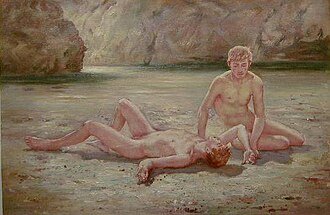
This entry corresponds to a work by Henry Scott Tuke, but the record gives no title, date or other details, so its composition, context and symbolism cannot be described with any reliability. A fuller record including the title and the circumstances of its creation would be needed to understand the work more precisely.
Where to see the work
- National Gallery London · 2
- Guildhall Art Gallery City of London · 1
- National Trust · 1
Teachers and pupils
Studied with
- Edward Poynter 1836–1919
- Jean-Paul Laurens 1838–1921
- Alphonse Legros 1837–1911
Curiosities
Interchangeable bodies
Tuke often swapped the heads and bodies of his models when painting, so in many canvases it is not possible to identify each figure exactly. His models were mostly local people from Falmouth, fishermen and swimmers, and some became close friends of the painter.
A boat turned into a studio
Tuke bought a fishing boat, the Julie of Nantes, for £40 and converted it into a floating studio and workspace. He often lived aboard boats, although his permanent base remained Pennance Cottage until his death, which helps explain his strong link with maritime scenes.
Models called to war
All of Tuke's regular models were called up during the First World War, and some did not return. Maurice Clift, who had posed for August Blue, was killed in France. His paintings thus preserve a portrait of a generation of young men that the war scattered or took away.