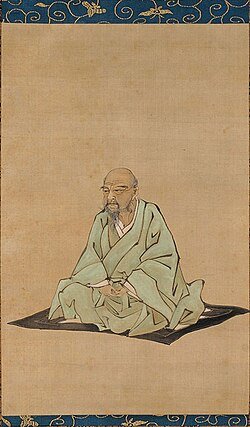
Itō Jakuchū
1716–1800 · Japanese painter of the Edo period, from Kyoto
Itō Jakuchū (Kyoto, 1716 – 1800) was a Japanese painter working in the mid-Edo period, when Japan kept its borders closed to the outside world. He is known for combining close observation of nature with an experimental approach to perspective and other devices that were unusual for his time, above all in his images of roosters, hens and other birds and animals.
He was the eldest son of a grocer and greengrocer in Kyoto, and he ran the family shop from his father's death in 1739 until 1755, when he handed it over to one of his brothers. His training drew on the Kano school, on the study of Japanese and Chinese paintings kept in Zen temples, and on direct observation of nature. Some sources suggest he may have studied with Ōoka Shunboku, an Osaka painter specialised in birds and flowers.
In his late thirties he built a studio on the west bank of the Kamo River, which he named Shin'en-kan. His friendship with the monk Daiten Kenjō gave him access to the temple of Shōkoku-ji and its collection of paintings, and it opened new artistic circles to him. He received commissions for folding screens and for panels for Buddhist temples and Shinto shrines, and he was once listed among the notable figures of the Heian Register. Although he was commercially successful, he is regarded as a bunjin, a literary intellectual who travelled with his fellow scholars and was shaped by their taste.
His major works include the Colorful Realm of Living Beings, twenty-seven hanging scrolls begun around 1757 and completed in 1765 as a personal offering to Shōkoku-ji, now held by the Museum of the Imperial Collections. Others include the Compendium of Vegetables and Insects and the screens Birds and Animals in a Flower Garden, built from a grid of tiny squares each coloured separately. His style reflects the influence of Shen Quan and Ogata Kōrin. Late in life he withdrew to Sekihō-ji, outside southern Kyoto, and kept painting until his death at eighty-five. His work, distinctive for its blend of realism and experiment, remains a landmark of Japanese art of his era.
Works (15)
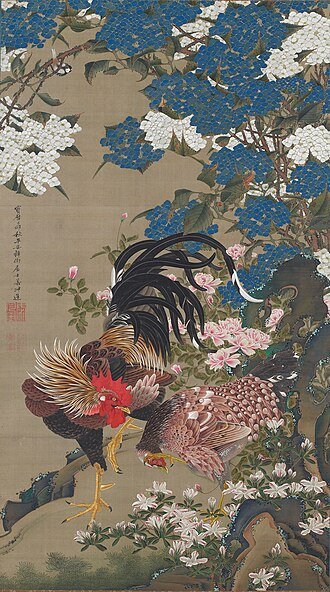
This 1759 work by Itō Jakuchū shows a rooster and a hen among hydrangeas. Its tall vertical format frames the birds, whose finely detailed plumage stands out against the foliage. Little is known about its commission, so its meaning should be read with caution.
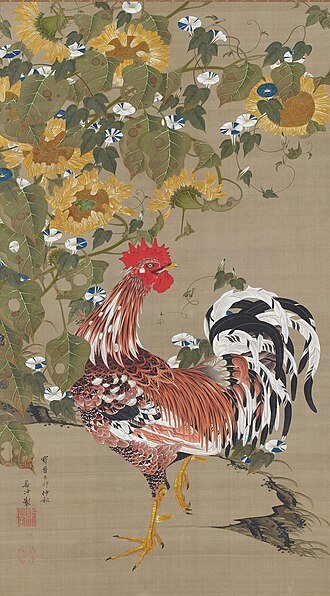
Painted by Itō Jakuchū in 1759, during Japan's Edo period, this work pairs a rooster with sunflowers. The bird's plumage and the flowers' forms invite close looking, while its tall, narrow proportions suggest a vertical composition, probably meant for display indoors.
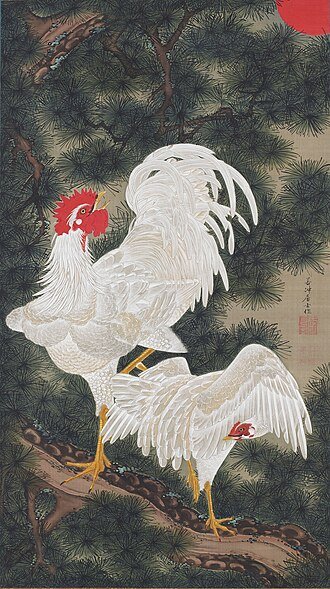
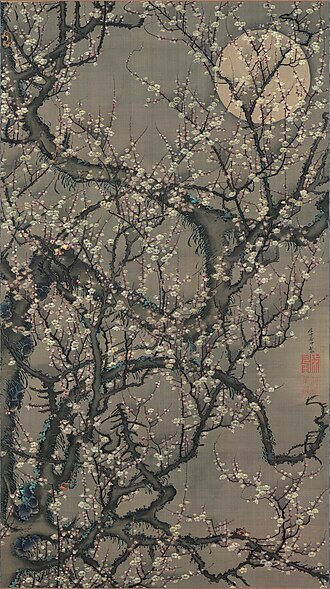
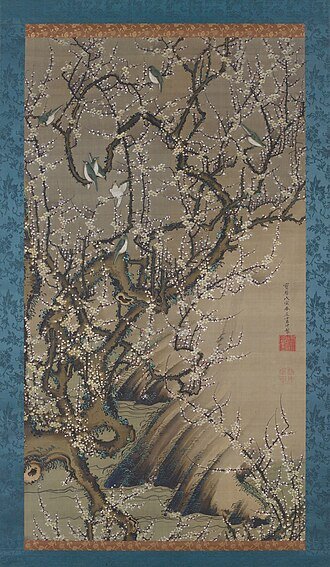
A work by Itō Jakuchū dated to around 1800, titled in English Blossoming plum under the moon. It is held in the Museum of the Imperial Collections. The record offers no further details about its commission, technique or context, so any reading of its composition, symbolism or reception should be treated cautiously. Its title places the scene under the moon, with a plum tree in bloom, a subject familiar in Japanese painting.
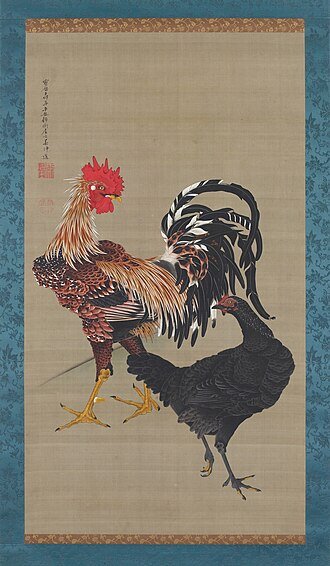
Painted by Itō Jakuchū in 1800, this work shows a rooster and a hen, two birds presented together within the scene. The available information does not specify the commission, technique or support, so any reading should stay with what the image itself reveals. The piece is held by the Museum of the Imperial Collections.
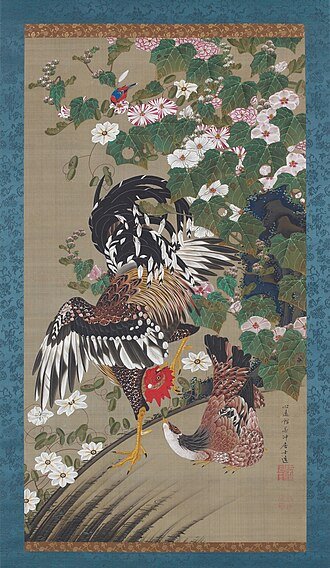
The work brings together rose mallow flowers (hibiscus mutabilis) and a hen, two motifs typical of the flower-and-bird painting tradition in Japan. It is dated 1800 and is held by the Museum of the Imperial Collections. No information is available about its commission, original setting or specific meaning, so any reading of the image should remain cautious.
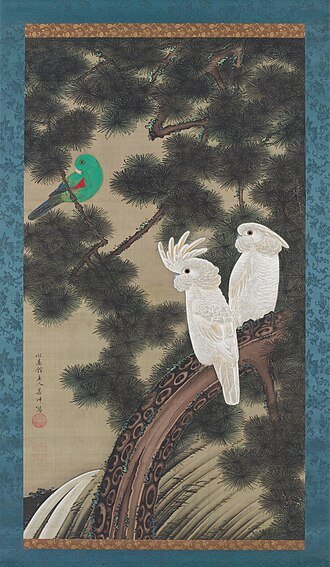
A work by the Japanese painter Itō Jakuchū, dated 1800, showing two cockatoos perched on an aged pine tree. Available records say little about its commission or technique, so the picture is best read through what it shows: the birds set against the rough bark and branches of the old tree. It is held by the Museum of the Imperial Collections.
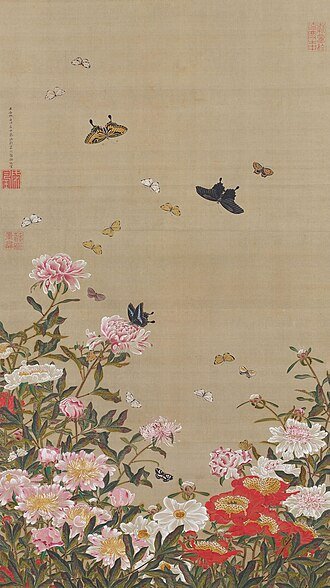
Painting by Itō Jakuchū dated 1758, bringing together herbaceous peonies and butterflies within a single composition. The title points to a scene of flora and fauna, a subject common in Japanese painting of flowers and birds. The available details do not specify its commission or technique, so this reading rests on the image and its theme.
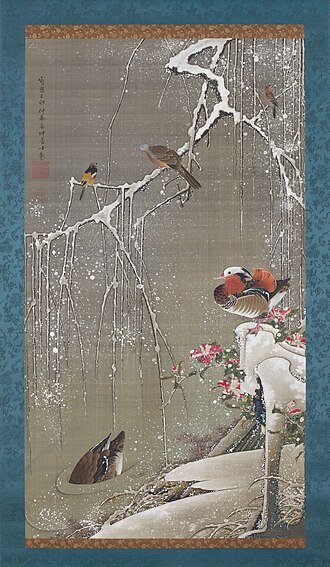
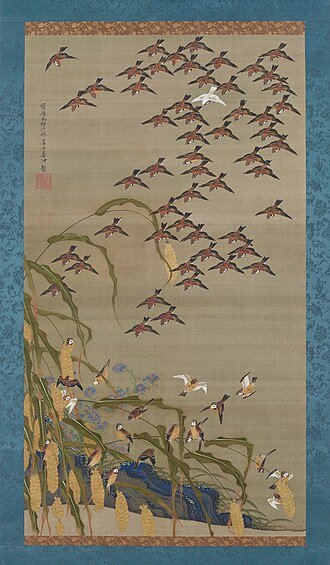
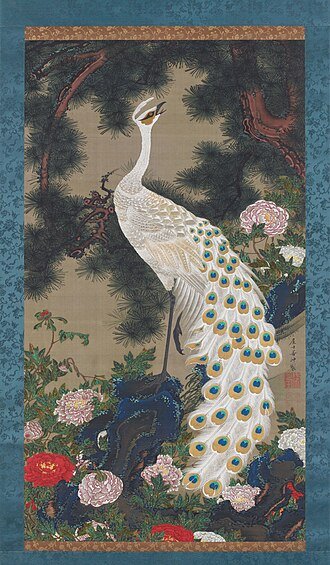
A work by Itō Jakuchū showing a white peacock beside peonies beneath a pine branch, with finely detailed treatment of the plumage and flowers. The record offers no further information about its commission or date, so it is best described without assigning a specific context. The main interest lies in the contrast between the bird's white plumage and the surrounding foliage, a device common in the bird-and-flower painting of his tradition.

Painting by Itō Jakuchū dated 1799 that depicts a dog. The vertical format is held by the Kyoto National Museum. The available information does not allow us to say for whom it was made or what commission lay behind it, so the best way to appreciate it is to look closely at how the artist renders the animal.
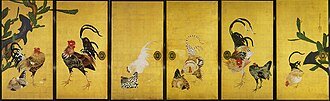
Cactus and Domestic Fowls is a painting by Itō Jakuchū, a Japanese artist of the Edo period. The scene brings together a cactus and several domestic birds arranged in a shallow, undefined space. With the information available, the date and the commission behind the work cannot be determined with certainty.
Where to see the work
- Museum of the Imperial Collections Tokyo · 12
- Kyoto National Museum Kyoto · 1
Teachers and pupils
Studied with
- Ōoka Shunboku 1680–1763
Curiosities
A screen built from squares
In Birds and Animals in a Flower Garden, Jakuchū divided the whole surface of the folding screens into a grid of squares, each about one centimetre across. Every square was coloured individually, and together these small units form the finished image. For this reason the work is considered one of the most modern pieces made in Japan during its period. It is now held by the Idemitsu Museum of Arts.
A borrowed Chinese technique
In some works he used a method called taku hanga, which uses wooden blocks to imitate Chinese ink rubbings taken from inscribed stone slabs. He used it for the scroll Pleasures Improvised on a Boat, which shows himself together with his mentor Daiten Kenjō. The background is black, while the inscriptions and the artist's details appear in greys and whites. The scroll is held by the Metropolitan Museum of Art in New York.