Jean-Baptiste Le Paon
1738–1785 · French battle-scene painter
Jean-Baptiste Le Paon (1736 or 1738 – 1785) was a French painter who had first worked as a military man before turning to art. He is remembered chiefly for his battle scenes, a genre he learned through his uncle, who arranged for him to study with the Venetian painter Francesco Casanova, a specialist in the same kind of compositions.
He later became principal painter to Louis Joseph, Prince of Condé, a military hero of his time. For the prince he decorated the Palais Bourbon, which the royal family had purchased, with battle scenes. His work in recording military events brought him recognition among the French nobility.
His best-known work outside France is Lafayette at Yorktown, dating from about 1783 to 1785, which depicts the Marquis de Lafayette during the American War of Independence. This painting served as the basis for the Lafayette Memorial in Prospect Park, Brooklyn, New York City, and today it belongs to the permanent collection of Lafayette College in Easton, Pennsylvania. Another notable piece is The Prince of Nassau Hunting a Jaguar, from 1784, showing the prince and the Chevalier d'Oraison confronting a jaguar on the coast of Argentina.
His legacy rests mainly on late eighteenth-century battle painting and on the visual memory of the American War of Independence, since his canvases served as the basis for later public tributes.
Works (2)
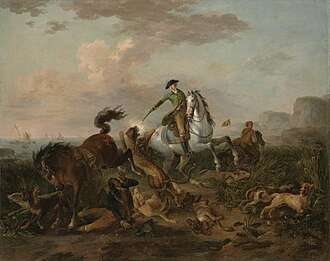
Oil on canvas painted in 1784 by Jean-Baptiste Le Paon, classed as history painting. It shows a Prince of Nassau in the middle of hunting a jaguar, a subject the title places within the setting of exotic hunting. The work is held at the Łazienki Palace, where it can be seen today.
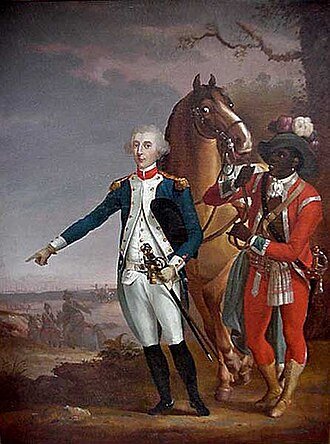
This painting shows the Marquis de Lafayette at the 1781 siege of Yorktown, the last major battle of the American Revolutionary War. Beside him stands a Black groom, whom several historians identify as James Armistead, who worked for the Continental Army as a double agent under the Marquis. Dated to around 1783–1785, the work served as the basis for the Lafayette Memorial in Prospect Park, Brooklyn, whose creation was funded by a bequest.
Where to see the work
- Łazienki Palace Warsaw · 1