
Jerzy Siemiginowski-Eleuter (born Jerzy Szymonowicz; c. 1660 – c. 1711) was a Polish Baroque painter and engraver, court painter to King John III Sobieski and a noble of the Polish–Lithuanian Commonwealth. He is regarded as one of the most accomplished painters of the Classical Baroque in Poland, and his work blends a classical approach with local elements. He was born in Lwów (Lviv, now in Ukraine) to the painter Jerzy Szymonowicz and Teodozja Korunka.
In 1677 his parents entrusted him to King John III Sobieski, who sent him to train abroad. He probably spent at least a year, and possibly two, in Paris before reaching Rome. In Rome he studied under Lazzaro Baldi, Luigi Garzi and Carlo Maratta, and in 1682 he won a contest at the Accademia di San Luca with two drawings, The Construction of the Tower of Babel and God's Anger at the Building of the Tower. During his stay he received the Knighthood of the Golden Spur and the title Eques Auratus from Pope Innocent XI, and he came under the protection of the Pope's nephew Livio Odescalchi.
After returning to Poland in 1684 he was ennobled by the king, who in 1687 granted him the village of Łuka near Złoczów to confirm his nobility. After John III's death he served as secretary to Augustus II the Strong and as court painter to Aleksander Benedykt Sobieski. In this period he worked at Wilanów, the Sobieski suburban palace, where he supervised the construction of new palace wings. In 1701 he was adopted by the impoverished Siemiginowski noble family, and from then on he used their name. He married four times and had eleven children.
His painting is strongly shaped by French Baroque artists. His ceilings recall those of Charles Le Brun, notably the decoration of the Pavillon de l'Aurore at Sceaux, and echoes of Carlo Maratta and Nicolas Poussin are also visible. He painted portraits of the royal family and made engravings, partly in collaboration with Charles de La Haye. He was the chief artist responsible for much of the interior decoration of Wilanów Palace, where four ceiling paintings of the seasons stand out. His murals are notable for their vivid color and range from dramatic scenes to peaceful landscapes. He founded a school of painting at Wilanów and took part in the design of the town hall in Żółkiew.
His legacy is diminished by the loss of many of his religious paintings in Warsaw, destroyed during the German bombardment of 1944, among them a Crucifixion in the Church of the Holy Cross and a Transfiguration in the Capuchin Church. He is now studied as one of the leading representatives of Polish Classical Baroque painting.
Works (1)
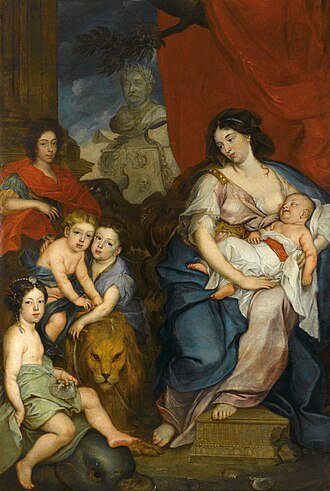
Oil-on-canvas genre portrait painted in 1684 by Jerzy Siemiginowski-Eleuter, showing Maria Casimira Louise de la Grange d'Arquien, whom the title calls queen, together with her children. The work is held at the Palace Museum in Wilanów. The available information does not clarify its commission, composition or symbolism further.
Where to see the work
- Palace Museum in Wilanów Warsaw · 1