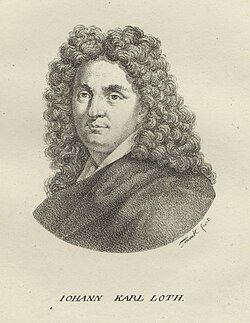
Johann Carl Loth (born in Munich, 1632; died in Venice, 1698) was a German Baroque painter who spent most of his working life in Venice. He was the son and pupil of Johann Ulrich Loth, trained further in Rome, and by around 1663 had settled in Venice, where he worked alongside Pietro Liberi. He is best known for crowded religious and mythological scenes with large-scale figures, showing contact with Venetian tenebrist painters, as seen in his Death of St Andrew Avellino, painted in 1677 for the Theatine church in Munich.
He produced religious works for San Silvestro in Venice in 1681. His reputation brought him a commission in 1692 to paint Emperor Leopold in Vienna, earning him the title of court painter. He had many pupils, among them Johann Michael Rottmayr, Paul Strudel and Daniel Seiter, whose work spread his style across southern Germany. Most of his paintings survive in collections in Germany and Italy.
Works (4)
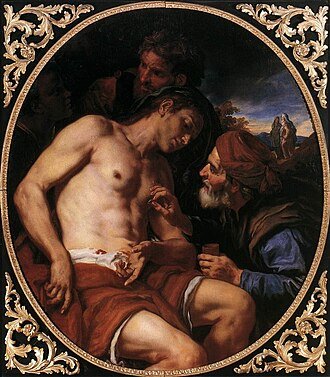
Dated 1676, this oil on canvas by Johann Carl Loth takes its theme from the parable of the Good Samaritan, a passage in the Gospel of Luke about helping a wounded stranger left by the roadside. The title points to compassion as the central idea of the scene, though little is known about its composition or original commission.
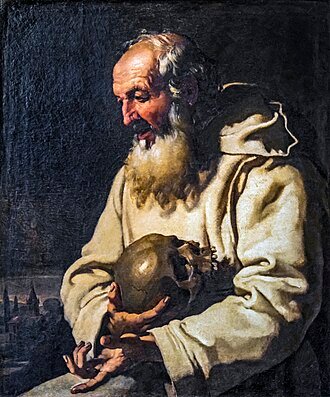
Oil on canvas by Johann Carl Loth depicting Saint Romuald, held at the Gallery of the Academy in Venice. With no further references available, the date of execution, any commission, and details of the composition cannot be determined. What can be noted is the use of oil on canvas, a technique widely used in European painting.
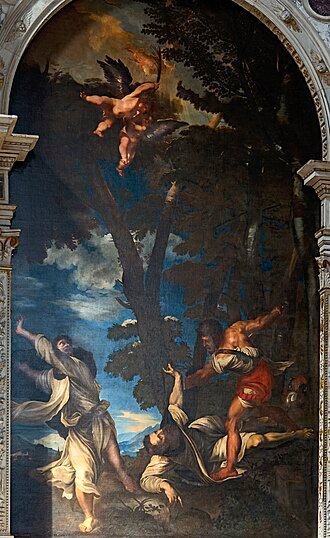
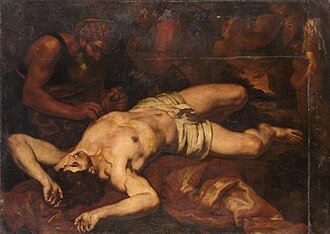
Oil on a large canvas dated 1691 by Johann Carl Loth, showing the martyrdom of Saint Peter of Verona at the hands of Carino of Balsamo. The painting focuses on the killing itself, treated as a moment of religious violence. Its monumental scale, nearly five metres tall, underlines the solemnity of the scene within a sacred setting.
Where to see the work
- Schloss Weißenstein Pommersfelden · 1
- Kunsthistorisches Museum Vienna · 1
- Gallerie dell'Accademia Venice · 1
- Santi Giovanni e Paolo Venice · 1
Teachers and pupils
Studied with
- Pietro Liberi 1605–1687
Curiosities
One of three Karels
According to the biographer Arnold Houbraken, Loth was one of three great masters of art named Karel or Carl. The other two were Karel Dujardin and Karel Marat, usually called Carlo Maratta. The anecdote reflects the fame Loth enjoyed among his contemporaries, although the classification rests on a single testimony.
A painting recovered after eighty years
In 2023, a Loth painting looted by the Nazis was found after a search of more than eighty years by the family of Jewish Czech industrialist Johann Bloch. Changes in the title and attribution made the search particularly difficult. Another work, Isaac Blessing Jacob, is on long-term loan to the Skirball Cultural Center in Los Angeles after being reclaimed by the same family.