
John Constable
1776–1837 · English landscape painter, renovator of Romantic landscape
John Constable (East Bergholt, Suffolk, 1776 - London, 1837) was an English landscape painter working in the Romantic tradition. He is best known for reshaping the genre with his views of the Stour valley, on the border of Suffolk and Essex, an area now called "Constable Country". His work is among the most valued in British art today, yet he earned little from it during his lifetime, and he found more success in France than in England.
Childhood and first years
The second son of Golding Constable, a prosperous miller and corn merchant, and Ann Constable, John was expected to join the family business, since his elder brother had an intellectual disability. He was largely self-taught and began drawing as a boy in his village under the influence of John Dunthorne. In 1799, with the backing of an early patron, he persuaded his father to let him pursue painting and study at the Royal Academy in London.
Masters and early works
During these years he admired Gainsborough, Reynolds, Claude Lorrain, Rubens, Annibale Carracci and Ruisdael. In 1802 he first exhibited at the Royal Academy and, in a letter to Dunthorne, declared his resolve to become a professional landscape painter. To earn a living he painted portraits, copies of old masters and religious pictures, though the last were not his strength. His early style, with its freshness of light and colour, already shows the compositional influence of Claude Lorrain. His everyday subjects, however, were out of fashion in an age that preferred ruins and wild scenery.
Working outdoors
Constable painted from nature and is regarded as one of the first to make oil sketches directly outdoors. His large sketches, with free and vigorous brushwork, were revolutionary in their time and still attract interest. He was especially concerned with light and clouds, which he recorded with the hour and the weather, convinced that the sky was the key note of a landscape.
Marriage and the "six-footers"
His childhood sweetheart, Maria Bicknell, married him in 1816 after years of opposition from her family. That year he began Flatford Mill, a large canvas that found no buyer but drew praise. In 1819 he sold The White Horse to his friend John Fisher, which gave him a financial freedom he had never known. That work led to a series of six monumental paintings of the River Stour, the "six-footers", including Stratford Mill and The Hay Wain of 1821, his most famous picture. The Hay Wain found no buyer in London but sold in Paris and won a gold medal at the Salon.
Reception in France
Constable's work impressed Géricault and Delacroix, who saw it in London, and its influence reached the Barbizon School. Delacroix noted in his journal what he had learned from the green of Constable's meadows. Although he sold little in England, in France he sold more than twenty paintings within a few years.
Brighton and the death of Maria
Between 1824 and 1828 the family lived in Brighton, seeking sea air for Maria, who had tuberculosis. Constable then painted coastal scenes and studies of clouds and sea, in a looser and gloomier style. Maria died in 1828 after the birth of their seventh child, and Constable was left to raise the children alone. In those years his speculation on engravings of his landscapes, financed with his late wife's inheritance, ended in financial loss.
Final years and legacy
He was elected to the Royal Academy in 1829. He lectured on the history of landscape and argued that landscape painting is both scientific and poetic. He died in 1837 and was buried at Hampstead beside Maria. His view of landscape as something lived rather than neutrally copied influenced the Barbizon painters and, through them, Impressionism.
Works (82)


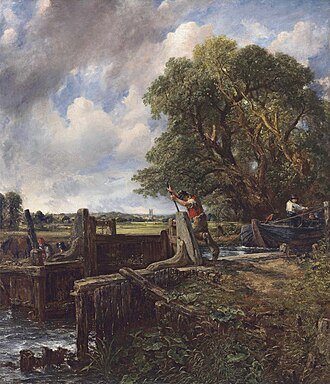


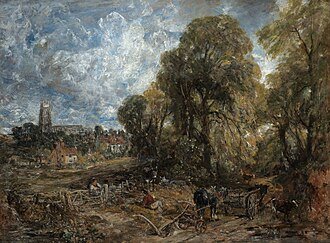


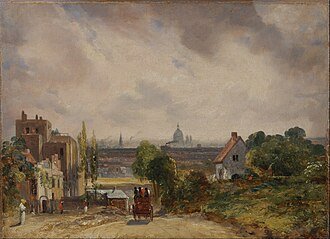


Constable painted this view in 1820, showing Salisbury Cathedral across the River Avon, its Gothic spire rising above the landscape. The title also names Leadenhall, placing it alongside the cathedral in the scene. The oil on canvas is now held at the National Gallery in London.

Landscape by John Constable, painted in 1833 in oil on canvas. It shows a modest cottage in the rural surroundings of East Bergholt, beneath a broad sky where a rainbow appears. Rather than a grand scene, it is an everyday view that invites the viewer to focus on the sky and the shifting light.

Landscape painting by John Constable dated 1828, made in oil on canvas, centred on the ruins of Hadleigh Castle. Its title identifies it as a sketch, suggesting a preparatory study or a looser work than a finished picture. The painting is held by the National Gallery in London.

Oil on canvas by John Constable, dated 1825, showing Salisbury Cathedral seen from a garden. A tree stands in the foreground, with a cow and a couple included in the scene, where the great Gothic building blends into a rural landscape. The composition feels calm and unforced.


This seascape shows Weymouth Bay on the English Channel under a cloud-filled sky that promises a storm. A cliff and a rock frame the coast, while sea foam breaks over the beach and a small boat stands out on the water. A lone figure among the rocks gives the scene a sense of scale.

This 1809 oil on canvas by John Constable shows Malvern Hall in Warwickshire, set within open countryside. It belongs to the landscape genre. The available record offers no further information about its commission or reception, so it is best seen as a direct record of the painter's attention to the place around him.

Oil on canvas from 1828 by John Constable, now in the Cleveland Museum of Art. The title places the scene at Branch Hill Pond in Hampstead, an area on the edge of London, although its subject classification points to a mountain, so the motif should be read with caution. Without further documentation, its commission and reception cannot be established precisely.

A small oil landscape in which Constable turns his gaze toward the horizon of Harrow, seen from the grounds of Hampstead Heath, north of London. The work is dated 1821. The record offers no further details about its commission or reception, so it is best to stay with what is visible: an open view of land and sky, painted with quick brushwork attentive to shifting light.

Small oil study on paper dated 1824 by John Constable, within the landscape genre. Its modest size and support suggest it was probably a sketch made from life, rather than a finished composition, with the Brighton coast as its subject. The work is held at the Victoria and Albert Museum.

Portrait of the painter's sisters, Anne and Mary Constable, made by John Constable in 1818. The work is now held by the Huntington Library. The available information does not establish more about its commission or composition, so it is best read as a record of the artist's close family ties.


Cloud study painted by John Constable in 1822, in oil, now held at Tate Britain. Constable studied the sky outdoors and recorded its conditions with care; in works like this, the sky stops being a mere backdrop and becomes the main subject. The picture reflects his interest in capturing the movement and shifting light of clouds rather than building a narrative scene.

This 1825 oil on canvas by John Constable is a full-scale study of a leaping horse. It is classed as both a genre scene and a landscape painting, though the record does not specify its original purpose. Its interest lies in the close observation of the animal's movement and in the large-scale treatment of a single figure.

Study of cirrus clouds painted by John Constable in 1822, using oil on paper on a small sheet. The work records fleeting cloud formations with quick brushwork and delicate tones, reflecting the artist's direct observation of the sky. It is best understood as a working sketch rather than a finished composition.
Where to see the work
- Tate London · 14
- National Gallery London · 12
- Victoria and Albert Museum Royal Borough of Kensington and Chelsea · 9
- Yale Center for British Art New Haven · 6
- Royal Academy of Arts London · 3
- The Huntington Library, Art Museum, and Botanical Gardens San Marino · 3
- Philadelphia Museum of Art Philadelphia County · 3
- Clark Art Institute Massachusetts · 3
- Victoria and Albert Museum · 2
- Museum of Fine Arts Boston Boston · 2
- Ipswich Museum Ipswich · 2
- Cleveland Museum of Art Cleveland · 2
- Galería Nacional de Arte Washington, D.C. · 1
- National Galleries Scotland City of Edinburgh · 1
- The Frick Collection New York City · 1
- Cincinnati Art Museum Cincinnati · 1
- Art Institute of Chicago Chicago · 1
- National Gallery of Victoria City of Melbourne · 1
- Toledo Museum of Art Toledo · 1
- Corcoran Gallery of Art Washington, D.C. · 1
Curiosities
Two drawings found in 2019
In 2019 two drawings by Constable were found among the possessions of the late playwright and poet Christopher Fry. The drawings later sold at auction for £60,000 and £32,000. The discovery shows that works by him still turn up outside public collections.
Painting without pictures in mind
According to Leslie, when Constable sketched from nature, the first thing he tried to do was forget that he had ever seen a picture. The attitude reflected his rejection of composing from imagination and from other paintings, against the academic practice of his day.