
Jost Amman (baptised in Zürich on June 13, 1539 – died in Nuremberg on March 17, 1591) was a Swiss-born artist, known chiefly for his woodcuts made mainly as book illustrations. The son of a professor of classics and logic, he was well educated. He moved to Nuremberg in 1560, where he took citizenship and lived until his death. There he first worked with Virgil Solis, then a leading producer of book illustrations. His significance lies largely in his output: about 1,500 prints are attributed to him. He was one of the last major producers of woodcuts for books, at a time when engraving was gradually taking over that role.
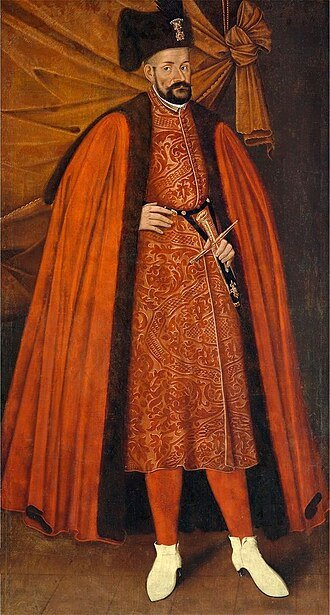
Although he usually left the cutting of the block to a specialist formschneider, some of his signatures include a cutter's knife and a quill pen, suggesting that he sometimes cut his own blocks. Among his best-known series are engravings of the kings of France, each with a short biography, published in Frankfurt in 1576, and the woodcuts for a Bible printed in Frankfurt by Sigismund Feierabend. Another valuable work is the Panoplia Omnium Liberalium Mechanicarum et Sedentariarum Artium Genera Continens, with 115 plates. His drawings are meticulous and precise, especially in costume. The record also lists an engraving of the Russian embassy (1576) and a portrait of Stephen Bathory (1585). His legacy lies in the documentary value of his prints of trades and clothing of his time.
Works (2)

An engraving by Jost Amman dated 1576 depicting a Russian embassy. The record offers no further details about the scene or its participants, so the image should be read with caution. As a late sixteenth-century print, it reflects the European interest of the period in distant peoples and courts.
Where to see the work
- Royal Castle in Warsaw Warsaw · 1
Teachers and pupils
Studied with
- Virgil Solis 1514–1562
Curiosities
A hay wagon
According to a statement by one of the pupils in his workshop, the drawings Amman made over a period of four years would have filled a hay wagon. The anecdote gives a sense of how productive his Nuremberg studio was. Since it comes from an indirect testimony, it should be read as a vivid account rather than an exact measure, but it is often cited to show the intensity of his work as a book illustrator.
A knife and a quill in the signature
Some of his prints include in the signature a cutter's knife and a bird's quill pen. This detail suggests that Amman sometimes cut his own blocks, although he normally delegated that task to a specialist. Historians treat it as a sign rather than conclusive proof that he also mastered the technical craft of woodcutting.
Unidentified paintings
Oil paintings and works on glass are attributed to him, yet none of them has been identified with certainty. His reputation therefore rests almost entirely on his prints and drawings. This uncertainty is striking for an artist so prolific, and it leaves his work as a painter an open question for specialists.