Kanō Masanobu
1434–1530 · Japanese painter of the Ashikaga shogunate, considered founder of the Kanō school
Kanō Masanobu (c. 1434–c. 1530) was a Japanese painter active in Kyoto, generally considered the founder of the Kanō school, one of the longest-lasting painting traditions in Japan. He served the Ashikaga shogunate as chief painter, holding the post of official painter (goyō eshi), and he is the first of the professional artists in his family. His father, Kanō Kagenobu, was a samurai and an amateur artist.
His training is largely attributed to the priest-painter Tenshō Shūbun, although some sources suggest that he received most of his artistic education under him. Masanobu worked in the suiboku ink-and-wash style, derived from Chinese painting, but gave it a Japanese character through more defined forms. He specialized in Zen painting and in elaborate images of Buddhist deities and bodhisattvas. Very few of his works survive; the best-known exception is «Zhou Maoshu Appreciating Lotuses», dated 1500.
He did not hold a court rank, since his family was provincial, and his appointment came from a mix of achievement and social connections. This drew criticism: the aristocrat Shūzan Tōki scorned him as not a «born court painter». He succeeded Ten-Ō Sōtan in the post.
His legacy is more complicated than his name suggests. The Kanō school remained the dominant painting style for more than four centuries, until the Meiji Restoration in 1868, but its distinctive style is linked more closely to his son Kanō Motonobu, who took over as head of the school after him. Masanobu laid the foundations of a dynasty that shaped much of later Japanese painting.
Works (1)
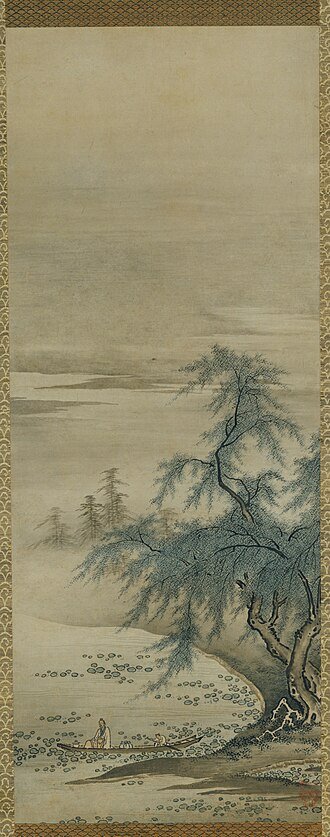
The painting shows Zhou Dunyi gazing at lotus flowers, a subject that gives the scene its focus. It is attributed to the painter Kanō Masanobu and dated 1500. Its tall, narrow vertical format measures about 84 by 33 centimetres. Without documented details about its commission, it is best to focus on the figure and the composition.
Teachers and pupils
Studied with
- Tenshō Shūbun 1414–1463
- Ten-Ō Sōtan 1413–1481