
Lawrence Alma-Tadema
1836–1912 · Dutch painter of Classical subjects, Victorian era
Lourens Alma Tadema (Dronryp, 8 January 1836 - Wiesbaden, 25 June 1912), known in England as Lawrence Alma-Tadema, was a Dutch painter who settled in London in 1870 and later became a British subject. He was one of the most popular painters of the Victorian era. He is remembered above all for his scenes of Greek, Roman and Egyptian antiquity, with elegant figures, marble interiors and dazzling Mediterranean skies. His importance lies in the care with which he reconstructed the ancient world and in the influence he had on later painters and on the cinema.
Childhood and training in Antwerp
He was born in Dronryp, a village in Friesland, the son of a notary who died when Lourens was only four. His family expected him to study law, but after a serious physical and mental breakdown as a teenager he spent his time drawing and painting and decided to become an artist. In 1852 he entered the Royal Academy of Antwerp, where he studied early Dutch and Flemish art under Gustaf Wappers. Before leaving the academy he worked as assistant to the professor Louis de Taeye, whose courses in history and historical costume had impressed him. De Taeye passed on his interest in ancient civilisations and encouraged historical accuracy, a trait for which Alma-Tadema later became known. He then moved to the studio of Jan August Hendrik Leys, one of the most respected in Belgium, and helped him with the wall paintings of the Antwerp city hall.
First successes and the Merovingian series
His first major success was The Education of the Children of Clovis (1861), shown in Antwerp. Leys criticised his treatment of marble, which he compared to cheese, and this remark pushed Alma-Tadema to improve his technique with stone and reflective materials, which became one of his signatures. In the years that followed he worked on Merovingian subjects, his favourites up to the mid-1860s. Within that series, Fredegonda (1878) shows a woman watching a wedding from behind a curtain, a scene with a more romantic tone than much of his output. Merovingian themes had little international appeal, however, and Alma-Tadema, who had been working independently since 1862, turned to subjects with a wider market.
Egypt, Greece and Rome
In September 1863 he married Marie-Pauline Gressin-Dumoulin de Boisgirard in Antwerp, and their honeymoon in Florence, Rome, Naples and Pompeii proved decisive. In Pompeii he met the Italian painter Geremia Discanno, who was copying the frescoes uncovered in the excavations, and he consulted him several times to make his scenes of ancient daily life accurate. From then on his work focused almost entirely on antiquity. He produced an Egyptian series, with works such as Egyptians 3,000 Years Ago (1863) and The Death of the Pharaoh's Firstborn Son (1872), and a Greco-Roman one, including Phidias Showing the Frieze of the Parthenon to His Friends (1868) and Escena pompeyana (1868). In 1864 the dealer Ernest Gambart, the most influential of the period, commissioned twenty-four pictures from him, which gave him financial stability.
Career in England
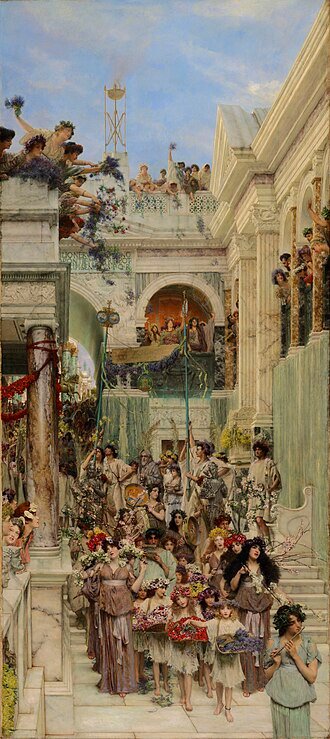
After the death of his first wife in 1869 and the outbreak of the Franco-Prussian War, Alma-Tadema decided to settle in London, where his pictures had already found buyers. In 1871 he married Laura Epps, who was seventeen when he met her and who appears in several of his canvases, such as The Women of Amphissa (1887). In 1873 Queen Victoria granted him and his wife the status of British denizens, and in 1879 he became a member of the Royal Academy. His success reached a peak: a major retrospective was held at the Grosvenor Gallery in 1882, and he was knighted in 1899. The most famous work of this period is The Roses of Heliogabalus (1888), based on the debauched Roman emperor, for which the flowers were sent to his London studio from the French Riviera over several months. Other key works include An Earthly Paradise (1891), Spring (1894) and Preparation in the Coliseum (1912), his last major composition. He also painted portraits, watercolours and made some etchings.
Style and technique
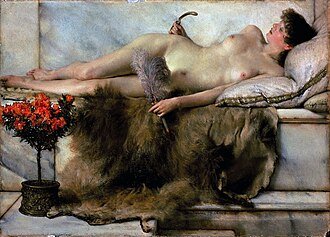
His paintings are remarkable for the precise depiction of flowers, textures and reflective materials such as metal, pottery and, above all, marble. Alma-Tadema relied on books, on objects from museums such as the British Museum, and on a large archive of photographs of Italian sites to achieve an unusual archaeological exactness. He was a perfectionist who reworked his pictures until he was satisfied, and he was very careful in the preparation of his sketches. His bright colours, handled with delicacy, contrast with scenes that often have a playful or sensual tone, with men and women on marble terraces overlooking the sea. His rigour was admired, though some critics accused him of pedantry. He drew on the old Dutch masters for his craft and for his handling of light.
Legacy and rediscovery
After his death in Wiesbaden he was buried in the crypt of St Paul's Cathedral in London. His reputation fell sharply with the rise of twentieth-century modernism, and for decades critics dismissed him. Since the 1960s, however, his work has been reassessed as an important part of Victorian painting and of nineteenth-century classical-subject painting. His influence can be seen in painters such as Gustav Klimt and Fernand Khnopff, who used classical motifs and similar compositional devices. His reconstructions of Rome also served as models for film directors, and his work remains a key reference for the interest in everyday life in the ancient world.
Works (38)







Pompeian Scene is an 1868 oil on canvas by Lawrence Alma-Tadema, a British painter of ancient subjects. The arrangement gathers Greek vases, a rhyton, an aulos and a sculpture reminiscent of the Venus de' Medici, objects that suggest a classically inspired interior. Its wide format and frieze-like look invite viewers to follow the scene from left to right.

Oil on canvas from 1872 by Lawrence Alma-Tadema, held in the Rijksmuseum. It belongs to religious art and relates to the Ten Plagues of Egypt; its title points to the last of them, the death of Pharaoh's firstborn son. The available information does not allow us to say more about its commission or reception.


Alma-Tadema is known for painting scenes of ancient Rome with careful attention to architecture and domestic settings. The title points to a reception at the house of Agrippa, a figure from the Roman world, with people waiting for an audience. It is a relatively small oil on canvas, now held by The Dick Institute.

History painting from 1883, oil on panel by Lawrence Alma-Tadema, in the Academic and Orientalist styles. The scene gathers motifs linked to ancient Egypt: a throne, an Egyptian hieroglyph, a barge with oars and a flute player beside a slave. Seated figures and frankincense also appear, adding atmosphere.
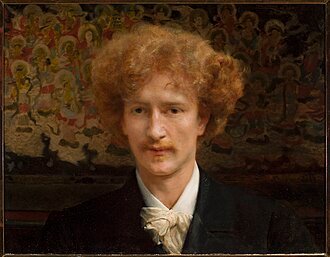
Portrait of Ignacy Jan Paderewski, painted in 1890 by Lawrence Alma-Tadema in oil on canvas. The sitter, who lived from 1860 to 1941, is presented in a portrait format that focuses attention on his figure. The work is held by the National Museum in Warsaw.

Painted by Lawrence Alma-Tadema in 1863, the work is titled Egyptians 3,000 Years Ago, pointing to a scene set in ancient Egypt. Beyond what the title suggests, little can be said with certainty about its figures, composition or the artist's intentions. It is now held by the Auckland Art Gallery in New Zealand.

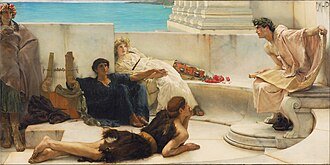
Lawrence Alma-Tadema painted this 1862 scene showing the poet Venantius Fortunatus reading his verses to Radegonda and an abbess in the monastery of Poitiers. Reading is the focus of the oil on canvas, now held by the Dordrecht Museum. Few further details are available, so the work is best approached as a painted reconstruction of that encounter rather than a documented record.

Oil on panel painted in 1879 by Lawrence Alma-Tadema and held at the National Gallery in London. The composition brings together a staircase, a statue and a figure identified as Marcus Vipsanius Agrippa, a personality of ancient Rome. With the information available, we can only describe these elements, without establishing the exact narrative context of the scene.
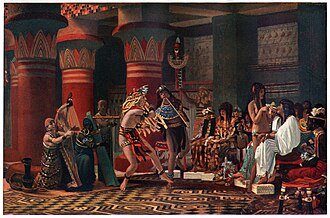


Oil on panel, dated 1870, by Lawrence Alma-Tadema, whose title identifies the subject as a juggler. The vertical format focuses attention on this act of skill, though the available information does not clarify the specific scene, its setting, or its commission. The work is held at the Art Gallery of New South Wales.

Painting by Lawrence Alma-Tadema dated 1895, executed in oil on canvas and classed as a genre scene and history painting. Its title, A Coign of Vantage, refers to a favourable vantage point from which the scene is observed. Without reference sources available, the episode depicted and the original commission cannot be confirmed, so attention is best directed to the composition and the handling of light.

Lawrence Alma-Tadema sets this scene in ancient Rome during Agrippa's time, showing figures pausing among marble sculptures. The picture rests on careful attention to space, materials and light. Rather than depicting a specific event, it evokes an atmosphere of contemplating classical art.
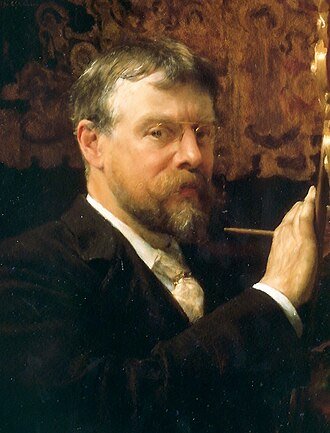
Self-portrait by Lawrence Alma-Tadema, painted in 1896 in oil on canvas. It is held at the Uffizi Gallery in Florence, which includes it among its collection of artists' self-portraits. The painter appears half-length, with a direct gaze that conveys seriousness and a certain reserve. Without further sources, it is best to stick to what is visible: a studio-style portrait centred on the artist's face, where attention rests on his presence rather than on a narrative background.

Painted in 1861 by Lawrence Alma-Tadema, this oil on canvas is titled Education of the Children of Clovis, referring to the Frankish king. The available record offers no further detail about the scene, its commission or its original setting, so the specific moment shown and the painter's intent remain uncertain. Its modest size points to an intimate piece rather than a large history painting.

This genre scene by Lawrence Alma-Tadema, dated 1879 and painted in oil on canvas, shows two players seated before a chessboard in an setting inspired by ancient Egypt. The composition is compact and small in format, and its interest lies mainly in the careful attention to objects and costume, which place the scene in an antique world imagined by the artist.

This canvas shows a group gathered for a grape-harvest celebration, dressed in garments inspired by classical antiquity. Alma-Tadema, known for historical subjects, rendered the festive atmosphere with careful attention to detail. Dated 1871 and painted in oil on canvas, the work is held at the Hamburg Kunsthalle.


This small panel from 1874, painted in oil by Lawrence Alma-Tadema, takes its title from Joseph, overseer of Pharaoh's granaries, a figure from the Old Testament. It is classed as a genre scene, so the emphasis falls on everyday setting rather than on the religious narrative.

This scene of a Roman workshop shows a sculptor and his assistants at work in a room lit by a large opening, surrounded by busts, statues and fragments of marble. Alma-Tadema, a Dutch-born painter of ancient subjects, attends carefully to materials, light and everyday objects, so the picture works as a detailed reconstruction of a classical working environment.

A small oil-on-panel work dated 1870 and attributed to Lawrence Alma-Tadema. Its title, A Roman Amateur, suggests a scene from classical antiquity centred on a figure who pursues something out of passion rather than profession. Its modest scale invites close looking. No further documentation is available, so its precise subject and original commission cannot be confirmed.


Painted in 1866, the picture shows the Latin poet Tibullus before the house of Delia, the beloved of his elegies, set in an antique world reconstructed with great care. The scene invites us to imagine the poet waiting or yearning, linking the figure to the tradition of Latin love poetry. The work is held at the Museum of Fine Arts, Boston.
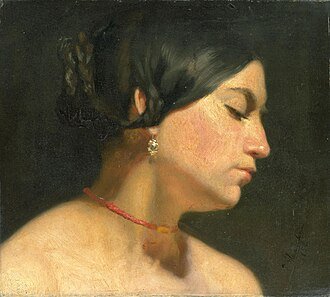

Genre scene painted by Lawrence Alma-Tadema in 1885, in oil on a small panel and now held by the Tate. Its title hints at an outcome settled in advance, so viewers must read the situation through gesture and the intimate atmosphere of the scene. The available information does not clarify the commission or the specific circumstances of its making.
Where to see the work
- National Gallery London · 2
- Rijksmuseum Amsterdam · 2
- Art Gallery of New South Wales Sydney · 2
- Hamburger Kunsthalle Hamburg · 2
- Pérez Simón Collection · 1
- J. Paul Getty Museum Los Angeles · 1
- Walters Art Museum Baltimore · 1
- Clark Art Institute Massachusetts · 1
- Lady Lever Art Gallery Liverpool · 1
- Bristol City Museum & Art Gallery City of Bristol · 1
- Manchester Art Gallery Manchester · 1
- Museo del Prado Madrid · 1
- Birmingham Museums Trust Birmingham · 1
- National Museum in Warsaw Warsaw · 1
- Auckland Art Gallery Auckland Region · 1
- Dordrechts Museum Dordrecht · 1
- Harris Museum Preston · 1
- Montreal Museum of Fine Arts Montreal · 1
- Uffizi Gallery Florence · 1
- Dahesh Museum of Art New York City · 1
Curiosities
From painting to cinema
According to the sources, the director Cecil B. DeMille would spread out prints of Alma-Tadema's paintings to guide his set designers while making The Ten Commandments (1956), as his co-writer Jesse Lasky Jr. recalled. The design of the Oscar-winning Roman epic Gladiator (2000) also took its main inspiration from his paintings, showing how his ancient scenes became a visual model for film.
A canvas turned into a tablecloth
One story relates that after one of his paintings was rejected, Alma-Tadema gave the canvas to a maid, who used it as a table cover. The anecdote reflects his demanding standards and his sensitivity to every detail and architectural line in his settings, which he reworked again and again until he was satisfied.
A painting nobody wanted
In 1960 the Newman Gallery could not sell, or even give away, one of his most celebrated works, The Finding of Moses (1904). Its first purchaser had paid £5,250 in 1904, and after falling sales it was bought in at £252 in 1960. When the same picture was auctioned at Christie's New York in 1995, it sold for £1.75 million.