
Lorenzo di Bicci (c. 1350-1427) was an Italian painter of the Florentine school and one of the most important painters in Florence in the second half of the fourteenth century. He is believed to have learned his trade from his father, whose full name is unknown. His style, faithful to the Gothic tradition, features bright colours, uncomplicated compositions, round faces and a notable precision of execution.
He joined the Guild of Saint Luke, the painters' guild of Florence, by 1370. His first public work was a panel of St Martin Enthroned, commissioned by the wine-merchants' guild and placed at Orsanmichele in 1380; it is now in the Depositi of the Galleria d'Arte in Florence. Around 1387 he worked on preliminary drawings for the statues of the Apostles for the cathedral façade, and later on their painting and gilding. His patrons were mostly country clergy and lower-middle-class guilds rather than the great families.
Among his documented works are the panels of the Evangelists for the altar of the Madonna delle Grazie in the cathedral (1397) and a triptych for the Compagni della Croce di Santo Stefano in Empoli, with two crucifixions dated 1399 and 1400. After 1410 little is recorded of his activity. His legacy passed largely through his son Bicci di Lorenzo and his grandson Neri di Bicci, who inherited the workshop. Vasari attributed to Lorenzo works now assigned to the son, so his catalogue is still being revised.
Works (2)
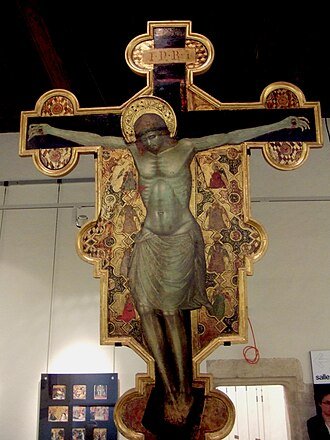
A painted crucifix on wood, executed in tempera and gold, showing Jesus nailed to the cross. It is attributed to Lorenzo di Bicci, a painter working in Florence, and dated to around 1450. The work belongs to the tradition of large crucifixes made for churches, where gold in the background and details helped the figure stand out.

This Annunciation, dated 1420 and attributed to Lorenzo di Bicci, belongs to religious art. It brings together the angel's announcement to Mary with donors and saints, an arrangement common in devotional painting of the period. No further details about its commission or original context are recorded, so it is best read with caution.
Where to see the work
- Musée du Petit Palais Avignon · 1
Teachers and pupils
Studied with
- Spinello Aretino 1350–1410
Pupils
- Bicci di Lorenzo 1373–1452