
Louis de Silvestre the Younger (Sceaux, 1675 - Paris, 1760) was a French history and portrait painter. He was court painter to King Augustus II of Poland and director of the academies of painting in Dresden and Paris. The son of the engraver Israël Silvestre, he trained in Paris under Charles Le Brun and Bon Boullogne, then completed his studies in Rome with Carlo Maratta. After returning, he joined the Academy in 1702 and early in his career received commissions for Paris churches, including a series on Saint Benedict.
In 1716 he moved to Dresden to serve the Saxon court, and he spent about thirty years there, moving between Saxony and Warsaw. He painted official portraits of Augustus II, his son Augustus III and the courtiers, as well as oil and fresco decorations, much of which was destroyed in the Second World War. After retiring, he returned to Paris, where he was elected director of the Academy in 1752 and died at the Louvre in 1760.
His legacy lies mainly in court portraiture, a genre in which he followed the official tradition. His pupil Jean-Eleazar Schenau later directed the Dresden Academy.
Works (11)

These ceiling paintings decorate the bedroom of King Augustus II in the Dresden Residence Palace and are attributed to the painter Louis de Silvestre. The year 1909 linked to the work most likely refers to later documentation or reproduction rather than the original execution date, which is not specified.

Portrait of Augustus III of Poland, painted by Louis de Silvestre in 1737. The king is shown in Polish dress, a traditional costume that emphasises his national identity rather than the formal court attire typical of portraits of the period. The painting is held at the Palace Museum in Wilanów. Its tall format and official character suggest it was intended as an image of royal authority.
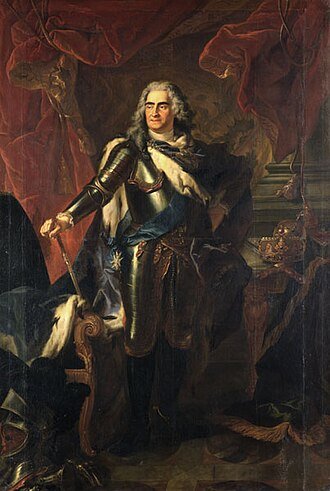
Large-scale portrait dated 1718, showing Augustus II of Poland in armour and royal mantle. Painted in oil on canvas, the work relies on the sitter's armour and mantle as emblems of authority rather than on any narrative scene. It is held today in Dresden.

Large-format portrait by Louis de Silvestre showing Augustus III of Saxony dressed in Polish fashion. Dated 1737 and painted in oil on canvas, the work stands about three metres tall, which gives the figure a commanding presence. It is now held by the Staatliche Kunstsammlungen in Dresden.

Portrait dated 1715 and painted by Louis de Silvestre in oil on canvas. The record identifies the sitter as Louise Françoise de Bourbon, Duchess of Bourbon, though another name also appears, so the identification should be treated cautiously. The woman wears widow's dress and fur trim, details that point to an elevated social position.

Portrait of Tekla Róża Radziwiłł, painted by Louis de Silvestre in 1720 on canvas. The record offers no further details about the commission, composition or symbolism, so any reading of the image should remain cautious. It belongs to the genre of formal portraiture and is held at the National Art Museum of Belarus.
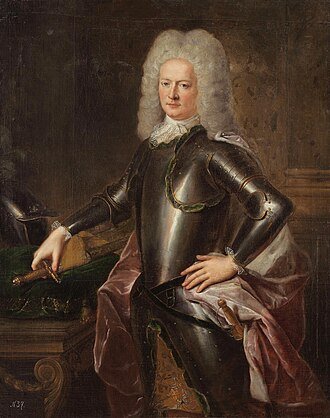
Portrait of Count Jacob Heinrich von Flemming, painted in 1720 by Louis de Silvestre in oil on canvas. The available record offers no details about who commissioned it or the circumstances of its creation, so we can only describe its genre and sitter. Like many portraits of the period, it would have helped to affirm the rank and social standing of the nobleman who posed for it.


Portrait of Maria Josepha of Austria, painted by Louis de Silvestre in 1700 as an oil on canvas of considerable size. It belongs to the portrait genre, where the main interest lies in depicting the sitter's figure. Today the work is held by the Palace Museum in Wilanów, which keeps it in its collection.

Portrait of Maria Amalia of Saxony, second wife of Philip V, painted in 1738 by Louis de Silvestre. The queen appears in the foreground in a court gown with bright tones and a dignified bearing, features typical of official representations of a sovereign. The large oil on canvas shows the richness of the fabrics and the care given to the details of her dress.
Where to see the work
- Palace Museum in Wilanów Warsaw · 2
- Staatliche Kunstsammlungen Dresden Dresden · 2
- Belarusian National Arts Museum Minsk · 2
- Musée de l'Histoire de France Versailles · 1
- Museo del Prado Madrid · 1
Teachers and pupils
Studied with
- Charles Le Brun 1619–1690
- Bon Boullogne 1649–1717
Pupils
- Giovanni Battista Casanova 1730–1795
Curiosities
A portrait in the Prado
The only painting by Silvestre held in the Museo del Prado is a betrothal portrait of Maria Amalia of Saxony dressed in the Polish fashion. It was made for her engagement to Charles VII of Naples, the future Charles III of Spain. Portraits of this kind served a diplomatic purpose: they presented the future queen to the court that would receive her and showed the image her family wished to project.
From canvas to tapestry
Silvestre's painting of the meeting between Louis XIV and Frederick Augustus of Saxony, son of the prince-elector, dates from September 1714. The canvas was used as a model for making tapestries, so a scene from the French court was reproduced in textile form. The work shows how history painting could feed other prestigious decorative arts.
A severe verdict
The critic Mariette, quoted in the sources, considered Silvestre a painter of merit, although his style had nothing new or especially striking. In his view, Silvestre was only a good follower of Bon Boullogne. The judgement sums up how his work was received in France, where his craft was acknowledged but his originality was considered limited.
A family of artists
His wife, Marie-Catherine Hérault, collaborated with him on many oil paintings and frescos made in Dresden and Warsaw. His daughter Marie-Maximilienne also became a painter. Among his students was Jean-Eleazar Schenau, who later directed the Dresden Academy and the Meissen porcelain factory. Silvestre's workshop was thus a place of both family and professional training.