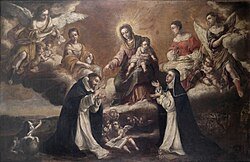
Lucas Valdés (Seville, 1661 – Cádiz, 1725) was a Spanish Baroque painter and engraver, son and pupil of Juan de Valdés Leal. He matters mainly for carrying on the family workshop in Seville with a large body of mural and easel painting, and for applying his mathematical training to illusionistic painting.
Born into a family of artists, he began working in his father's studio at a very young age. His earliest known work dates from 1671, when he was eleven: four engravings for a book on the festivities at Seville Cathedral for the canonization of Saint Ferdinand, in which his elder sister Luisa de Morales also took part. Few works securely attributed to him survive from before 1690, as he worked mainly alongside his father. He completed his training at the Jesuit-run Colegio de San Hermenegildo, where mathematics, geometry and perspective were taught.
After his father's death in 1690 he developed his own style, showing influences from Murillo among others. His output covered murals, engravings, canvases, portraits and drawings. His main commissions include the wall paintings of the Hospital de los Venerables and the Real Monasterio de San Clemente, both in Seville, and, between 1709 and 1715, the decoration of the convent of San Pablo el Real, which required assistants because of its size. He later decorated the dome of the church of San Luis de los Franceses. In 1719 he moved to Cádiz to teach mathematics at the Academia de Guardiamarinas, after which his artistic production declined considerably.
His legacy is closely tied to early eighteenth-century mural painting in Seville and to a long family tradition of painters and engravers.
Teachers and pupils
Studied with
- Juan de Valdés Leal 1622–1690