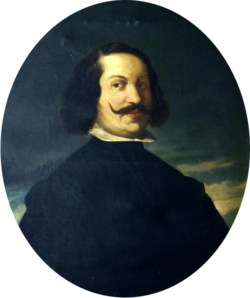
Juan de Valdés Leal (Seville, 1622-1690) was a Spanish Baroque painter who spent much of his career between Córdoba and Seville. He is remembered for his inventive power and the dramatic force of his compositions, although the finish of his works was uneven. He worked mainly in oil on canvas, but also practised mural painting in tempera, polychromy and etching.
He was baptised in Seville in 1622. His training is not well documented, but he probably began in the workshop of Francisco de Herrera the Elder and completed it in Córdoba with Antonio del Castillo, whose influence is visible in his early works. In 1647 he married in Córdoba and painted the monumental Saint Andrew for the church of San Francisco. Around 1653 he produced the cycle on Saint Clare for the convent in Carmona, where The Retreat of the Saracens stands out for its Baroque vigour.
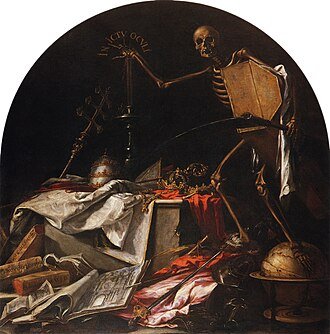
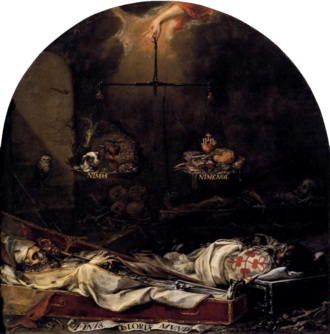
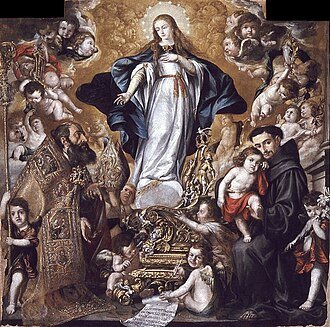
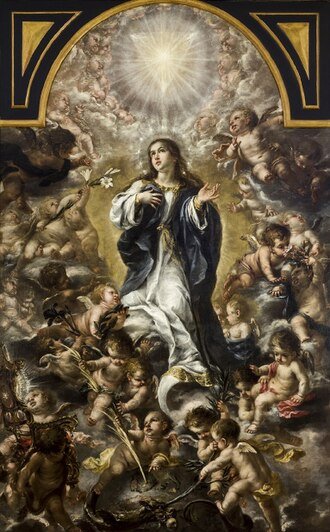
Around 1654 he returned to Córdoba, where he painted the Virgin of the Silversmiths and the Immaculate Conception now in the Louvre. His best-known work in Seville is the pair of allegories of the last things, Finis gloriae mundi and In ictu oculi, painted around 1672 for the Hospital de la Caridad. These meditations on vanity and death complete, alongside Murillo's Works of Mercy, the iconographic programme of the chapel.
His legacy was shaped by the macabre character of his subjects. After his death many weak paintings with corpses or severed heads were attributed to him, and the critic Enrique Romero de Torres called him the painter of the dead. The rivalry with Murillo, deepened by a romantic reading of their personalities, has weighed on his reputation as much as his own work.
Works (8)
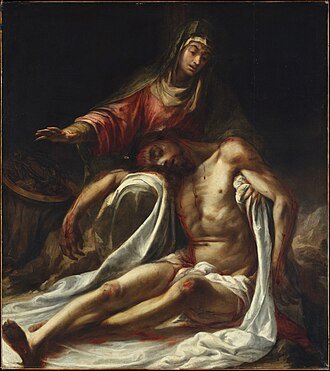
This Pietà by Juan de Valdés Leal, dated 1657, shows the Virgin Mary holding the dead body of Jesus of Nazareth. As a religious subject, it conveys grief and sorrow at the death. Painted in oil on canvas, the work is held at the Metropolitan Museum of Art.

Painted by Juan de Valdés Leal in 1663, this Spanish Baroque canvas shows Jesus of Nazareth attended by angels around a table set with bread, fish, a jug, a knife and a citrus fruit on a tablecloth. The simple meal likely carries a symbolic meaning, perhaps of spiritual nourishment, in keeping with the religious subject of the period.
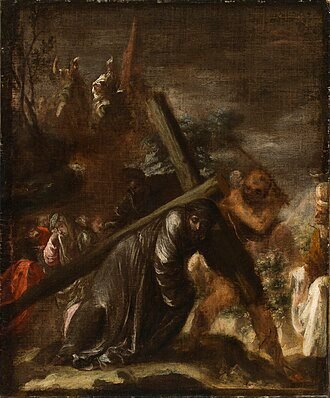
Jesus Christ Carrying the Cross is an oil on canvas by Juan de Valdés Leal, dated 1661 in the record. It belongs to religious art and depicts the moment of the Passion when Jesus takes up the cross on the road to Calvary. The available information does not clarify who commissioned it or the circumstances of its making, so the painting is best approached through its imagery and the established iconography of this subject.
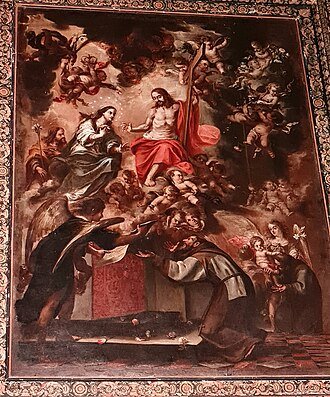
This large composition by Juan de Valdés Leal, dated 1672, shows Francis of Assisi at the Porziuncola chapel in Assisi receiving a vision of Christ and the Virgin. An angel acts as intermediary and hands him a scroll granting full indulgence to anyone who visits the chapel. Notably, Saint Anthony with the Child appears in the lower right, probably a nod to the patron, a count named Antonio. The scene seems influenced by Murillo's treatment of the same subject.
Where to see the work
- Hospital de la Santa Caridad Seville · 2
- Museum of Fine Arts of Córdoba Córdoba · 1
- Metropolitan Museum of Art New York City · 1
- Goya Museum Castres · 1
- Bilbao Fine Arts Museum Bilbao · 1
- Museo de Bellas Artes de Sevilla Seville · 1
Teachers and pupils
Pupils
- Lucas de Valdés 1661–1725
Curiosities
A book carelessly fallen
Palomino praised the Saint Andrew in the church of San Francisco in Córdoba, in which the saint appears larger than life. At his feet a book seems to have fallen by accident, with a disorder that the critic described as very whimsical. This apparently casual detail shows how Valdés Leal cultivated the look of spontaneity within a carefully calculated composition.
Fragments of a dismembered series
The Saint Clare series remained in Carmona until 1910, when Jorge Bonsor acquired it. After restoring it, he standardised its size and trimmed some fragments showing flying angels, which are now lost. The canvas showing the saint halting the Turks was also divided into two paintings, now in the Seville City Council, so the original composition can only be reconstructed from old descriptions.