Niccolò Bambini (Venice, 1651 – Venice, 1736) was an Italian painter who worked mainly in his native Venice, where he is placed between the late Renaissance and the early Baroque. He matters because he brought the Roman manner of Carlo Maratta to Venice, although his work kept the colour of the local school.
He first trained under Giulio Mazzoni in Venice and later moved to Rome, where he became a pupil of Carlo Maratta. On his return, seeing how fashionable Liberi was, he also adopted that manner, as the allegorical ceiling of Ca' Pesaro (1682) shows. He painted for several Venetian churches, among them San Zaccaria, where his Adoration of the Magi was painted in competition with Balestra, and Santa Maria di Nazareth, which holds his scenes of Saint Teresa.
In his last period he came so close to Sebastiano Ricci that some works by the two can be confused. His legacy survives mainly in Venetian churches. He had two sons who were also painters, Giovanni and Stefano.
Works (3)
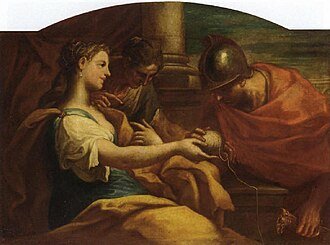
This painting by Venetian artist Niccolò Bambini, dated to around 1730, shows Ariadne handing Theseus a ball of thread to find his way through the Cretan labyrinth. The goddess Athena presides over the scene, with Ariadne on her right and the Athenian hero on her left. It is a subject artists returned to many times.

Niccolò Bambini painted this mythological scene in oil on canvas in 1736. It depicts Achilles among the daughters of Lycomedes, a subject drawn from ancient myth, with the hero's encounter with the young women forming the core of the composition. The painting is held at the Ca' Rezzonico.

The painting depicts the legendary abduction of the Sabine women, an episode from early Rome that ancient writers describe as the Romans seizing women from a neighbouring community. It is an oil on canvas dated 1750 and held at the Ca' Rezzonico. Without further sources, its commission, exact composition and place in the artist's career remain uncertain, so it is best seen as evidence of the eighteenth-century taste for classical subjects.
Where to see the work
- Ca' Rezzonico Venice · 2
Teachers and pupils
Studied with
- Carlo Maratta 1625–1713