
Alessandro Leone Varotari, better known as Il Padovanino, was an Italian painter born in Padua in 1588 and who died in Venice in 1649. Working during the Baroque period, he matters because he extended Titian's legacy deep into the seventeenth century, at a time when Counter-Reformation ideals shaped much of the painting being made.
He was the son of the painter and architect Dario Varotari, who most probably gave him his first training, although his father died when Alessandro was about ten years old. As a young man he studied Titian's frescoes in Padua, and that influence is clear in early works such as The Incredulity of St. Thomas. He married Caterina Mesa in Padua in 1612 and moved to Venice in 1614, where he joined the city's painters' guild the following year. He travelled to Rome several times, mainly to copy the great masters, and this work earned him wide renown, although much of that fame rests on his skill as a copyist. In Venice he designed mosaics for St Mark's Basilica and worked on the interior of Santa Maria Maggiore. After losing the competition for Santa Maria della Salute, he was left with the task of painting a work for the basilica's high altar.
His style is marked by narrative power and a sensuality that goes beyond the Counter-Reformation spirit of his age. His major works include The Victory of the Carnuti over the Normans, The Wedding at Cana and Mars and Venus Playing Chess, as well as Judith with the Head of Holofernes from 1636. His legacy passed to pupils such as Pietro Liberi, Pietro della Vecchia, Giulio Carpioni and his son Dario Varotari the Younger, and also to his sister Chiara, a well-known portraitist.
Works (12)
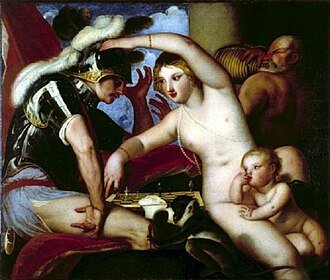
Mythological painting showing Mars and Venus before a chessboard, in a scene that refers to checkmate. It is dated 1635 and attributed to Padovanino, painted in oil. Without further references, the commission and the precise meaning of the game cannot be established, so the reading rests on the pairing of the two gods and the chess motif.

The record describes this work as a triptych devoted to Saint Andrew, painted in oil on canvas in 1631 by Padovanino. Its title points to a composition divided into three sections, a format common in altarpieces. Without reference texts, the scene depicted and the original commission cannot be confirmed, so this account is limited to the available data.
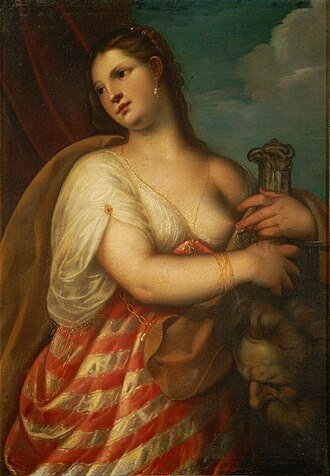
This painting shows Judith, the heroine of the Old Testament, at the moment after beheading the general Holofernes. Executed in oil on canvas in 1636 by Padovanino, the work belongs to the genre of religious art. The available information does not establish the commission or the specific circumstances of its creation, so it is best to focus on what the painting itself presents.


Portrait of an unidentified woman, painted in oil on canvas in 1640 by Padovanino, shows her beside a vase that completes the scene. Its meaning is not documented, so it can only be read cautiously as a decorative or symbolic detail. The painting is held in the Dresden State Art Collections.

Oil on canvas by Padovanino, dated 1620, depicting Cornelia, the Roman matron and mother of the Gracchi. The available information says little about its commission or early reception, so the work is best read as a portrait of a figure drawn from classical history. Its exact context remains uncertain.
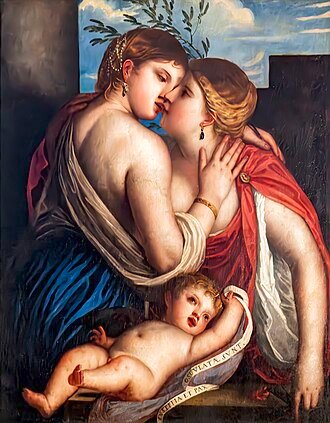
An allegory painted in 1649 by Padovanino, bringing together the ideas of justice and peace within a single canvas. Little is documented about its commission or the specific meaning of its figures, so any reading of the scene should be approached with caution. Executed in oil on canvas, it is now held at the Querini Stampalia Picture Gallery.

The record credits Padovanino with this oil on canvas, now held at the Museum of 18th-century Venice. No information is available on its subject, commission or date, so its composition and meaning cannot be described with confidence here.

A parable from the Gospel of Matthew (25:1-13) in which ten young women wait for a bridegroom. Five bring spare oil for their lamps and five do not, so the scene sets foresight against carelessness and the moral value of staying watchful. Padovanino painted it in oil on canvas.

Venus with an Amor is a mythological painting attributed to Padovanino, a Venetian artist active in the seventeenth and early eighteenth centuries. The goddess appears alongside a putto, the winged child figure common in such scenes, and the drapery around her helps organise the composition. With no further documentation available, it is best to restrict remarks to what the canvas itself shows.

It depicts a scene from the biblical story of David and Goliath: the young shepherd, having defeated the Philistine giant, holds up his severed head. This oil on canvas, dated 1650, is classified as religious art and is held at the Complesso di Santa Caterina. Its commission and original setting are unknown from the available data.
Where to see the work
- Kunsthistorisches Museum Vienna · 2
- Staatliche Kunstsammlungen Dresden Dresden · 2
- Museum of 18th-century Venice Venice · 2
- Niedersächsisches Landesmuseum für Kunst und Kulturgeschichte Oldenburg · 1
- Sant’Andrea Bergamo · 1
- Pinacoteca Querini Stampalia Venice · 1
- Gallerie dell'Accademia Venice · 1
- Complesso di santa Caterina Treviso · 1
Teachers and pupils
Studied with
- Dario Varotari the Elder 1539–1596
Pupils
- Pietro Liberi 1605–1687
- Pietro della Vecchia 1600–1678
- Giulio Carpioni 1613–1678
- Dario Varotari the Younger 1650–http
Curiosities
An unusual pupil
Among his students was Caterina Tarabotti, a name that stands out in an environment where painting workshops were usually reserved for men. The sources do not detail how long her training lasted or what work she produced under his direction, so it is best not to credit her with more than is documented.
A family workshop
His sister Chiara Varotari travelled with him and assisted with his work, suggesting a closely knit family studio. The texts do not specify which parts of the paintings were done by each of them, so any division of tasks should be regarded as probable rather than confirmed.