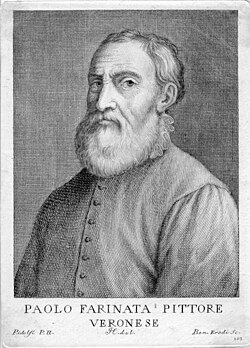
Paolo Farinati (Verona, 1524-Verona, 1606), also known as Farinato, was a painter of the Veronese school active during Mannerism. He matters as a link between local tradition and the colour of Paolo Veronese, whose manner he gradually adopted.
According to Vasari, he first trained in the workshop of Niccolò Giolfino, and he probably also worked with Domenico Brusasorci and Antonio Badile at some point. His earliest documented work, Saint Martin and the Beggar for Mantua Cathedral (1552), shows the influence of Giulio Romano. His early paintings, with a sober palette and a strong emphasis on drawing, gave way to a brighter range of colour, visible in the frescoes of the Cappella Marogna and in the Massacre of the Innocents at Santa Maria in Organo.
He left numerous chiaroscuro studies on tinted paper and a diary, begun in 1573, in which he recorded his artistic activity. His son Orazio also became a painter.
Works (15)
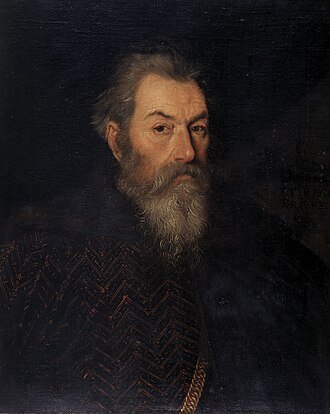
Oil on canvas portrait of a man, attributed to the painter Paolo Farinati and dated 1700 in the catalogue record. It belongs to the portrait genre and shows an unidentified male sitter. The date is hard to reconcile with what is known of Farinati's activity, so it should be treated with caution rather than as a firm fact.


This 1602 oil on canvas by Paolo Farinati depicts Saint Catherine of Alexandria. It belongs to Mannerism and to the realm of religious art. The painting is now held at the Castelvecchio Museum. With the information available, it is not possible to say more about its commission or composition.
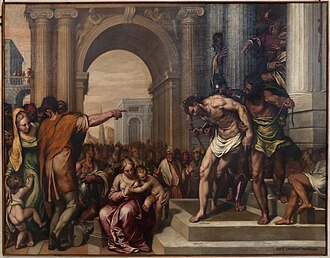
Painted by Paolo Farinati in 1562, this Mannerist work shows Jesus of Nazareth among a crowd. It is held in the Castelvecchio Museum and was executed in oil on canvas. Within Mannerism, the composition places attention on the relationship between Jesus and the people surrounding him. The available record offers no further detail on its commission or original setting.
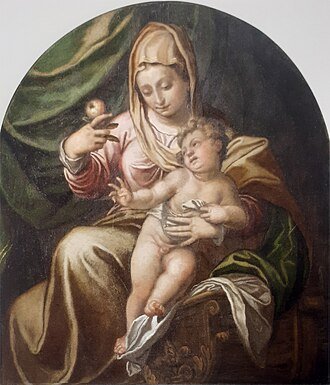
Mannerist work by Paolo Farinati, dated 1579 and painted in oil on canvas. It depicts the Virgin Mary with the Christ Child, a common subject in religious painting of the period. The record offers no further details about its commission or composition, so it is best to stick to what is known with certainty.


Portrait of Paolo Cartolari, painted by Paolo Farinati in 1582 in oil on canvas. The work belongs to Mannerism, a late Renaissance current that favoured elegance and artifice in the depiction of the human figure. The available information does not clarify the commission or the exact circumstances of its creation, so it is best read mainly as evidence of portrait-making practice of the period.

Large oil on canvas dated 1583 by Paolo Farinati, depicting Jethro and Moses, figures from the Old Testament. It belongs to Mannerism and to religious art. It is held in the Castelvecchio Museum in Verona. Its large vertical format suits the monumental scale of the subject, though the available information offers little further detail.
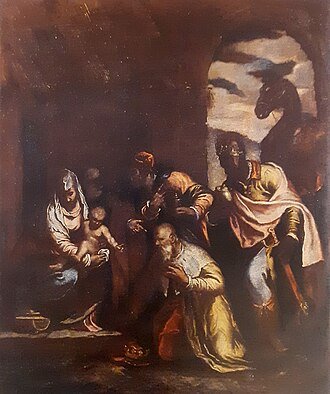
A Mannerist work by Paolo Farinati, dated around 1580 and painted in oil on canvas. It belongs to religious art and presents Joseph, the Virgin Mary and the infant Jesus alongside the Magi, in what is traditionally understood as the Adoration scene. Held at the Castelvecchio Museum, its record offers no further details about commission or composition, so it is wiser to restrict description to what the image and these catalogue entries support.

A portrait of Matilda of Canossa, the medieval noblewoman linked to northern Italy, painted by Paolo Farinati in 1587 in the Mannerist style. The work shows the countess on horseback, and this equestrian pose turns the image into a statement of power and authority rather than a simple likeness. Without further references, it is best to stick to what the canvas presents, without assuming commissions or details we cannot verify.
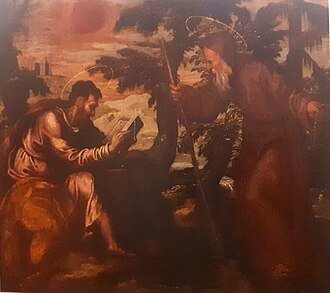

Paolo Farinati painted this large oil on canvas in 1592. In a single scene it gathers the Virgin and Child, Joseph and Jesus with several saints, among them Francis of Assisi, Onuphrius, Diego of Alcalá, Louis of Toulouse and Leonard of Noblac. Its broad format and crowded figures place it within Mannerism. Little more is known about its commission.

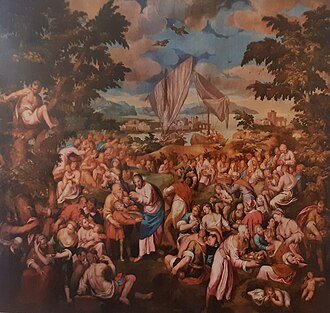
Work by Paolo Farinati, a painter of Mannerism, executed in oil on canvas. It depicts the Gospel episode of the multiplication of the loaves and fishes, in which Jesus of Nazareth feeds a large crowd with very little food. It is held at the church of San Giorgio in Braida. Without further documentary sources, it is best to stay with its religious subject and its place within the Mannerist style.
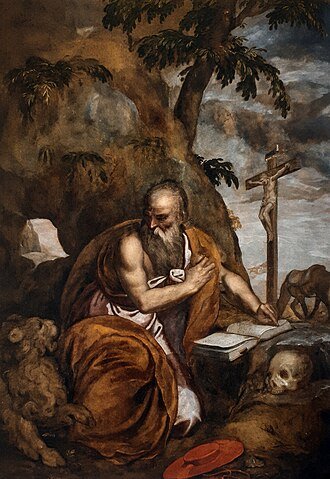
Oil on canvas dated 1578 by Paolo Farinati, painted in the Mannerist manner. It depicts Saint Jerome, a subject common in religious painting of the period, and is held at the Museo di Castelvecchio. The available information does not clarify the commission or specific compositional details, so this reading stays with the subject and stylistic context.
Where to see the work
- Castelvecchio Museum Verona · 13
- Vlaamse Kunstcollectie · 1
- San Giorgio in Braida Verona · 1
Curiosities
A supposed ancestor in Dante
Farinati is said to have been a descendant of Farinata degli Uberti, the Florentine condottiero whom Dante places in the Inferno of the Divine Comedy. The kinship is handed down as tradition rather than clearly documented, so it should be treated with caution. The name Farinato, by which he was also known, seems linked to that lineage, although the connection remains uncertain.
A shared commission in Mantua
His first documented work was commissioned by Cardinal Ercole Gonzaga alongside pieces by Battista dell'Angolo del Moro, Domenico Brusasorci and Paolo Veronese. Bringing several young Veronese painters into one project for the Gonzaga court shows the weight that Giulio Romano, the family's chief painter and architect at the time, still carried.