
Pedro de Orrente (Murcia, 1580 - Valencia, 1645) was a Spanish Baroque painter, trained in Toledo, who became one of the main promoters of naturalism in Castile and Valencia. His large output combines the influence of Leandro Bassano with that of other Venetian masters and with traits of tenebrist naturalism.
The son of a merchant from Marseille settled in Murcia, he was baptised there in 1580. Around 1600 he was already working in Toledo, and between 1604 and 1612 his movements are documented, probably including a stay in Italy. After a period in Valencia around 1616, where he painted the Martyrdom of Saint Sebastian for the cathedral, he returned to Toledo, where in 1630 he was paid for a Nativity for the cathedral. By around 1638 he was back in Murcia, and he died in Valencia in 1645.
His style turns biblical subjects into pastoral scenes, with twilight landscapes and numerous animals, though he also painted large altarpieces with monumental figures. Alongside his Bassano-inspired approach, the influence of Veronese and Tintoretto is visible in his complex compositions, and works such as the Valencian Saint Sebastian show knowledge of Caravaggio. His followers in Valencia, such as Esteban March, carried this manner forward.
Works (3)
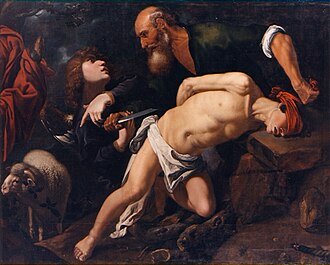
Pedro de Orrente painted this episode from Genesis in which Abraham, ready to sacrifice his son Isaac, is stopped at the last moment. The scene captures the tension of that instant: the raised knife, the young man bound over the wood and, beside them, the sheep meant to take his place. Without reference texts offering further context, the safest reading is to recognise the subject and the dramatic force of the composition, which is religious in tone and restrained in its handling.
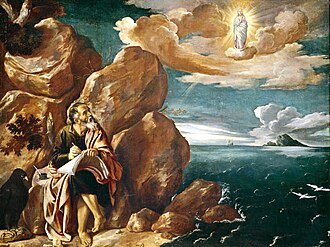
Pedro de Orrente painted this canvas around 1620, showing Saint John the Evangelist on the island of Patmos, where tradition places the writing of the Book of Revelation. The saint appears with a book, the attribute that identifies him as an evangelist and visionary author. No commission or provenance is recorded, so it is best to describe the painting without assuming more than it shows. It is held at the Museo del Prado as part of Spanish religious painting of the seventeenth century.
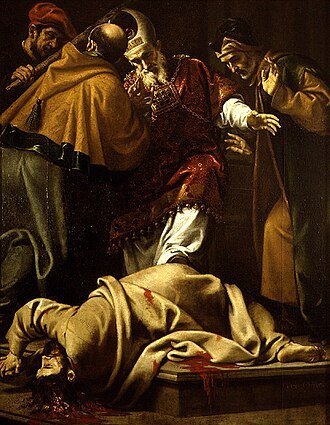
This oil painting by Pedro de Orrente, dated 1639, depicts the martyrdom of Saint James the Less, one of Christ's apostles. It is a large-format religious work, roughly two metres tall, most likely made for a devotional setting. Without reference texts, its original commission and later history cannot be stated with certainty.
Where to see the work
- Bilbao Fine Arts Museum Bilbao · 1
- Museo del Prado Madrid · 1
- Museu de Belles Arts de València Valencia · 1