
Pietro Perugino
1448–1523 · Umbrian Renaissance painter, leader of the Umbrian school
Pietro Vannucci, known as Perugino, was an Italian Renaissance painter of the Umbrian school, working in Umbria, Florence and Rome. He is considered one of the artists who helped prepare the move towards the High Renaissance. His nickname points to Perugia, the main city of Umbria, although he was born in Città della Pieve. His fame was partly overshadowed by that of his most famous pupil, Raphael, yet his way of composing, his palette and his handling of space were decisive for painting at the start of the sixteenth century.
Origins and first training
He was born around the middle of the fifteenth century in Città della Pieve, the son of Cristoforo Vannucci. His exact birth date is unknown: based on the ages at death mentioned by Vasari and Giovanni Santi, it has been placed between 1445 and 1452. Scholars still debate the family's social standing. Some believe Vannucci rose out of poverty through his own efforts, while others argue that the Vannucci were among the wealthiest families in the town. His first experiences probably came in local Perugian workshops, such as those of Bartolomeo Caporali and Fiorenzo di Lorenzo, and in the circle of Benedetto Bonfigli.
In Perugia he could see works by Piero della Francesca, Domenico Veneziano, Fra Angelico and Benozzo Gozzoli. From Piero he took a sense of harmony between the flat surface of the picture and the volume of its figures, along with clear light and rigorous architecture. The date of his first stay in Florence is not certain: some place it around 1470, others around 1479.
Apprenticeship in Florence
According to Vasari, in Florence he worked in the workshop of Andrea del Verrocchio, one of the most important training centres of the time, where painting, sculpture and goldsmithing were practised side by side. There he worked alongside young talents such as Leonardo da Vinci, Domenico Ghirlandaio, Lorenzo di Credi and Filippino Lippi, and with Botticelli, whom an anonymous sixteenth-century writer named, perhaps with some exaggeration, as his direct master. Florentine teaching rested on drawing from life and anatomical study, and gave great weight to the line of contours. From Verrocchio he learned a naturalism built on firm line.
According to guild statutes, an apprenticeship then lasted at least nine years. By about 1472 Perugino could work independently, and he enrolled in the Compagnia di San Luca in Florence with the title of dipintore. He is considered one of the first painters in central Italy to use oil paint, although his early chronology is largely reconstructed through stylistic comparison.
Early works in Umbria
Back in Perugia, his Florentine training is visible in the Scenes from the Life of Saint Bernardino, commissioned in 1473 by the Franciscans, who wanted to spread the cult of Bernardino of Siena. Eight small panels were painted, now scattered, by several artists. Two of the finest are attributed to Perugino: the Miracle of the Stillborn Child and, above all, Saint Bernardino Heals a Girl. In them a monumental, decorated architecture dominates the small figures, and a clear light recalls Piero della Francesca.
In 1478 he painted frescoes in the Magdalen chapel of Santa Maria Assunta at Cerqueto, of which only fragments survive. Among them is a Saint Sebastian, a subject he would return to often: a young, naked saint that allowed a male nude to be shown under a religious pretext. Versions in fresco and oil multiplied for private devotion, and the best known are in Stockholm and St Petersburg. In the Hermitage example there is only one arrow, and the inscription PETRUS PERUSINUS PINXIT, "Pietro Perugino painted this".
The same period produced many Madonnas now spread across European museums. Several were long attributed to Verrocchio, and in all of them the influences of his two great reference points blend together.
Rome and the Sistine Chapel
Around 1479 his reputation was considerable and Pope Sixtus IV called him to Rome. He painted the apse of the chapel of the Conception in the choir of St Peter's, a work destroyed in 1609 when the basilica was rebuilt. Documents describe a cycle showing the Virgin and Child in a mandorla, surrounded by saints. Its success led the pope to commission the decoration of the walls of the Sistine Chapel.
From the summer of 1481 a group of leading Florentine painters gathered there, among them Botticelli, Ghirlandaio and Cosimo Rosselli, with their assistants. The works had to follow shared conventions: the same scale, a common rhythmic structure, a unified landscape and a single range of colours. Perugino's surviving contributions include the Delivery of the Keys to Saint Peter, dated 1481-82 and one of the most celebrated images on the north wall, and the Baptism of Christ, the only signed work in the whole ensemble. The architectural backdrop, with two triumphal arches and a central temple, shows close attention to detail and tight control of the composition.
Although one of the youngest in the group, Perugino soon took a leading role in directing the work. Pinturicchio collaborated with him. On the altar wall he also painted a feigned altarpiece of the Assumption, later destroyed to make room for Michelangelo's Last Judgement. His method of dividing the space into two parallel planes that barely communicate reappeared in later works, such as the Albani Torlonia Altarpiece (1491).
Florence and the Medici circle
After Rome he returned to Florence, where he worked mainly between 1486 and 1499, with trips to Rome and Perugia. He rarely had fixed assistants: he preferred to recruit locally wherever he worked, so his style sometimes adapted to its setting. His light grew softer, and his landscapes moved away from the harshness of the early works towards gentle, rolling hills that seem to belong to no particular time or place.
His solemn compositions suited the habits of visual meditation promoted by prayer books widely used at the end of the fifteenth century. His figures, with restrained expressions and refined elegance, stand in generic landscapes. His portraits, by contrast, show precise observation of features and character, such as the portrait of Francesco delle Opere of 1494, with a meticulous landscape showing Flemish influence. In 1494 he travelled to Venice, where he saw the work of Carpaccio and Giovanni Bellini.
In 1483 he took part in the decoration of the Villa di Spedaletto, near Volterra, commissioned by Lorenzo the Magnificent, alongside Botticelli, Ghirlandaio and Filippino Lippi. Its mythological scenes were entirely lost. Around 1485 he painted the Galitzin Triptych. His harmonious painting suited the Neoplatonic atmosphere of Lorenzo's circle. To this period belongs the Louvre picture traditionally called Apollo and Marsyas, though it is now more often thought to show the shepherd Daphnis seated. Its figures quote classical models, such as Praxiteles' Hermes.
After Lorenzo's death and the political upheavals of the 1490s, his art kept its character without any sharp break. For the Florentine convent of the Gesuati at San Giusto he painted panels such as the Pietà, and for the Nasi family chapel he painted The Vision of Saint Bernard. In these works he began framing figures beneath a portico and using aerial perspective with tones of sea green and blue. In 1493 he married Chiara Fancelli in Florence, who according to tradition served as the model for many of his Madonnas.
Perugia and the Exchange Hall
In Perugia he left important works, such as the Decemviri Altarpiece and the polyptych of Saint Peter, which was dismantled in 1591 after the church was destroyed. His most admired work in the city, however, is the decoration of the Sala del Cambio. In 1496 the guild of money-changers and bankers commissioned him to decorate its audience hall. The humanist Francesco Maturanzio advised on the programme, which explored the harmony between pagan and Christian wisdom: a vault with the seven planets and the signs of the zodiac, the Nativity, the Transfiguration, the Eternal Father, and figures of heroes, prophets and sibyls. Perugino designed the figures, and his pupils probably carried out much of the painting. On a half-pilaster he added his own bust, with an inscription calling himself egregius pictor.
The hall shows Perugino's language at its most balanced: bright but harmonious colours, serene scenes and light broken into brushstrokes that merge into a unified effect. Its limits are also visible, in the repetition of familiar schemes and the difficulty of giving dynamism to narrative scenes.
Late years and legacy
By 1501 Perugino was one of the priors of Perugia. He faced criticism, including Michelangelo's remark that he was a goffo nell'arte, a clumsy painter. Perugino sued for defamation and lost. Shortly afterwards he painted a Madonna and Saints for the Certosa di Pavia, now dispersed among museums.
Between 1504 and 1507 he produced the Annunziata altarpiece in Florence, which was judged lacking in innovation and cost him several pupils. Around 1506 he left Florence for Perugia and then Rome, where Pope Julius II preferred Raphael for the Vatican rooms. From 1512 he withdrew to Perugia. His last frescoes, at Trevi, Perugia and Fortignano, survive only in part or have left their original locations. He died in 1523 at Fontignano, of the plague.
His legacy lies above all in Raphael, who took from him the foundations of perspective and composition, and in the Umbrian school, which spread a painting of clear forms, calm figures and harmonious landscapes that formed a basis for the move towards the High Renaissance.
Works (100)










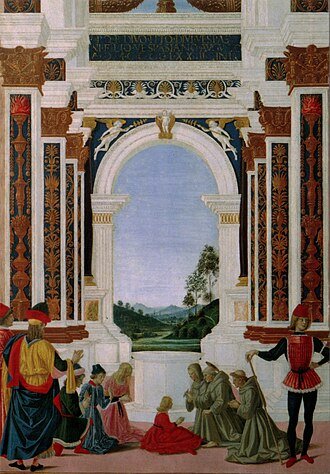
Tempera on wood panel dated 1473 and painted by Pietro Perugino, a member of the Umbrian School. It depicts Saint Bernardino of Siena in the episode of curing the daughter of Giovannantonio Petrazio da Rieti, a religious subject that fits the devotional art of the period. Today it is held by the National Gallery of Umbria.

Pietro Perugino painted this small panel in 1499, showing the baptism of Jesus by John the Baptist. The religious subject is preserved at the Museum of Art History in Vienna. Given its modest size, it was probably intended for private devotion rather than a large altarpiece.

Painted around 1470 by Pietro Perugino, this small panel shows the Virgin Mary with the Christ Child, a devotional subject widely found in religious painting of the period. The work is held at the Musée Jacquemart-André. The record notes the use of tempera and oil on panel, a combination common in the workshops of the time. Beyond this, the description should be read cautiously.


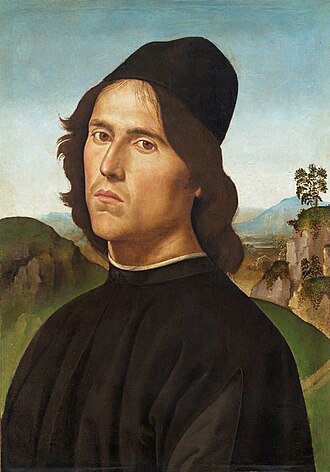
Portrait from 1500, oil on panel by Pietro Perugino, an artist of the Italian Renaissance. It shows a man with a tonsure, a sign of religious life, and he is associated with the Franciscan Order. The small format and plain background focus attention on the face, now held in the Uffizi.

This panel by Perugino, dated 1510 and painted in tempera, brings several saints together. Sebastian is identified by the arrow he carries, while Apollonia holds a tooth and a pair of pincers, attributes that allude to her martyrdom. Irene of Rome also appears among the figures.


Work by Pietro Perugino dated 1505, painted in oil on panel, showing the Virgin Mary with the Christ Child, an angel and the young Saint John. It belongs to religious painting, and its upright format suggests an altarpiece or devotional image. The available data do not clarify its commission or history, so it is worth looking closely at how the figures are arranged.

Pietro Perugino painted this Annunciation in 1497, in oil on panel. It shows the Virgin Mary and the Archangel Gabriel, identifiable from the announcement scene that gives the work its name. The painting is held at the National Gallery of Umbria. The record offers no further details about its commission or specific context.

The painting depicts the Nativity: the Virgin, Saint Joseph and a group of shepherds adoring the Christ Child. A common subject in religious art, here set in a wide horizontal format. It is attributed to Pietro Perugino and dated 1522, a date worth treating with some caution.

A seated Virgin holds the Christ Child, flanked by Saints Jerome and Augustine of Hippo. Four angels and two cherubs fill the scene in a symmetrical, orderly arrangement typical of Perugino's calm manner. Dated 1500 and painted in tempera and oil on panel, the work is now held in Bordeaux.


A small panel painted on wood showing King David, a figure from the Old Testament, in the religious art of the Italian Renaissance. It is attributed to Pietro Perugino, though the date given, 1550, falls long after the painter's death, so it should be read with caution. The panel is now held at the Louvre in Paris.

Portrait of Biagio Milanesi, painted by Pietro Perugino in 1500 in oil on panel. It is a small-scale bust portrait, the kind Italian Renaissance painters used to record the recognisable features of a specific sitter. The work is held in the Uffizi Gallery in Florence. The available record says nothing further about who commissioned it or about Milanesi's background.


Pietro Perugino painted this oil on panel of Saint Sebastian in 1495, a subject common in the religious art of his time. The work is held at the Galleria Borghese. Details about its commission or original setting are not available, so any reading should stay close to what the picture itself shows.

This panel painting in egg tempera shows the Virgin Mary holding the infant Jesus, a subject central to religious art. Dated 1500 and attributed to Pietro Perugino, it was painted on wood, a support that allowed fine detail. The available information does not record its original commission or setting, so it is best read as a devotional image of its period.


This panel by Pietro Perugino depicts the Adoration of the Shepherds, a traditional scene of Christ's birth in which shepherds come to honour the newborn child. The record dates it to 1518, when the painter was already an established figure of the Umbrian Renaissance. As a religious work, it belongs to the devotional painting of its era.

Pietro Perugino painted this oil on panel in 1475, a religious work showing Saint Sebastian. The record offers few further details, so its commission and original setting cannot be confirmed. Its small, upright format suggests, tentatively, a devotional piece meant for private or chapel use. It is now held in Nantes.

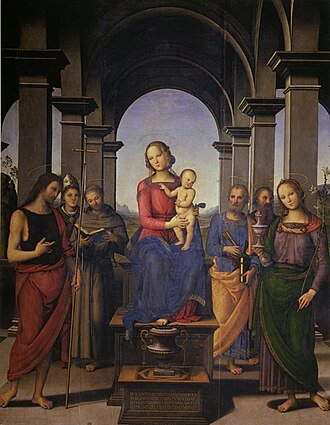
Pietro Perugino painted this large panel in 1497 using tempera, gathering the Virgin and Child with a group of saints arranged in an orderly, calm composition. The figures include Louis of Toulouse, John the Evangelist, Peter, John the Baptist, Francis of Assisi and Paul of Tarsus. The work belongs to the Umbrian School, and its balanced, serene composition places it within the High Renaissance.


Painted by Pietro Perugino in 1496, this oil on panel shows the Archangel Michael, a subject common in religious art of the Italian Renaissance. The original commission and intended location are not known for certain, but its tall, narrow format suggests a devotional picture. It is now held at the National Gallery in London.

Painted by Perugino in 1496, this panel shows the archangel Raphael accompanying Tobias, a figure from the biblical Book of Tobit. The artist focuses attention on the luminous angel, calm in profile and protective in posture, while the young traveller stands beside him. The vertical format and clear tones typical of the Italian Renaissance lend the scene a quiet composure.
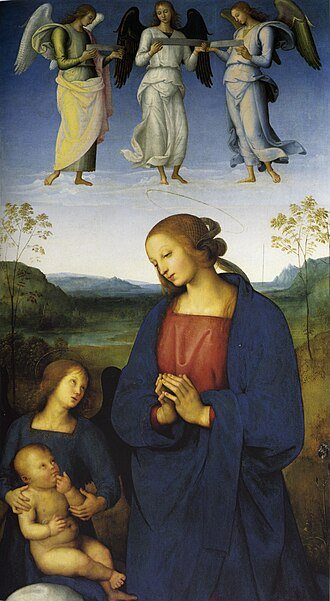
Italian Renaissance religious painting dated 1496 and attributed to Pietro Perugino. It shows the Virgin Mary with the Christ Child and an angel, in a scene of devotion. The available information does not allow us to establish the commission or the specific circumstances of its making.
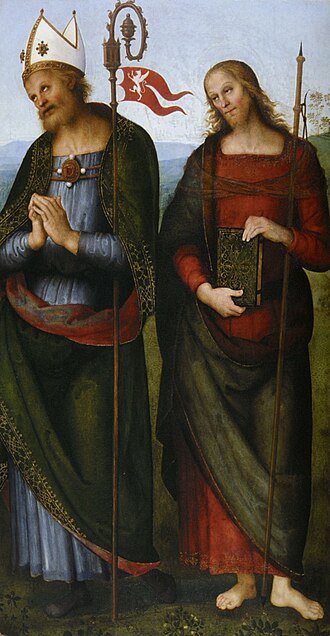
The panel shows two standing saints: a bishop holding a pastoral staff and a book, and Saint James the Great. The record attributes it to Pietro Perugino, an Italian Renaissance painter, and dates it to 1450, a date that should be read cautiously. It is a religious work on wood, tall and narrow, where each figure's attributes help identify them.

Pietro Perugino painted this tempera panel in 1513 during the Italian Renaissance. It shows Saint Jerome, a bearded man with a halo accompanied by a lion with a mane, alongside Mary Magdalene, a fair-haired woman with bare feet. Both saints are recognised through these attributes, and the work is now held in the National Gallery of Umbria.

Pietro Perugino painted this small poplar panel in 1473, during the Italian Renaissance. It shows Christ dead in the tomb, a subject common in religious painting of the period. The record notes the combined use of tempera and oil, but offers no further details about its commission or composition.

On this small poplar panel painted in oil, Perugino shows the moment when Saint Jerome brings a cardinal lying in his bed back to life, with a pope present. The religious subject unfolds in a plain setting where the resurrection is the focus. Given its modest size, it was probably intended for private devotion.

This panel by Perugino, dated 1502, depicts Jesus of Nazareth at his resurrection, accompanied by a soldier. It is painted in tempera on wood, a medium that favors fine, precise detail. Today it is held by the Metropolitan Museum of Art in New York.

This panel by Pietro Perugino, dated 1496, presents two standing saints, John the Baptist and Saint Lucy, in a restrained vertical composition. The record offers no further information about its commission, origin or context, so it is best to stick to what the painting itself shows: the presence of both saints and its narrow, elongated format, suited to a particular devotional setting.


Painted by Pietro Perugino in 1493, this religious work shows the Virgin Mary with the Christ Child and four saints in a large-scale composition. Its size suggests a devotional purpose, probably for an altar, though its original commission is not known with certainty. It is now held at the Museum of Art History in Vienna.
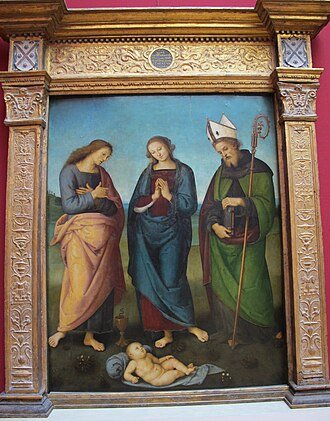
This panel by Pietro Perugino, dated 1500 and painted on poplar wood, is known as Adoration of the Child and is identified as showing Augustine of Hippo. The available record gives no further details about its commission or composition, so its meaning should be approached with caution. It belongs to the religious art of the Italian Renaissance and to the devotional tradition of Christian imagery.
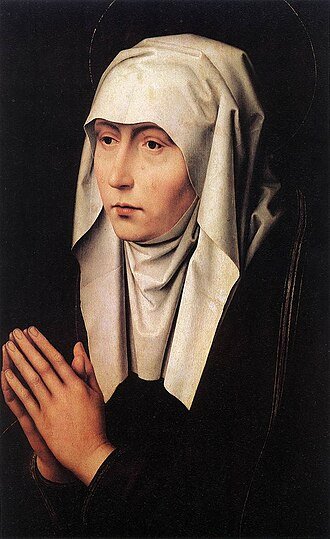
The panel shows the Virgin in grief, a subject common in devotional religious art. Painted in oil on wood in 1480, its small format probably suggested private devotion rather than a large altar setting, though no commission details are recorded. It is held in the Uffizi Gallery and is classed under Early Flemish painting.

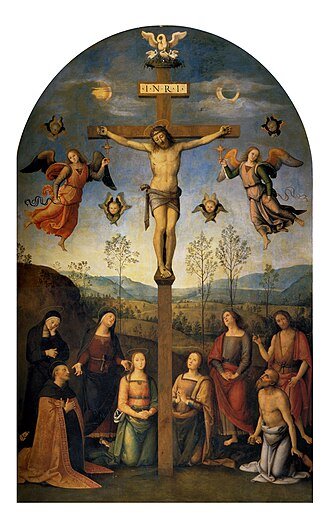
This painting by Pietro Perugino depicts the Crucifixion of Jesus, a central subject of religious art in his era. It is housed in the Cenacolo di Fuligno in Florence. The available information does not allow us to establish with certainty its date or original commission, so the scene is best approached mainly as a devotional image.

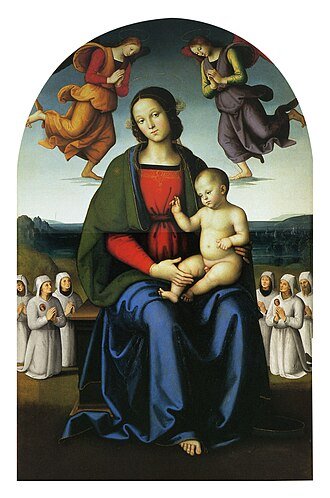
This oil-on-panel work shows the Virgin Mary with the Christ Child, a common subject in religious painting. A landscape fills the background, placing the scene in a natural setting rather than a plain interior. No records of its commission or context are available, so the reading rests on what the painting itself shows.

Christian religious painting by Pietro Perugino, dated 1500 and executed in tempera on panel. The available information does not specify the scene depicted, who commissioned it, or its history. Its technique stands out: egg tempera was the usual medium for panel painting in Renaissance Italy, offering luminous colours and crisp outlines.

Oil on panel from 1497 by Pietro Perugino, showing Jesus of Nazareth alongside John the Baptist, the figure who in the Gospels heralds Christ and baptises him in the Jordan. Its landscape format and modest size suggest a devotional piece, although its original commission is not known with certainty.

Work by Pietro Perugino dated 1497 and painted in oil on panel. Its subject is Jesus of Nazareth, within Christian religious painting. The record offers no further details about its commission, composition or context, so any detailed reading would require consulting the museum's documentation.

Painted by Pietro Perugino in 1495, this Pietà shows the dead Christ attended by Nicodemus and Joseph of Arimathea, the two figures traditionally linked with taking Jesus down from the cross and burying him. The record offers no further details about its commission or early history, so its original setting and patron remain unrecorded here. It is held by the Clark Art Institute.


Where to see the work
- National Gallery of Umbria Perugia · 16
- Louvre Museum Paris · 10
- Uffizi Gallery Florence · 9
- National Gallery London · 5
- Galleria Palatina Florence · 3
- Museum of Fine Arts of Lyon Lyon · 3
- Galería Nacional de Arte Washington, D.C. · 3
- Kunsthistorisches Museum Vienna · 3
- Musée des Beaux-Arts de Rouen Rouen · 3
- Musée des Beaux-Arts de Caen Caen · 2
- Bavarian State Painting Collections Munich · 2
- Galleria dell'Accademia Florence · 2
- Campana collection · 2
- Galleria Borghese Rome · 2
- Metropolitan Museum of Art New York City · 2
- Städel Museum Frankfurt · 1
- Pinacoteca Vaticana Vatican City · 1
- Pinacoteca Nazionale di Bologna Bologna · 1
- Pinacoteca comunale Deruta · 1
- Vatican Museums Vatican City · 1
Teachers and pupils
Studied with
- Andrea del Verrocchio 1435–1488
Pupils
- Raphael 1483–1520
- Girolamo Genga 1476–1551
- Lo Spagna 1450–1528
- Giannicola di Paolo 1460–1544
- Eusebio da San Giorgio 1470–1539
Curiosities
A self-portrait among the apostles
In the Delivery of the Keys in the Sistine Chapel, the figure in a black cap on the right foreground is thought to be Perugino himself. The identification is not certain, but it is repeated in the literature. Something similar applies to the bust he added in the Sala del Cambio in Perugia, where his name appears in an explicit inscription.
An insult from Michelangelo
According to the sources, Michelangelo once told Perugino to his face that he was a clumsy painter, goffo nell'arte. Perugino brought a defamation suit, which failed. He is said to have been spurred by the humiliation to produce his masterpiece for the Certosa di Pavia, now dispersed among museums.
A death from plague
Perugino died at Fontignano in 1523 of the plague. Like other victims of the disease, he was hastily buried in an unconsecrated field, and the exact spot is now unknown. He left considerable property and three sons, a quiet end for an artist who ran busy workshops and received constant commissions.