Qian Xuan
1239–1290 · Chinese painter of the Song-Yuan transition, known for landscapes and animal painting
Qian Xuan (c. 1235-1305 according to some sources; another record gives 1239-1290) was a Chinese painter from Huzhou, in what is now Zhejiang. He lived across the end of the Song dynasty and the early Yuan, and he matters because he blended Song realism with an archaic Tang manner, producing work that looks to the past with a clear political undertone.
He began as an aspiring scholar-official under the Southern Song, but he struggled to rise through the bureaucracy. After the Mongol conquest of southern China in 1276, he effectively gave up on a civil career. In 1286 his friend Zhao Mengfu accepted a post in the new government, and Qian Xuan seemed poised to do the same, but he declined on patriotic grounds, citing his advanced age. For this reason he is regarded as a loyalist to the Song.
From then on he devoted himself entirely to painting. He is best known as a painter of "fur and feathers", that is, of animals, though he also worked in bird-and-flower painting, figure painting and landscape (shanshui). His landscapes, such as Home Again, are often read as a longing for the return of native Chinese rule. Works attributed to him include Watching Geese at Lan-t'ing Pavilion (1295), Court Lady and Yang Guifei Mounting a Horse.
His legacy lies in the bridge he built between the Song tradition and an archaic Tang manner, and in showing that painting could be both a personal refuge and a quiet commentary on the times. He remains a useful reference for understanding the transition between dynasties.
Works (3)
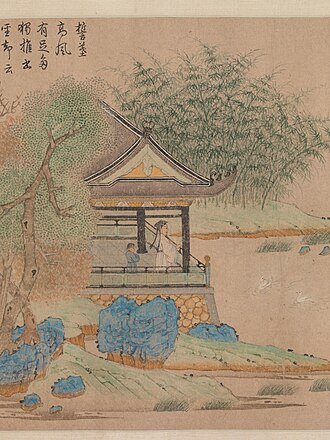
A work by Qian Xuan dated 1295 showing Wang Xizhi, a calligrapher of ancient China, watching geese beside a lake, with a pavilion, trees and bamboo around him. The record offers no further details about its commission or technique, so it is best to stick to what is visible: a calm, contemplative scene in which the scholar and the birds engage with the landscape.


The scene shows a pavilion beside water and several geese within a quiet, open space. The narrow, elongated format pushes the composition upward and suggests distance with only a few elements. The record attributes the painting to Qian Xuan, but it offers no reliable details about its commission or original context.
Where to see the work
- Metropolitan Museum of Art New York City · 1
- Kyoto National Museum Kyoto · 1
- National Palace Museum Taipei · 1
Curiosities
A courtesy name and several pen names
Besides his courtesy name, Shun Ju, Qian Xuan used several pseudonyms. One of them, Yu Tan, can be rendered as "Jade Pool". Others, such as Xi Lanweng and Zha Chuanweng, link his identity to a withdrawn life and to the Huzhou region. Taking several names was common among Chinese scholars, who used them depending on the setting in which they moved.