
Roelant Savery (Kortrijk, 1576 – Utrecht, 1639) was a Flemish-born Dutch Golden Age painter and one of the notable landscape artists of his time. His significance lies in combining the Flemish landscape tradition with Dutch painting, producing scenes filled with carefully observed animals and plants.
His family, Anabaptists, left the Spanish-held Southern Netherlands when he was about four and settled in Haarlem around 1585, later moving to Amsterdam. There his older brother Jacob Savery taught him to paint, and he also trained with Hans Bol. Around 1604 he went to Prague, where he became court painter to Emperor Rudolf II and later to Emperor Matthias in Vienna, courts that made mannerist art a centre of attention. Between 1606 and 1608 he travelled to the Tyrol to study plants, an interest visible in his work.
Before 1616 he returned to Amsterdam, and in 1618 he settled in Utrecht, joining the artists' guild the following year. In 1621 he bought a large house on the Boterstraat with a garden of flowers and plants that attracted many fellow painters. He was friends with still life painters such as Balthasar van der Ast and Ambrosius Bosschaert. In the 1620s he was among the most successful painters in Utrecht, but later his fortunes declined, perhaps because of heavy drinking, and he went bankrupt in 1638. He died half a year later.
He painted mainly landscapes in the manner of Gillis van Coninxloo, usually with a mythological or biblical theme in the background, often with classical ruins or the subject of Noah's Ark. Animals, common and exotic, and plants are rendered in fine detail. He also painted flower still lifes, and his preparatory drawings are highly valued. Among his best-known works are several depictions of the dodo, painted between 1626 and 1628, which shaped later images of this extinct bird. His style remains popular with collectors and can be seen in museums across Europe and North America.
Works (20)


A Dutch Golden Age still life from 1620, painted in oil on panel, showing a bouquet arranged in a glass goblet alongside a butterfly and a bumblebee. Among the recognisable flowers are poppy and cornflower, together with a rose. The picture suggests careful observation of nature, with insects keeping company with the blooms in a restrained composition. It is held at the Palais des Beaux-Arts in Lille.

Mythological painting by Roelant Savery, dated 1628 and executed in oil on panel. It depicts Orpheus, a figure from Greek mythology associated with music. Reliable information about its commission, composition or the precise meaning of the scene is not available, so the picture is best understood by looking closely at the image itself.

Roelant Savery painted this Tower of Babel in 1602, a biblical subject within religious art. Oil on copper, a smooth and durable support, allows a finely detailed finish at a small size. In the Genesis account, the construction ends in the confusion of tongues that scattered the people.

Roelant Savery painted this work in 1623 in oil on canvas, and it is now held at the Rijksmuseum. Its title describes the scene: a poet crowned by two monkeys during a feast of animals. The composition is probably allegorical, with landscape and a gathering of creatures forming an unusual situation. Little is known about its commission or original context.
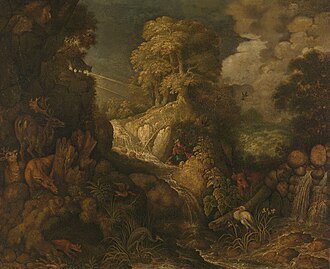
Roelant Savery depicts the prophet Elijah receiving food from ravens, the scene that gives the painting its title. Painted in 1634 in oil on copper, the small panel allows a close, meticulous treatment of the landscape and the birds. It belongs to the religious art category.

Oil on panel dated 1617 and painted by Roelant Savery, a landscape painter. The scene brings together ruins, cattle and deer, with a tree standing out as the main element. Without information on its commission or context, the reading rests on the composition and on the relationship between nature and the crumbling architecture.

Painted in 1615 in oil on panel, this small work by Roelant Savery combines two elements in its title: cows in a stable and witches placed in the four corners of the composition. It is classified as a landscape. Its modest size invites close looking at the unsettling coexistence of domestic animals and witchcraft figures.

Painted in 1626 on an oak panel, this religious work shows a paradise scene filled with exotic fauna, including the dodo, identified as Raphus cucullatus. No details about its commission or context are recorded, so it is best read as an image of an idealised natural world rather than a narrative. It is held in the Bode Museum.

Painted in 1626 by Roelant Savery, this animal painting in oil on canvas depicts dodo birds, Raphus cucullatus. It is now held at the Natural History Museum in London. As a work of animal painting, it offers a window onto how seventeenth-century artists portrayed fauna, at a time when exotic species attracted growing curiosity among painters and collectors alike.

Painting by Roelant Savery dated 1620 and held in the Rijksmuseum. It shows a wild boar hunt set in a rocky landscape, with a tree as a prominent element. The scene centres on a rugged natural setting, and the composition reflects the painter's interest in landscapes featuring animals and hunting figures.

This small panel by Roelant Savery gathers birds around a theme of vanitas: the idea that life is brief and death comes for everyone. Titled with the Latin phrase Memento mori, the work invites religious reflection, reflected in its still-life genre with a devotional character. The record offers no further details about its commission or reception.


This panel by Roelant Savery, dated 1610, shows peasants dancing in front of an inn within an open landscape. Scenes of popular festivity and encounters on the road were a familiar subject in painting of his time. No further details about its commission or the specific context of the scene are recorded.

A floral still life painted by Roelant Savery in 1615 on panel. A vase of flowers stands inside a stone niche, a device that frames the bouquet and sets it apart from the viewer's space. The record offers no further details about its commission or history, so any reading of the composition should stay with what the painted surface shows.

The painting shows Orpheus, the mythological musician, playing as animals gather around him. The subject draws on the myth in which his music calms wild creatures. Savery painted it in 1627 in oil on panel, and the scene suggests a harmony between humans and the natural world.

Oil on panel dated 1614 and attributed to Roelant Savery, showing cavalry advancing through a wooded landscape. Among the elements identified are a gonfalon, or banner, and a helmet, details that point to the military character of the scene. Beyond these features, little can be said with certainty about the circumstances of its commission or its historical interpretation.

Painted in 1618 by Roelant Savery on an oak panel, this horizontal work gathers deer, birds and an aurochs (Bos primigenius taurus) within an idyllic landscape. Its classification as religious art suggests the scene is meant to evoke paradise, a realm of harmony among creatures, though the circumstances of its commission are not known.

Where to see the work
- Rijksmuseum Amsterdam · 4
- Mauritshuis The Hague · 2
- Centraal Museum Utrecht · 1
- J. Paul Getty Museum Los Angeles · 1
- Palais des Beaux-Arts de Lille Lille · 1
- National Gallery London · 1
- Germanisches Nationalmuseum Nuremberg · 1
- Bonnefanten Museum Maastricht · 1
- Bode Museum Berlin · 1
- Nationalmuseum Stockholm · 1
- collection Willem V Prince of Orange Nassau The Hague · 1
- Louvre Museum Paris · 1
- National Gallery Prague · 1
- Musée des Beaux-Arts de Chartres Chartres · 1
Teachers and pupils
Studied with
- Hans Bol 1534–1593
- Jacob Savery 1560–1603
Curiosities
A extinct bird painted again and again
Savery is regarded as the most prolific and influential illustrator of the dodo, with ten depictions attributed to him, often placed in the lower corners of his pictures. One of them, painted in 1626 and known as Edwards' Dodo after the ornithologist George Edwards who once owned it, has become the standard image of the bird. It is now held at the Natural History Museum in London, and many later dodo illustrations derive from his work.
An unidentified parrot in the same paintings
Less well known is that the same paintings include an unidentified blue and yellow macaw, unlike the typical South American species. It has been suggested that it may represent the Martinique macaw, a hypothetical species known only from a couple of brief seventeenth-century descriptions. The identification remains uncertain, and the bird is still a puzzle for scholars.