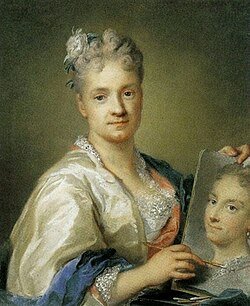
Rosalba Carriera (Venice, 1675-1757) was a Venetian Rococo painter best known for her portraits. Her lasting importance lies in making pastel a fashionable medium for portraiture, a technique rarely used for that purpose before her.
She began as a miniaturist on ivory, a support whose brightness gave her work its distinctive glow. Her first images were small female figures painted on snuff box lids, and from them she moved on to portrait miniatures. She broke with academic rules that called for short, carefully blended strokes and adopted the quick brushwork of the Venetian tradition. Gradually she devoted herself exclusively to pastel.
Her sitters included foreign visitors passing through Venice, young aristocrats on the Grand Tour, diplomats and Augustus the Strong of Saxony, who assembled a large collection of her pastels. She was admitted to the Academy of Saint Luke in Rome in 1705 and to the Bologna Academy in 1720. Between April 1720 and March 1721 she lived in Paris, where she set off a vogue for pastel, painted Louis XV and was elected to the Académie royale. She also made the last portrait of Antoine Watteau shortly before his death. Later she worked in Modena, Parma and Vienna, and at the court of Augustus III of Poland, where she taught the queen.
Her portraits show smooth outlines, bust poses with the head turned toward the viewer, and a skilful rendering of silks, lace, jewels and fur. In her final years she lost her sight almost completely despite two cataract operations. Her legacy rests on the pastel portraits that gave the medium prestige and on a series of self-portraits that traces her life from youth to old age.
Works (15)


Self-portrait by Rosalba Carriera, made in 1746 in pastel, a technique using powdered pigment in crayon form that allows soft transitions and subtle colour. The artist depicts herself in a small format, and the work is held at the Gallery of the Academy in Venice. No further details about its commission or setting are recorded.

Pastel on paper dated around 1730, attributed to Rosalba Carriera, a Venetian painter known for portraits in this medium. The sitter is shown with soft, subtle modelling typical of her handling of colour and light. The record gives no further information about the sitter's identity or the commission, so it is best to describe only what the work itself shows.

Rosalba Carriera painted this portrait of Faustina Bordoni in 1730, working in pastel on paper. The sitter is shown directly, and the soft medium allows gentle gradations across her face and the fabrics she wears, giving the image a delicate, luminous surface. The work is held at Ca' Rezzonico.
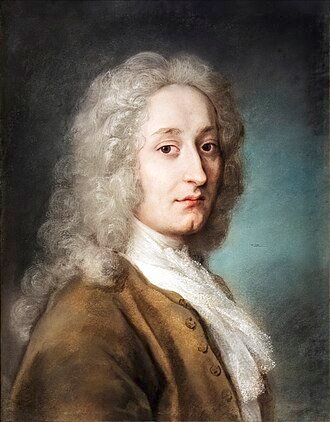
Portrait of Antoine Watteau by Rosalba Carriera, dated 1720. The work is executed in pastel on paper, which was mounted on cardboard. The medium allows soft gradations of colour and a velvety surface typical of the technique. It is held at the Complesso di Santa Caterina. No further details about its commission or context are known.

Portrait of Felicita Sartori in Turkish dress, painted by Rosalba Carriera in 1730. The sitter wears a costume inspired by the East, a fashionable exotic theme in eighteenth-century European portraiture. Carriera was known above all for her pastel work, which gives the picture its soft surface and delicate range of tones.

The available information only identifies Rosalba Carriera as the author of this work, without providing a title, date or description. Without reference texts, it is not possible to specify what it depicts, who commissioned it or which features set it apart. For its context, a specialist catalogue or the holding museum would be the place to look.
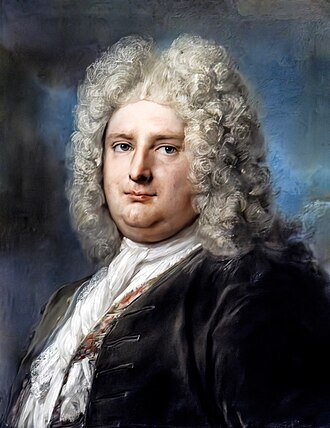
This 1727 portrait by Rosalba Carriera shows the French consul Le Blond, rendered in pastel on paper. The medium allows soft transitions between tones and a velvety surface, qualities that may heighten the sitter's immediacy. The work is now held by the Galleria dell'Accademia in Venice, and it belongs to the portrait genre.

Pastel on paper dated 1726 by Rosalba Carriera, showing a boy in a portrait format. Working in pastel allowed soft gradations of color and fine modulation across the face and skin, a delicacy typical of this medium on paper. The work is held in the Galleria dell'Accademia in Venice.

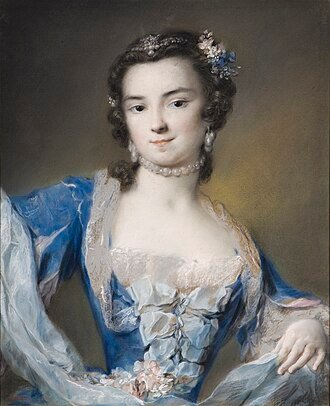
This portrait of a young woman is done in pastel on paper, a delicate medium that allows soft shifts of colour and tone. Its author is Rosalba Carriera. The record does not identify the sitter or explain the commission, so the work is best read mainly through its handling of the figure.


Self-portrait by Rosalba Carriera, the Venetian painter known for her pastel work, in which she presents herself with an attribute linked to winter. The record offers little more: dated 1730, it is executed in pastel on paper and belongs to the Dresden collections. The picture reflects the artist's habit of giving her portraits an allegorical tone, in which personal identity blends with a more general idea.
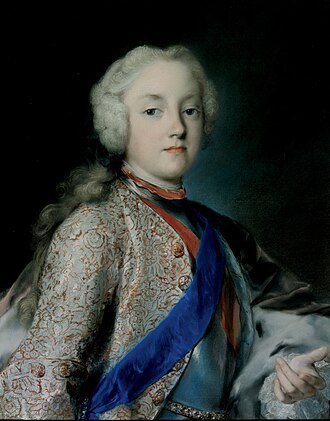
A pastel on paper portrait in which Rosalba Carriera depicts the crown prince Friedrich Christian of Saxony, dated 1740. The artist, a specialist in this medium, uses soft gradations of colour to model the face and convey a sense of delicacy. The available information does not allow us to say more about the commission or its context.
Pastel portrait of Barbara Campanini, made by Rosalba Carriera in 1739 and held in Dresden. Carriera was a leading specialist in this eighteenth-century medium, which allowed soft tonal shifts and a delicate palette on paper. The work reflects portraiture as a refined genre valued for its immediacy.
Where to see the work
- Gallerie dell'Accademia Venice · 5
- Staatliche Kunstsammlungen Dresden Dresden · 4
- Complesso di santa Caterina Treviso · 2
- Art collections of Fondazione Cariplo Milan · 1
- Ca' Rezzonico Venice · 1
- Museum of Art and History Geneva Geneva · 1
Teachers and pupils
Pupils
- Gustaf Lundberg 1695–1786
Curiosities
A Paris diary
During her stay in Paris, Rosalba kept a diary of her activities. Her admirer Antonio Zanetti published it in 1793, many years after her death. It records her routine: she painted in the mornings, and in the afternoons she visited museums and private collections while keeping a busy social life. Her extensive correspondence was published alongside it, so her daily life can be followed in some detail.
A portrait with a legend
At Prideaux Place, in Padstow, Cornwall, there is a portrait of the artist painted by Humphrey Prideaux during his Grand Tour. A legend holds that the picture concealed a love letter, a detail passed down as tradition that cannot be verified. The case shows how her image circulated among English travellers who knew her work outside Venice.
A series in the Vasari Corridor
One of her self-portraits is kept in Florence, in the Vasari Corridor that links the Palazzo Vecchio with the Pitti Palace, as part of a collection of painters' self-portraits. The earliest, dated 1709 and held in the Uffizi, shows her painting her sister. The last, from 1746, is known as the «tragedy» for its aged, impassive and severe face, painted shortly before an unsuccessful corneal operation.