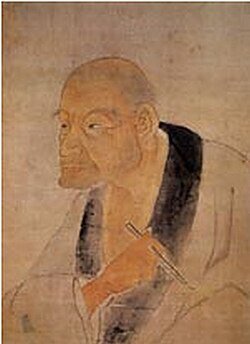
Kanō Tan'yū (born Kanō Morinobu, 1602-1674) was a Japanese painter of the Kanō school, active in Kyoto and Edo during the first century of the Tokugawa shogunate. He worked on genre scenes, animals and large mural compositions. His career shows how a family workshop became the official academy of the new regime.
He came from a family of painters: he was the son of Kanō Takanobu and the grandson of Eitoku. After his father's sudden death, he and his younger brothers Naonobu and Yasunobu took charge of the workshop, which was by then tied to the Tokugawa clan. His first major commission was the decoration of Nijō Castle in Kyoto, built by Tokugawa Ieyasu between 1601 and 1603. In 1626, when Emperor Go-Mizunoo was invited to stay there, the shogun Iemitsu ordered the building redecorated throughout, a decisive test for the family. Tannyū, leading his workshop, probably painted the great audience halls, whose walls carry multicolored compositions of pines and birds on gold grounds. These works aimed to display the power of the new ruler, although the vast expanse of gold began to drain the painting of its force.
Around 1648 he and his brothers painted portraits of the thirty-six immortal poets of waka poetry, all on gold grounds and of the same size. Documents kept at the Kotohira-gū shrine attribute twelve of them to Tannyū.
Kusumi Morikage was among his notable pupils. The academic manner that settled into the workshop during these years passed to his direct successors and, according to scholars, weakened the school's vitality. His legacy lies mainly in keeping the Kanō name influential throughout the Tokugawa period.
Teachers and pupils
Studied with
- Kanō Takanobu 1571–1618
Pupils
- Kusumi Morikage 1620–1690