Bathsheba at Her Bath
Rembrandt, 1654
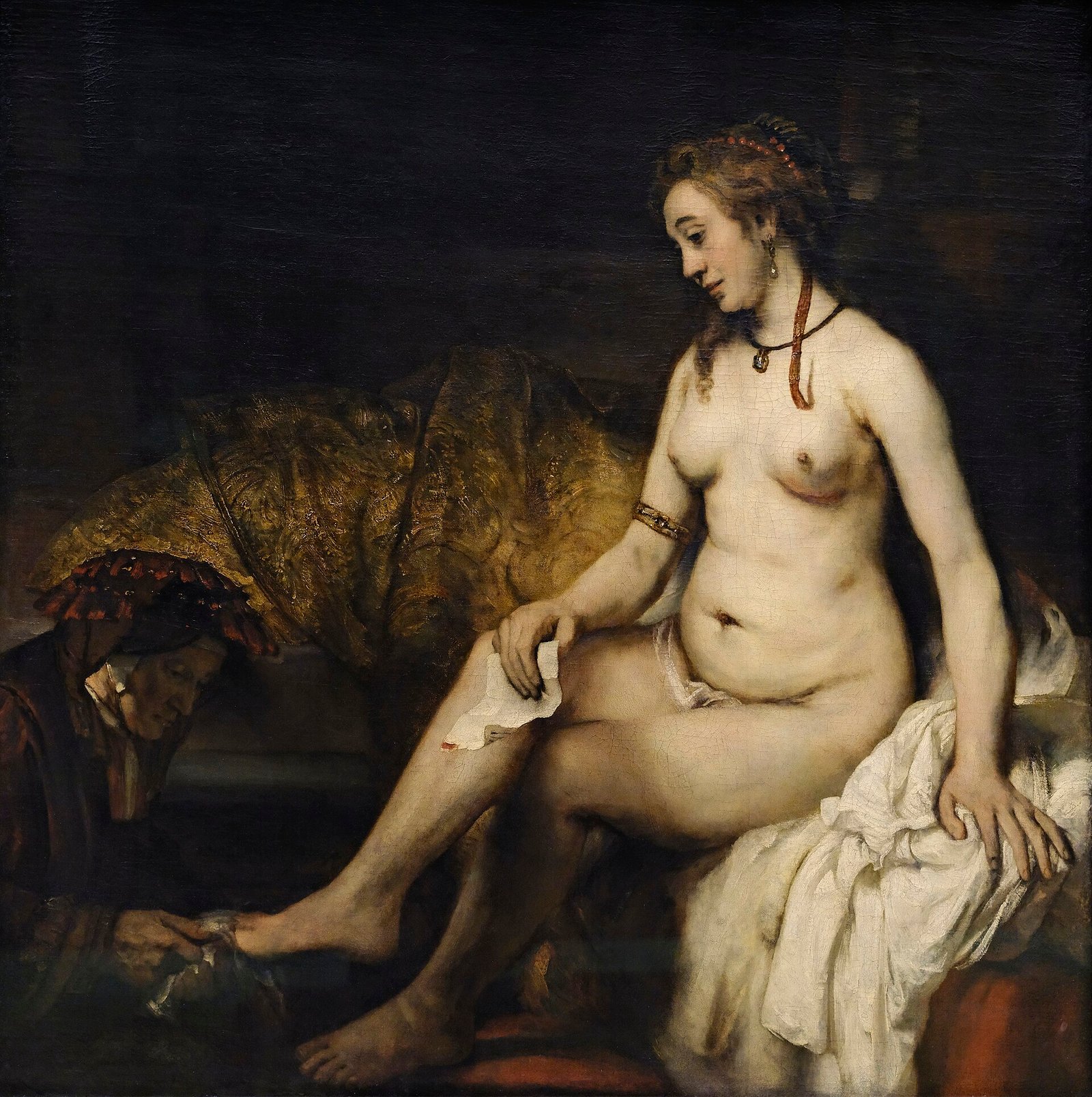
Bathsheba with David's Letter, painted by Rembrandt in 1654, depicts an episode from the Second Book of Samuel: King David watches Bathsheba bathing from his palace and, overcome by desire, takes her to his bed. To marry her, David sends her husband Uriah into battle, where he dies. The painting does not show that violence but the moment that follows, when the woman receives a letter from the king summoning her to the palace. That letter, which the biblical account does not mention, is the only anecdotal detail in the scene. Rembrandt drops David, the attendants and the landscape that usually framed the story in earlier versions, so the figure fills almost the entire picture.
This reduction changes the meaning of the image. Where tradition had placed moral reproach, Rembrandt places the viewer in the position of David as voyeur, and attention shifts to the woman's inner dilemma; her expression suggests resignation and reflection rather than surprise. The figure is life-sized, set in a space that is hard to read: a dark background that evokes night, a massive column and golden drapery that add warmth. The broad, thickly applied brushwork and strong highlights give the skin an almost tactile quality.
The work also has a complicated history. It was begun around 1647 and reworked until 1654. X-rays show that Rembrandt lowered Bathsheba's head and that, at first, there was no letter in her hand. The canvas may have been trimmed, possibly by the painter himself. The figure's proportions do not follow a classical ideal, and her body seems drawn from observation, although Eric Jan Sluijter argues that it cannot have been painted directly from a posing model because of anatomical and perspective inconsistencies.
The model is traditionally identified as Hendrickje Stoffels, Rembrandt's partner, though Sluijter suggests an ideal type instead. A deformity observed in one breast has prompted various medical hypotheses, without consensus. The painting hangs in the Louvre, where it arrived in 1869 as part of the donation of Dr Louis La Caze.
- Painter
- Rembrandt
- Date
- 1654
- Medium
- oil paint, canvas
- Dimensions
- 142 × 142 cm
- Museum
- Louvre Museum, Paris
- Movement
- Dutch Golden Age painting
- Genre
- religious art, nude
- Depicts
- nudity, sitting, pedicure, letter, nipple, washing, Bathsheba, bijou
More works by Rembrandt


