The Jewish Bride
Rembrandt, 1667
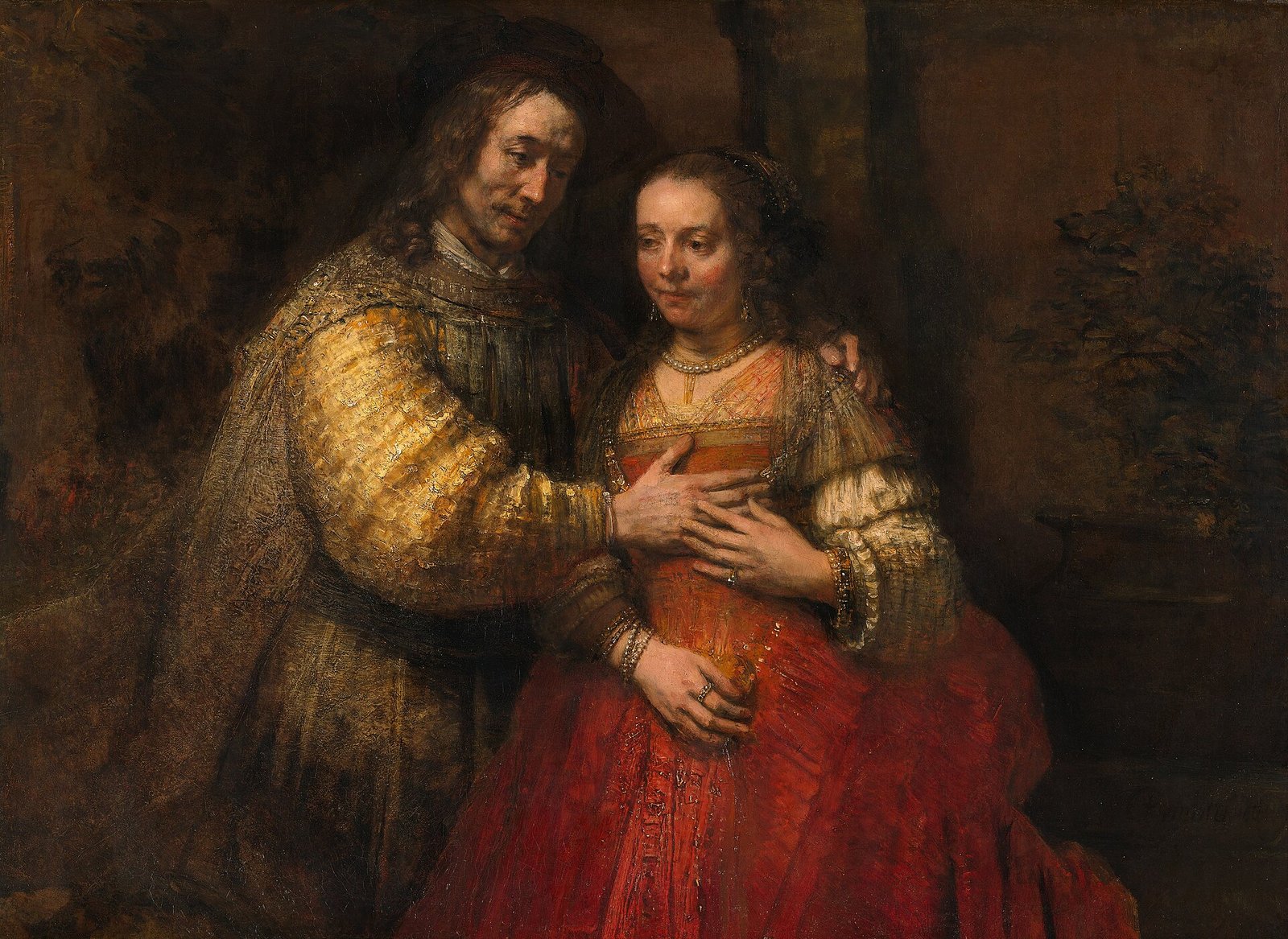
The Jewish Bride (Het Joodse bruidje) is an oil on canvas by Rembrandt, held in the permanent collection of the Rijksmuseum in Amsterdam. For a long time it was read as a scene of a Jewish father giving his daughter a necklace on her wedding day. That title took hold in the early nineteenth century, when an Amsterdam art collector identified the subject in this way. The reading is no longer accepted, and the identity of the couple remains uncertain. With no anecdotal clues to guide us, the painting's真正 subject becomes the universal one: two people joined in tenderness.
Over the years several names have been proposed. Rembrandt's son Titus and his bride have been suggested, as have the Amsterdam poet Miguel de Barrios and his wife. Couples from the Old Testament have also been considered, among them Abraham and Sarah, and Boaz and Ruth. The most plausible identification, however, is Isaac and Rebekah, as described in Genesis. That reading is supported by a drawing the artist made of the same episode some years earlier.
The work also shows clearly how Rembrandt built his images. It draws on techniques of earlier Flemish painting, on practices associated with Venice, and on methods that were his own. Among the personal ones, the thick impasto of the brightest highlights stands out. Over a ridged layer of lead white, once dry, he laid transparent colored glazes and then partly wiped them away with a cloth. Colour gathered in the hollows, stayed faint in the intermediate areas and almost vanished where he wanted the strongest light. This play of texture and transparency gives the bodies and fabrics a distinctive physical presence, and accounts for much of the attention the painting continues to attract from scholars.
- Painter
- Rembrandt
- Date
- 1667
- Medium
- oil paint, canvas
- Dimensions
- 122 × 166 cm
- Museum
- Rijksmuseum, Amsterdam
- Movement
- Dutch Golden Age painting, Baroque painting
- Genre
- genre art, portrait
- Depicts
- Isaac
More works by Rembrandt


