The Sea of Ice
Caspar David Friedrich, 1823
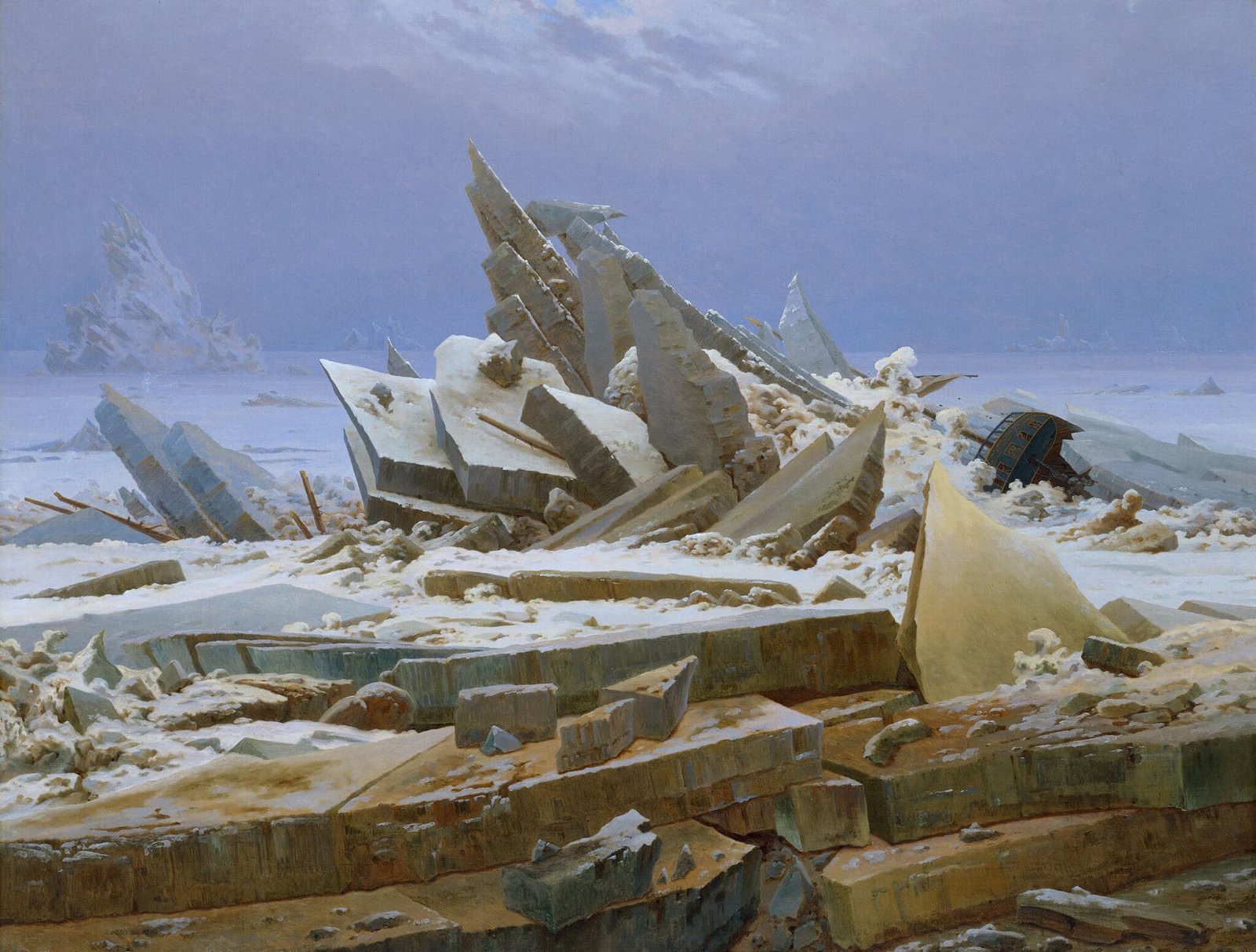
The Sea of Ice is an oil painting that Caspar David Friedrich made around 1823–1824, now held at the Kunsthalle in Hamburg. It shows a shipwreck among blocks of ice under a grey sky, apparently in the Arctic. Friedrich, however, never travelled to those latitudes: the scene was built from ice floes he studied on the River Elbe near Dresden, and from accounts of polar expeditions circulating in Germany at the time, such as those of William Edward Parry. The work originated in a commission from the collector Johann Gottlob von Quandt, who asked for two paired pictures: one of a southern nature, bright and abundant, and one of a northern nature in all its terrifying beauty. Friedrich received the northern one, and according to a contemporary account he was not even sure at first what he would paint, waiting for an inspiration that came to him, in his own words, now and then in a dream.
The composition is unusual. In the foreground, small ice blocks stack up like steps, and as the eye rises they merge into a huge frozen tower that fills almost the entire space. The shipwreck is a tiny detail beside that mass, and this imbalance seems deliberate: nature completely overpowers humankind. Friedrich painted the landscape as a place of death rather than a picturesque setting, which unsettled audiences of his day. The work was received with incomprehension and had not sold by the time the painter died in 1840.
The picture is often linked to Romanticism, which sought in nature a spiritual meaning, and to the theory of the sublime, which mixed terror and pleasure. Some scholars also point to the painter's childhood experience, when his brother drowned after falling through ice, although this remains an unconfirmed hypothesis. A political reading has also been proposed, seeing the trapped ship as a metaphor for Germany at the time. The painting is considered to have influenced later images of the Arctic, and it inspired Paul Nash's Totes Meer (Dead Sea) of 1941.
- Painter
- Caspar David Friedrich
- Date
- 1823
- Medium
- oil paint, canvas
- Dimensions
- 97 × 127 cm
- Museum
- Hamburger Kunsthalle, Hamburg
- Movement
- Romanticism
- Genre
- landscape painting
- Depicts
- ice, ice congestion, iceberg, HMS Griper, Arctic Ocean
More works by Caspar David Friedrich