The Fif
Édouard Manet, 1850
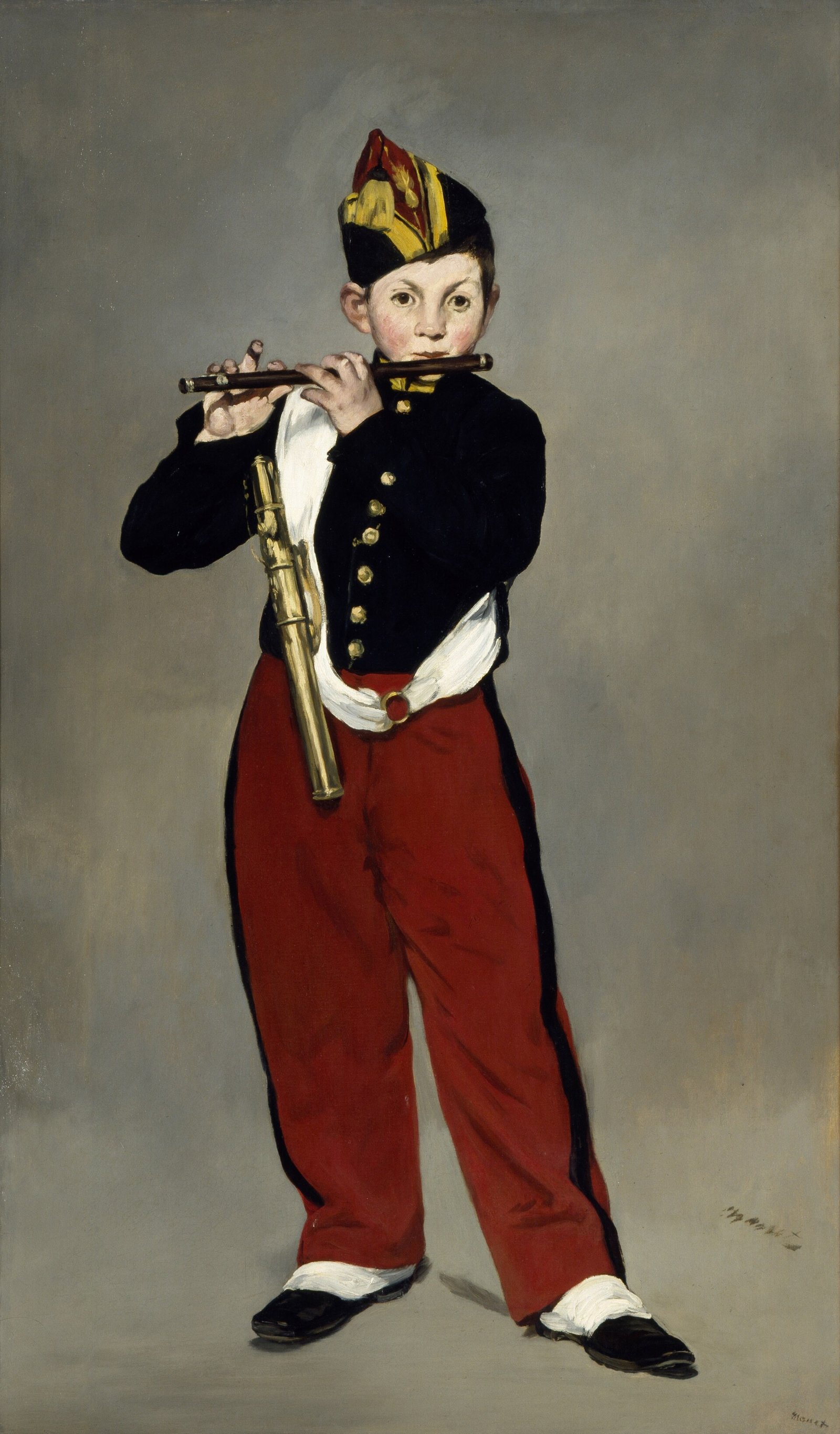
The Fifer is an oil on canvas by Édouard Manet showing a young musician in a military uniform, standing frontally and looking straight at the viewer. According to the reference texts, the sitter was an anonymous teenage member of the Imperial Guard's band, sent to Manet by commander Lejosne. The painter treated him, in the words of the sources, as a grandee of Spain, lending a solemn presence to a boy of humble rank.
Manet painted it after returning from his 1865 trip to Spain, where the Prado's collection of Velázquez made a deep impression on him. The composition owes much to that encounter: the background is shallow and nearly flat, with vertical and horizontal planes barely separable, so the viewer cannot easily judge the figure's real size or standing. The boy stands out against a monochrome ground, rendered in a limited but vivid palette, with the sharp black of the jacket and shoes, the red trousers, and the white strap and gaiters.
The thick, visible brushwork gives the figure a physical solidity that offsets the stiffness of his pose. Peter H. Feist has read the picture as an example of Manet's interest in the decorative force of a single large figure, emphatically outlined and set against a flat surface.
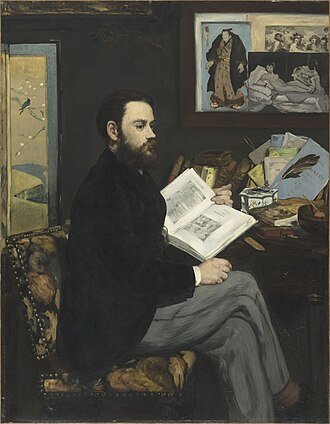
Rejected by the jury of the 1866 Salon, the painting prompted a defence of Manet by Émile Zola. It later passed through several private hands before entering the French state collections in 1911. After years at the Louvre and the Jeu de Paume, it now hangs at the Musée d'Orsay, where it remains a useful point of reference for Manet's move toward a modern, flattened picture space.
- Painter
- Édouard Manet
- Date
- 1850
- Medium
- oil paint, canvas
- Dimensions
- 160 × 97 cm
- Museum
- Musée d'Orsay, Paris
- Genre
- figure painting
- Depicts
- military uniform, flautist, dark brown, gaze towards the viewer, Western concert flute, fife, boy, trousers
More works by Édouard Manet