Inmaculada (Zurbarán, Catedral de Sevilla)
Francisco de Zurbarán, 1650
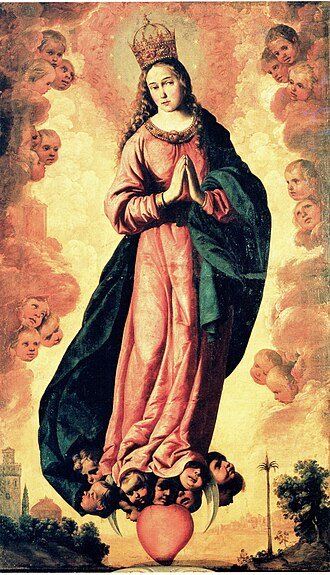
Zurbarán's Immaculate Conception, painted around 1650, occupies the centre of the second tier of the altarpiece in the chapel of St Peter in Seville Cathedral, and it still hangs in the place it was made for. The altarpiece is one of the few painted ensembles by the master to survive almost intact. Most of its canvases depict episodes from the life of the apostle, whereas this one is devoted to the doctrine of Mary's conception without sin, a subject deeply rooted in seventeenth-century Seville.
The Virgin appears young, elongated and dressed in pink, her cloak billowing around her. Her slight lean to the left gives the figure a sense of movement that heightens the Baroque character of the composition. The most unusual feature is its iconography: Mary rests not only on the crescent moon with its customary base of small angels, but also on a Sacred Heart whose tip touches the landscape below. This was probably a request from the patrons, perhaps linked to devotion to the Sacred Heart. An imperial crown, tilted over her head, is another uncommon detail. The celestial Marian symbols from the Litany of Loreto are barely visible, while the earthly ones can be seen clearly in a landscape that seems to surround the heart.
The golden sky, dotted with small angels' heads, brings luminosity and sculptural presence to the canvas. Its tone contrasts with the more tenebrist paintings of the altarpiece. At 323 by 190 centimetres, it is the largest of Zurbarán's Immaculate Conceptions. Its soft lighting, placed behind the chapel railings, makes it appear almost like a sculpture, an effect the setting itself helps to reinforce.
- Painter
- Francisco de Zurbarán
- Date
- 1650
- Medium
- oil paint, canvas
- Dimensions
- 323 × 190 cm
- Museum
- Seville Cathedral, Seville
- Movement
- Baroque
- Genre
- religious art
- Depicts
- Inmaculada Concepción
More works by Francisco de Zurbarán


